Roman-Type Domination on Bisplit Graphs: Hardness and Inapproximability
Abstract
Inspired by the structure and name of split graphs, bisplit graphs have three independent sets $I,A,B$, where every vertex of $A$ is adjacent to every vertex of $B$, and vertices of $I$ may have arbitrary neighborhoods in the core $A\cup B$. Thus they have a complete bipartite core together with the remaining vertices, making them a structured setting in which to study how core size affects complexity. Mann and Fernau's construction already implies NP-completeness of perfect Roman domination on bisplit graphs with a singleton core side \citep[Theorem~20]{mann-fernau-pr}. Motivated by this result, we study all four Roman-type domination problems across further core-size regimes: we prove NP-completeness when one core side has size one or two, and when both sides have size at least three. For perfect Italian domination, even deciding whether prescribed core labels of total weight two can be extended is NP-complete on bipartite bisplit graphs. Approximation is also addressed: for every fixed $0<\varepsilon<1$, unless $\mathrm{P}=\mathrm{NP}$, no $n^{1-\varepsilon}$-approximation exists for perfect Roman domination when one core side has fixed size $1$, $2$, or $3$, or for perfect Italian domination on bipartite bisplit graphs whose two core sides grow with the input. All four problems are fixed-parameter tractable for both parameters. Given supplied modulators of size $k$, the running-time bases, in the order Roman, perfect Roman, Italian, and perfect Italian, are $4,11,11,18$ for cluster vertex deletion and $6,11,11,18$ for biclique-cluster vertex deletion, up to polynomial factors. The $4^k$ Roman cluster-deletion bound is known; the other bounds follow from our dynamic programs. To our knowledge, the latter parameter has not previously been studied explicitly for domination variants.
Analysis
AI-generated · verify against the original paper
Generated Jan 1, 0001ResultsWhat the authors found
- NP‑completeness is shown for all four Roman‑type domination problems when one core side has size 1 or 2, and when both core sides have size at least three.
- Perfect Italian domination remains NP‑complete even when core labels of total weight two are prescribed on bipartite bisplit graphs.
- For any fixed 0 < ε < 1, no n^{1‑ε}‑approximation exists for perfect Roman domination with core side size 1, 2, or 3, nor for perfect Italian domination on bipartite bisplit graphs whose core sides grow with the input, unless P = NP.
- All four problems are fixed‑parameter tractable for both cluster‑vertex‑deletion and biclique‑cluster‑vertex‑deletion parameters, with running‑time bases 4, 11, 11, 18 and 6, 11, 11, 18 respectively.
LimitationsWhere the findings need caution
- The study is purely theoretical and does not include empirical evaluation of the proposed algorithms.
- Approximation lower bounds rely on complexity assumptions (P ≠ NP) and do not give explicit hardness factors beyond the n^{1‑ε} barrier.
MethodologyHow the work was done
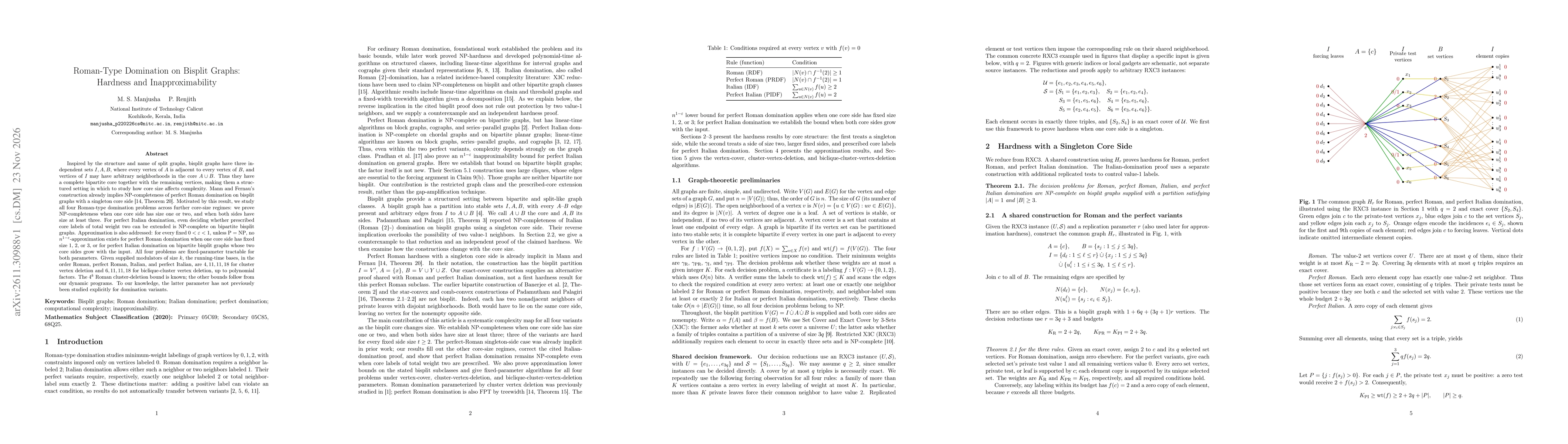
The authors use reductions from known NP‑complete problems to prove hardness for various core‑size regimes of bisplit graphs, construct specific exact‑cover gadgets for the reductions, and develop dynamic programming algorithms parameterized by cluster‑vertex‑deletion and biclique‑cluster‑vertex‑deletion modulators.
SignificanceWhy the work matters
The work provides a comprehensive complexity map for Roman‑type domination on bisplit graphs, highlighting how core size influences hardness and establishing tight inapproximability bounds, while also introducing new FPT results for previously unstudied parameters.
Technical contributionsWhat the work introduces
Systematic hardness proofs across all core‑size regimes, correction of prior Italian‑domination proofs, novel inapproximability results for perfect variants, and the first FPT algorithms for domination problems parameterized by biclique‑cluster‑vertex‑deletion.
NoveltyHow it differs from prior work
First complete classification of Roman‑type domination complexity on bisplit graphs with respect to core size, introduction of biclique‑cluster‑vertex‑deletion as a parameter for domination problems, and new inapproximability bounds for perfect variants on structured bipartite classes.
Discussion 0