RoSearch: Search for Robust Student Architectures When Distilling Pre-trained Language Models
RoSearch proposes a framework to develop robust student models via knowledge distillation from pre-trained language models, addressing their vulnerability to adversarial attacks. The framework employs an evolutionary search strategy to find architectures that balance robustness, accuracy, and efficiency, achieving significant improvements in adversarial robustness.
Abstract
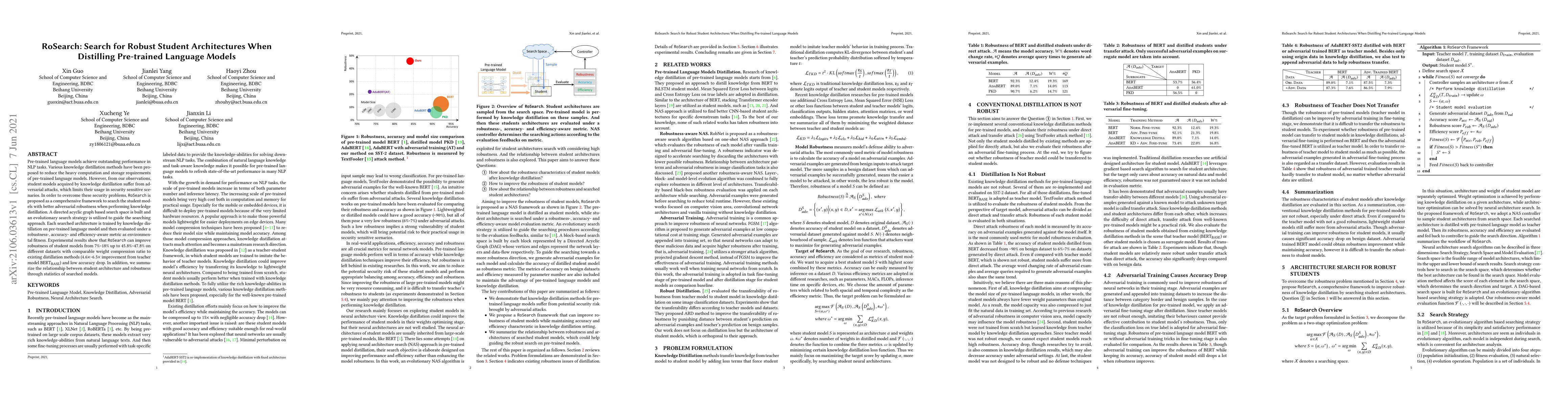
Pre-trained language models achieve outstanding performance in NLP tasks. Various knowledge distillation methods have been proposed to reduce the heavy computation and storage requirements of pre-trained language models. However, from our observations, student models acquired by knowledge distillation suffer from adversarial attacks, which limits their usage in security sensitive scenarios. In order to overcome these security problems, RoSearch is proposed as a comprehensive framework to search the student models with better adversarial robustness when performing knowledge distillation. A directed acyclic graph based search space is built and an evolutionary search strategy is utilized to guide the searching approach. Each searched architecture is trained by knowledge distillation on pre-trained language model and then evaluated under a robustness-, accuracy- and efficiency-aware metric as environmental fitness. Experimental results show that RoSearch can improve robustness of student models from 7%~18% up to 45.8%~47.8% on different datasets with comparable weight compression ratio to existing distillation methods (4.6$\times$~6.5$\times$ improvement from teacher model BERT_BASE) and low accuracy drop. In addition, we summarize the relationship between student architecture and robustness through statistics of searched models.
AI Key Findings
Get AI-generated insights about this paper's methodology, results, significance, and more — available when analysis has been generated.
Discussion 0