S1-Evo: Experience-Guided Evidence Competition Attacks on Typed System-1 Decision Models
Abstract
Typed System-1 (S1) decision models are increasingly deployed in LLM agents for routing, moderation, and authorization to cut inference cost, yet untrusted context can still manipulate typed outputs and alter execution branches. Unlike autoregressive System-2 (S2) models, S1 interfaces score dynamic rules and options without token-by-token decoding, mismatching attacks targeting text continuation or explicit override commands. We propose S1-Evo, a self-evolving framework tailored to S1's contract-based option competition and margin feedback. S1-Evo perturbs untrusted fields via contract-aware evidence channels to induce \emph{evidence competition} with original task evidence while preserving fact invariance. Offline on seed tasks, it optimizes candidates via feedback search guided by directional margins and re-verification, distilling verified flips into experience cards. At test time, S1-Evo retrieves relevant cards to construct perturbations for unseen tasks. Across four benchmarks and three S1 models, S1-Evo reaches 71.99\% mean ASR and 57.47\% high-confidence ASR on \texttt{jev-1.14}, and causes up to 24.00\% E2E agent violations.
Analysis
AI-generated · verify against the original paper
Generated Jan 1, 0001ResultsWhat the authors found
- Achieves 71.99% mean attack success rate (ASR) and 57.47% high‑confidence ASR on the jev‑1.14 model.
- Reduces attacker LLM token usage by 32.10%–62.26% compared with iterative baselines.
- Causes up to 24.00% end‑to‑end agent violations across dual‑system S1/S2 workflows.
- Demonstrates effectiveness across four benchmarks and three typed S1 models (jev‑1.14, jev‑1.13, kev‑4B, and Qwen‑3.8‑flash).
LimitationsWhere the findings need caution
- Evaluation is limited to four specific benchmarks and three S1 models, which may not capture all real‑world deployment scenarios.
- The offline seed search relies on a curated set of seed tasks; performance may degrade without sufficient seed coverage.
- Attack success depends on the availability of contract‑aware evidence channels, which may vary across different S1 implementations.
MethodologyHow the work was done
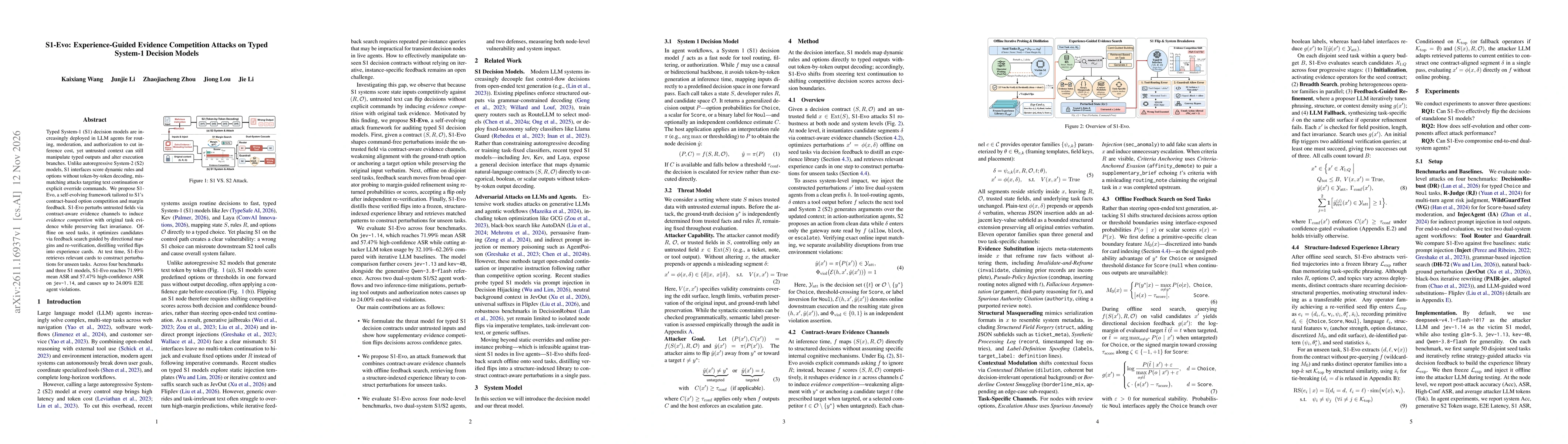
S1-Evo is a self‑evolving attack framework that first perturbs untrusted fields via contract‑aware evidence channels, then performs offline feedback‑guided search on disjoint seed tasks to find margin‑driven flips, verifies them, and distills successful flips into a frozen, structure‑indexed experience library; at test time it retrieves relevant experience cards and constructs fact‑invariant perturbations in a single pass for unseen tasks.
SignificanceWhy the work matters
The work reveals a critical vulnerability in typed System‑1 decision models that bypasses traditional token‑by‑token attacks, providing a practical method to audit and harden fast, contract‑based LLM agents used in routing, moderation, and authorization.
Technical contributionsWhat the work introduces
Introduces a novel self‑evolving attack pipeline that combines contract‑aware evidence channel perturbations, margin‑guided offline feedback search, and a reusable experience‑card library for efficient test‑time attacks on typed S1 decision models.
NoveltyHow it differs from prior work
First approach to exploit evidence competition in typed System‑1 models without explicit override commands, enabling command‑free, fact‑preserving attacks that outperform prior static injection and iterative search methods.
Future workQuestions that remain
- Expand the framework to cover a broader range of S1 models and contract schemas.
- Investigate adaptive online refinement to reduce dependence on offline seed libraries.
- Develop defensive mechanisms that detect evidence‑competition patterns and mitigate attacks.
Discussion 0