SAGE: A Hierarchical Framework for Evaluating Interpretive Literary Quality in Narratives
Abstract
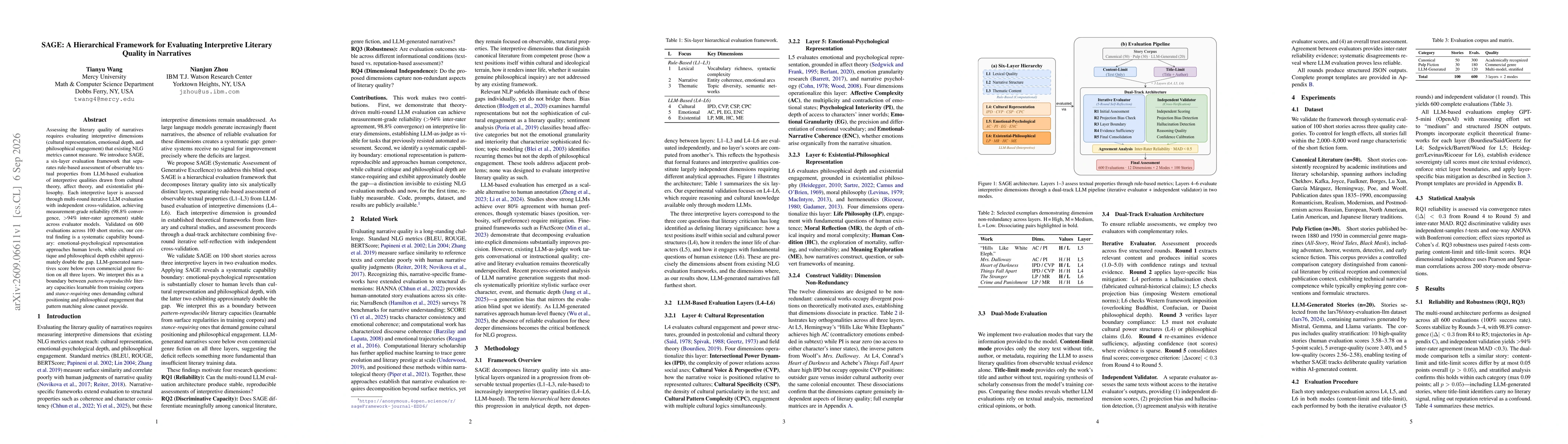
Assessing the literary quality of narratives requires evaluating interpretive dimensions (cultural representation, emotional depth, and philosophical engagement) that existing NLG metrics cannot measure. We introduce SAGE, a six-layer evaluation framework that separates rule-based assessment of observable textual properties from LLM-based evaluation of interpretive qualities drawn from cultural theory, affect theory, and existentialist philosophy. Each interpretive layer is assessed through multi-round iterative LLM evaluation with independent cross-validation, achieving measurement-grade reliability (98.8% convergence, >94% inter-rater agreement) stable across evaluator models. Validated on 600 evaluations across 100 short stories, our central finding is a systematic capability boundary: emotional-psychological representation approaches human levels, while cultural critique and philosophical depth exhibit approximately double the gap. LLM-generated narratives score below even commercial genre fiction on all three layers. We interpret this as a boundary between pattern-reproducible literary capacities learnable from training corpora and stance-requiring ones demanding cultural positioning and philosophical engagement that pattern matching alone cannot provide.
AI Key Findings
Get AI-generated insights about this paper's methodology, results, significance, and more — available when analysis has been generated.
Discussion 0