SALT: State-Aligned Low-Rank Transfer for Single-Temporal Cross-Dataset Structural Localization in Remote Sensing
Abstract
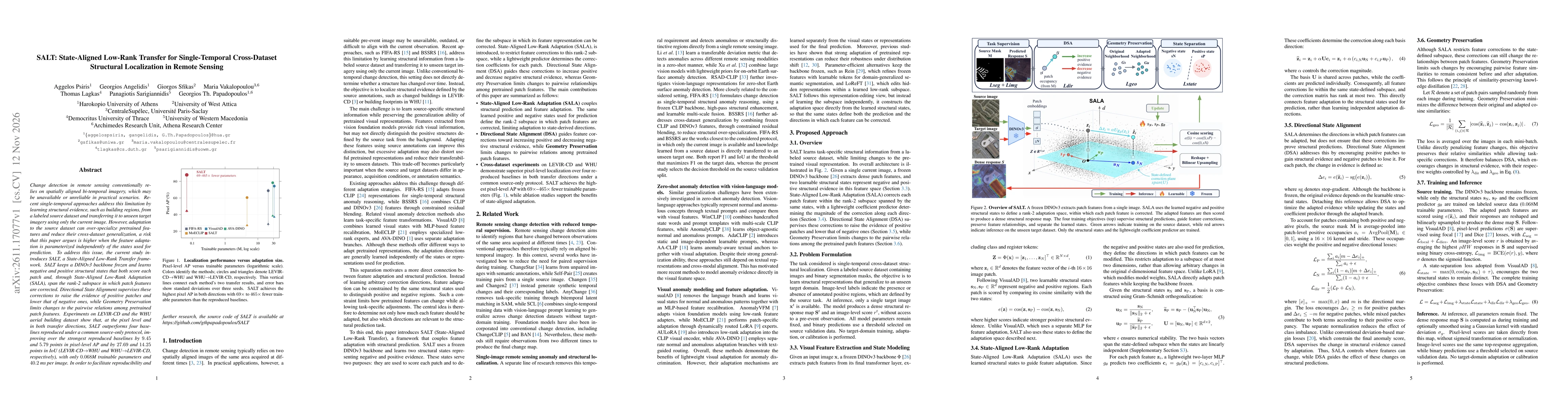
Change detection in remote sensing conventionally relies on spatially aligned bi-temporal imagery, which may be unavailable or unreliable in practical scenarios. Recent single-temporal approaches address this limitation by learning structural evidence, such as building regions, from a labeled source dataset and transferring it to unseen target imagery using only the current image. However, adaptation to the source dataset can over-specialize pretrained features and reduce their cross-dataset generalization, a risk that this paper argues is higher when the feature adaptation is parameterized independently of the states used for prediction. To address this issue, the current study introduces SALT, a State-Aligned Low-Rank Transfer framework. SALT keeps a DINOv3 backbone frozen and learns negative and positive structural states that both score each patch and, through State-Aligned Low-Rank Adaptation (SALA), span the rank-2 subspace in which patch features are corrected. Directional State Alignment supervises these corrections to raise the evidence of positive patches and lower that of negative ones, while Geometry Preservation limits changes to the pairwise relations among pretrained patch features. Experiments on LEVIR-CD and the WHU aerial building dataset show that, at the pixel level and in both transfer directions, SALT outperforms four baselines reproduced under a common source-only protocol, improving over the strongest reproduced baselines by 9.45 and 5.79 points in pixel-level AP and by 27.69 and 14.25 points in IoU (LEVIR-CD to WHU and WHU to LEVIR-CD, respectively), with only 0.068M trainable parameters and 40.2 ms per image. In order to facilitate reproducibility and further research, the source code of SALT is available at https://github.com/gthpapadopoulos/SALT
Analysis
AI-generated · verify against the original paper
Generated Jan 1, 0001ResultsWhat the authors found
- SALT outperforms four reproduced baselines on LEVIR‑CD → WHU and WHU → LEVIR‑CD by 9.45 and 5.79 points in pixel‑level AP, respectively.
- SALT improves IoU by 27.69 points (LEVIR‑CD → WHU) and 14.25 points (WHU → LEVIR‑CD) over the strongest baselines.
- The model uses only 0.068 M trainable parameters and processes an image in 40.2 ms, achieving 69×–465× fewer parameters than baselines.
LimitationsWhere the findings need caution
- The approach is evaluated only on two aerial building datasets (LEVIR‑CD and WHU), which may limit assessment of broader remote‑sensing scenarios.
- Adaptation relies on a frozen DINOv3 backbone, potentially restricting benefits from end‑to‑end fine‑tuning.
MethodologyHow the work was done
SALT keeps a frozen DINOv3 backbone and learns negative and positive structural states that score each patch. Through State-Aligned Low-Rank Adaptation (SALA) it defines a rank‑2 subspace for correcting patch features, guided by Directional State Alignment (DSA) to increase positive evidence and decrease negative evidence, while Geometry Preservation limits changes to pairwise relations among pretrained features.
SignificanceWhy the work matters
The work enables accurate structural localization for change detection using only a single current image, addressing the practical limitation of missing or unreliable pre‑event imagery and improving cross‑dataset generalization.
Technical contributionsWhat the work introduces
Introduces State‑Aligned Low‑Rank Adaptation (SALA) that couples feature correction to learned structural states, Directional State Alignment (DSA) for evidence‑driven correction direction, and Geometry Preservation to maintain pretrained feature relationships.
NoveltyHow it differs from prior work
First framework to align low‑rank feature adaptation directly with the same structural states used for prediction, providing a state‑driven, geometry‑preserving transfer mechanism for single‑temporal cross‑dataset localization.
Discussion 0