Sandwich-Residuals: Parameter-Efficient Test-time Adaptation of World Models
Abstract
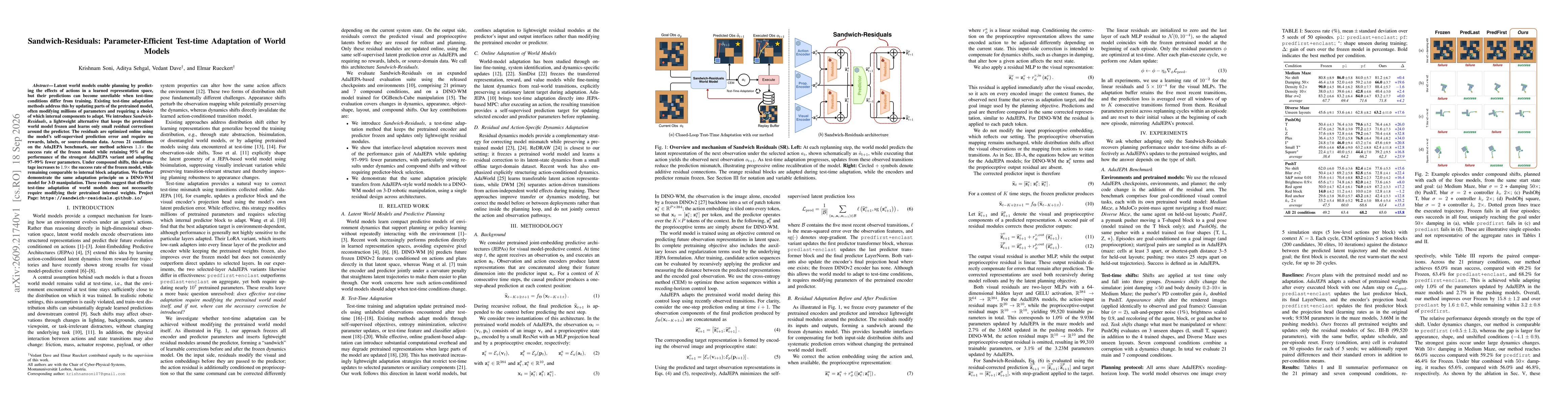
Latent world models enable planning by predicting the effects of actions in a learned representation space, but their predictions can become unreliable when test-time conditions differ from training. Existing test-time adaptation methods address this by updating parts of the pretrained model, often modifying millions of parameters and requiring a choice of which internal components to adapt. We introduce Sandwich-Residuals, a lightweight alternative that keeps the pretrained world model frozen and learns only small residual corrections around the predictor. The residuals are optimized online using the model's self-supervised prediction error and require no rewards, labels, or source-domain data. Across 21 conditions on the AdaJEPA benchmark, our method achieves $1.3\times$ the success rate of the frozen model while retaining 95% of the performance of the strongest AdaJEPA variant and adapting 97-99% fewer parameters. Under compound shifts, this advantage increases to $1.9\times$ the success rate of the frozen model, while remaining comparable to internal block adaptation. We further demonstrate the same adaptation principle on a DINO-WM model for 3-D manipulation. These results suggest that effective test-time adaptation of world models does not necessarily require modifying their pretrained internal weights.
AI Key Findings
Get AI-generated insights about this paper's methodology, results, significance, and more — available when analysis has been generated.
Discussion 0