Scaling classical hardware for accurate real-time quantum error correction
Abstract
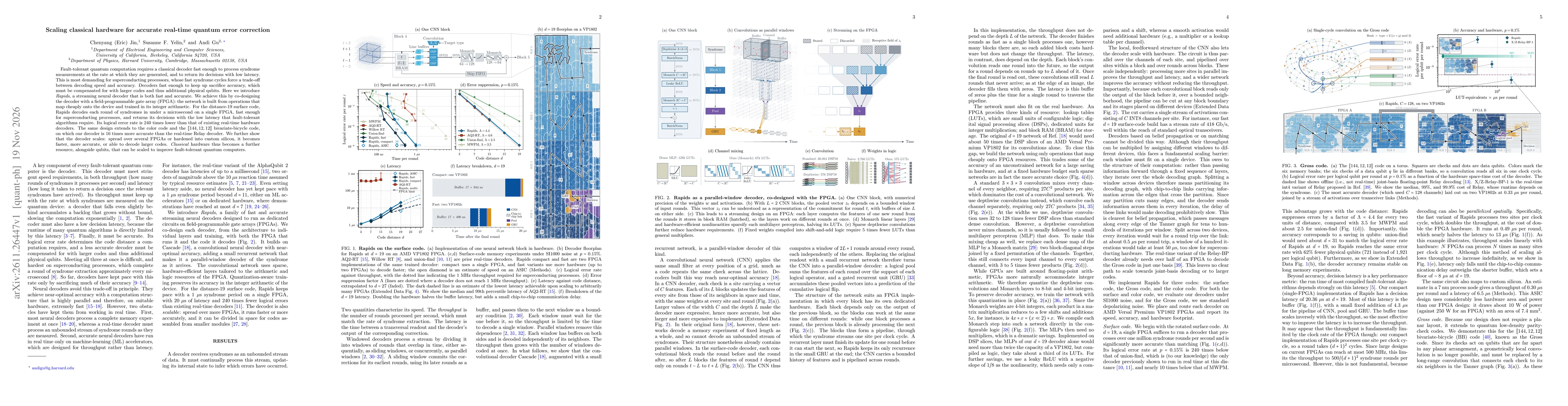
Fault-tolerant quantum computation requires a classical decoder fast enough to process syndrome measurements at the rate at which they are generated, and to return its decisions with low latency. This is most demanding for superconducting processors, whose fast syndrome cycles force a trade-off between decoding speed and accuracy. Decoders fast enough to keep up sacrifice accuracy, which must be compensated for with larger codes and thus additional physical qubits. Here we introduce Rapids, a streaming neural decoder that is both fast and accurate. We achieve this by co-designing the decoder with a field-programmable gate array (FPGA): the network is built from operations that map cheaply onto the device and trained in its integer arithmetic. For the distance-19 surface code, Rapids decodes each round of syndromes in under a microsecond on a single FPGA, fast enough for superconducting processors, and returns its decisions with the low latency that fault-tolerant algorithms require. Its logical error rate is 240 times lower than that of existing real-time hardware decoders. The same design extends to the color code and the [[144,12,12]] bivariate-bicycle code, on which our decoder is 16 times more accurate than the real-time Relay decoder. We further show that the decoder scales: spread over several FPGAs or hardened into custom silicon, it becomes faster, more accurate, or able to decode larger codes. Classical hardware thus becomes a further resource, alongside qubits, that can be scaled to improve fault-tolerant quantum computers.
Analysis
AI-generated · verify against the original paper
Generated Jan 1, 0001ResultsWhat the authors found
- Decodes each round of distance‑19 surface‑code syndromes in under 1 µs on a single FPGA with 20 µs latency.
- Achieves a logical error rate 240× lower than existing real‑time hardware decoders.
- Provides 16× higher accuracy than the real‑time Relay decoder on the color code and the [[144,12,12]] bivariate‑bicycle code.
- Scales across multiple FPGAs or to a custom ASIC, yielding faster decoding, higher accuracy, or support for larger code distances.
LimitationsWhere the findings need caution
- Performance is bounded by chip‑to‑chip communication latency when scaling to many FPGAs.
- FPGA resource constraints limit the maximum code distance achievable without additional hardware.
- Integer quantization, while preserving accuracy, may still restrict the decoder’s ultimate performance compared to full‑precision models.
MethodologyHow the work was done
Co‑design of a streaming neural decoder (Rapids) with a field‑programmable gate array (FPGA), using quantization‑aware training in integer arithmetic and hardware‑efficient sparse convolutional layers combined with a small recurrent network to process an unbounded syndrome stream in real time.
SignificanceWhy the work matters
Demonstrates that classical hardware can be scaled as a resource alongside qubits to meet the stringent speed and accuracy requirements of fault‑tolerant quantum computing, enabling practical real‑time decoding for superconducting processors.
Technical contributionsWhat the work introduces
A hardware‑aware streaming neural decoder that maps efficiently onto FPGA resources, featuring quantization‑aware training, sparse convolutional layers, and a recurrent windowing mechanism for real‑time syndrome processing.
NoveltyHow it differs from prior work
First decoder to simultaneously achieve sub‑microsecond latency and near‑optimal accuracy in real‑time hardware, delivering a 240× reduction in logical error rate over prior real‑time decoders.
Future workQuestions that remain
- Implement and validate the design on custom silicon ASICs to further reduce latency and power.
- Explore deeper scaling to larger numbers of FPGAs for decoding higher‑distance codes.
- Optimize the architecture for improved power efficiency and resource utilization.
- Test the decoder on live quantum hardware to assess end‑to‑end fault‑tolerant operation.
Discussion 0