SCAP: Stochastic Context for Action Expert Pretraining
Abstract
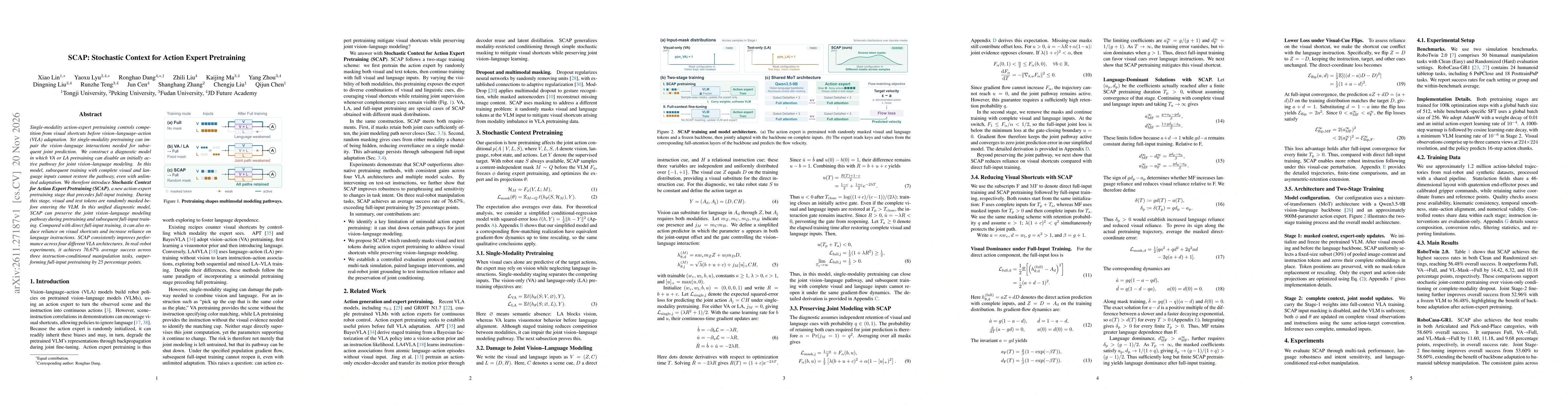
Single-modality action-expert pretraining controls competition from visual shortcuts before vision--language--action (VLA) adaptation. Yet single-modality pretraining can impair the vision--language interactions needed for subsequent joint prediction. We construct a diagnostic model in which VA or LA pretraining can disable an initially active pathway for joint vision--language modeling. In this model, subsequent training with complete visual and language inputs cannot restore the pathway, even with unlimited adaptation. We therefore introduce Stochastic Context for Action Expert Pretraining (SCAP), a new action-expert pretraining stage that precedes full-input training. During this stage, visual and text tokens are randomly masked before entering the VLM. In this unified diagnostic model, SCAP can preserve the joint vision--language modeling pathway during pretraining and subsequent full-input training. Compared with direct full-input training, it can also reduce reliance on visual shortcuts and increase reliance on language instructions. SCAP consistently improves performance across four different VLA architectures. In real-robot experiments, it achieves 76.67% average success across three instruction-conditioned manipulation tasks, outperforming full-input pretraining by 25 percentage points.
Analysis
AI-generated · verify against the original paper
Generated Jan 1, 0001ResultsWhat the authors found
- SCAP consistently improves performance across four different VLA architectures.
- In real‑robot experiments SCAP achieves 76.67% average success on three instruction‑conditioned manipulation tasks, outperforming full‑input pretraining by 25 percentage points.
- SCAP reduces reliance on visual shortcuts and increases reliance on language instructions.
- The method improves robustness to paraphrasing and changes in task intent.
MethodologyHow the work was done
SCAP introduces a two-stage pretraining where the action expert is first trained with random masking of visual and text tokens before entering the vision‑language model (VLM), followed by full‑input training; masking distributions are varied to expose the expert to diverse modality combinations and prevent shutdown of the joint vision‑language modeling pathway.
SignificanceWhy the work matters
SCAP addresses a critical limitation of unimodal action‑expert pretraining by preserving the joint vision‑language modeling pathway, thereby enabling more reliable multimodal grounding and instruction following in robot control.
Technical contributionsWhat the work introduces
The paper proposes stochastic context masking of both visual and textual inputs during action‑expert pretraining, a simple yet effective regularization that mitigates visual shortcut bias while maintaining joint multimodal supervision.
NoveltyHow it differs from prior work
SCAP is the first approach to apply random multimodal masking in the expert pretraining stage to simultaneously curb visual shortcuts and preserve joint vision‑language learning for downstream VLA adaptation.
Discussion 0