SciExplore: Evaluating Autonomous Agents from Scientific Navigation to Information Integration
Abstract
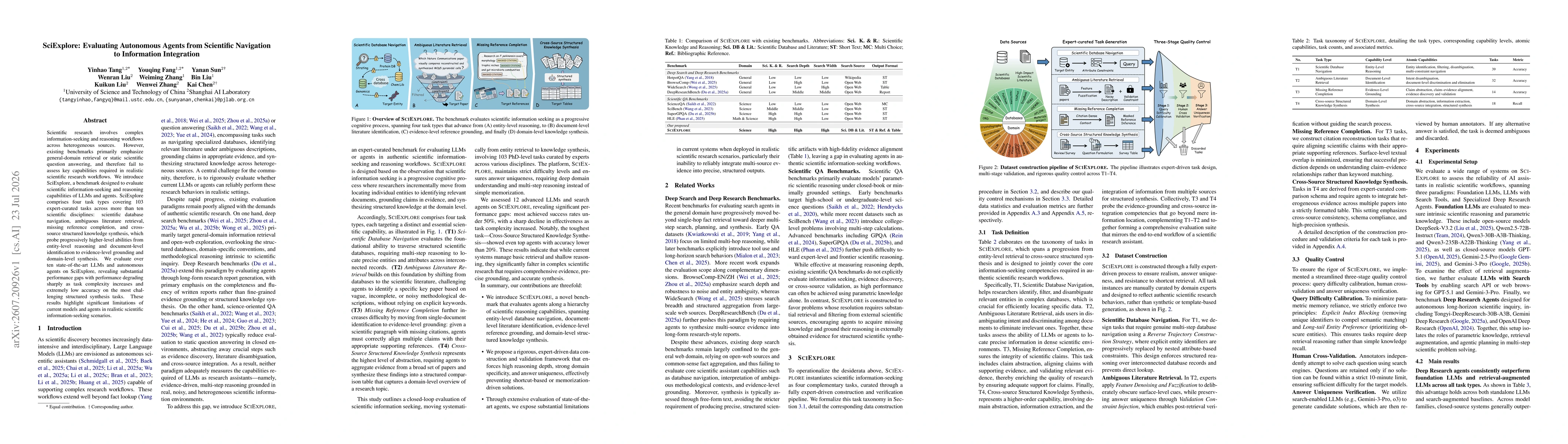
Scientific research involves complex information-seeking and reasoning workflows across heterogeneous sources. However, existing benchmarks primarily emphasize general-domain retrieval or static scientific question answering, and therefore fail to assess key capabilities required in realistic scientific research workflows. We introduce SciExplore, a benchmark designed to evaluate scientific information-seeking and reasoning capabilities of LLMs and agents. SciExplore comprises four task types covering 103 expert-curated tasks across more than ten scientific disciplines: scientific database navigation, ambiguous literature retrieval, missing reference completion, and cross-source structured knowledge synthesis, which probe progressively higher-level abilities from entity-level reasoning and document-level identification to evidence-level grounding and domain-level synthesis. We evaluate over ten state-of-the-art LLMs and autonomous agents on SciExplore, revealing substantial performance gaps with performance degrading sharply as task complexity increases and extremely low accuracy on the most challenging structured synthesis tasks. These results highlight significant limitations of current models and agents in realistic scientific information-seeking scenarios.
Analysis
AI-generated · verify against the original paper
Generated Jul 25, 2026ResultsWhat the authors found
- Most tasks yield success rates below 50%, with performance sharply decreasing as task complexity increases.
- The most challenging Cross-Source Structured Knowledge Synthesis task sees agent accuracies below 20%.
- Results indicate current models manage basic retrieval and shallow reasoning but falter in comprehensive evidence-grounding and domain-level synthesis.
LimitationsWhere the findings need caution
- Evaluation is closed-loop and may reflect the specific task design rather than generalizability across domains.
- Performance depends on the quality of expert-curated tasks and may not capture all real-world variability in scientific reasoning.
MethodologyHow the work was done
The paper presents SciExplore, a closed-loop benchmark evaluating scientific information-seeking and reasoning across four task types (Scientific Database Navigation, Ambiguous Literature Retrieval, Missing Reference Completion, Cross-Source Structured Knowledge Synthesis) over 103 expert-curated tasks spanning 10+ disciplines. It uses expert-curated data, progressive difficulty, and strict evaluation of entities, documents, references, and domain-level synthesis across both LLMs and autonomous agents, with a focus on evidence-grounding and synthesis rather than mere retrieval. Evaluation involves 12 advanced LLMs/agents and analyzes performance as tasks become more complex, highlighting gaps and limitations.
SignificanceWhy the work matters
The benchmark aligns evaluation with authentic scientific workflows, emphasizing evidence discovery, disambiguation, cross-source grounding, and structured knowledge synthesis, thereby exposing critical limitations of current models in realistic research scenarios.
Technical contributionsWhat the work introduces
Introduction of SciExplore, a novel, hierarchical benchmark for evaluating scientific information-seeking and reasoning across entity navigation, document identification, evidence grounding, and domain-level synthesis; an expert-driven data construction and validation framework; and comprehensive evaluation of current state-of-the-art models highlighting substantial limitations.
NoveltyHow it differs from prior work
First closed-loop benchmark that systematically progresses from entity-level navigation to domain-level structured knowledge synthesis in scientific contexts, emphasizing evidence-grounding and synthesis rather than static QA or shallow retrieval.
Future workQuestions that remain
- Expand task coverage to additional disciplines and real-world pipelines for autonomous scientific assistants.
- Develop methods to improve evidence-grounding and cross-source synthesis capabilities of LLMs and agents.
- Investigate scalable evaluation protocols to reduce annotation bias and enhance robustness across task types.
Discussion 0