Seed2GS: Camera-Free, Training-Free Object Extraction from 3D Gaussian Scenes via a Single Reference-View Grounding
Seed2GS enables camera-free, training-free extraction of a target object from 3D Gaussian Splatting scenes by using a single reference view to lock object identity and then exposing it from new viewpoints with seed lifting and visibility-aware virtual orbits. It achieves state-of-the-art accuracy (up to 92.1% mIoU on LERF-MASK and 95.7% on 3D-OVS) with minimal per-scene computation, without original cameras or scene-specific training, and maintains high performance even with a fixed reference mask.
Abstract
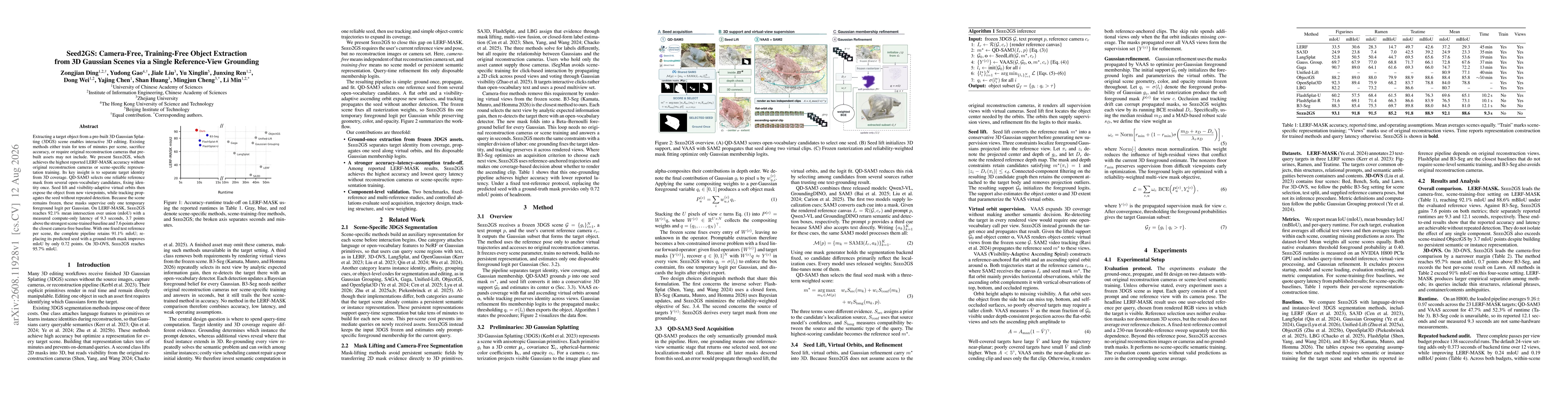
Extracting a target object from a pre-built 3D Gaussian Splatting (3DGS) scene enables interactive 3D editing. Existing methods either train for tens of minutes per scene, sacrifice accuracy, or require original reconstruction cameras that pre-built assets may not include. We present Seed2GS, which achieves the highest reported LERF-MASK accuracy without original reconstruction cameras or scene-specific representation training. Its key insight is to separate target identity from 3D coverage. QD-SAM3 selects one reliable reference mask from several open-vocabulary candidates, fixing identity once. Seed lift and visibility-adaptive virtual orbits then expose the object from new viewpoints, while tracking propagates the seed without repeated detection. Because the scene remains frozen, these masks supervise only one temporary foreground logit per Gaussian. On LERF-MASK, Seed2GS reaches 92.1% mean intersection over union (mIoU) with a measured compute-only latency of 9.3 seconds, 3.7 points above the strongest scene-trained baseline and 7.6 points above the closest camera-free baseline. With one fixed test reference per scene, the complete pipeline retains 91.1% mIoU; replacing its predicted seed with a ground-truth mask improves mIoU by only 0.72 points. On 3D-OVS, Seed2GS reaches 95.7% mIoU.
Analysis
AI-generated · verify against the original paper
Generated Aug 14, 2026ResultsWhat the authors found
- On LERF-MASK, Seed2GS achieves 92.1% mIoU with 9.3 seconds compute latency, outperforming the strongest scene-trained baseline by 3.7 points and the closest camera-free baseline by 7.6 points.
- With a fixed test reference per scene, the complete pipeline maintains 91.1% mIoU; replacing the predicted seed with a ground-truth mask yields only +0.72 mIoU improvement.
- On 3D-OVS, Seed2GS reaches 95.7% mIoU.
LimitationsWhere the findings need caution
- Grounding may fail due to severe occlusion, same-class instances, or complex references, causing seed propagation to fail.
- Virtual views cannot recover missing geometry and tracking drift can occur with large viewpoint changes.
- Reliance on off-the-shelf recognition weights means backbones can introduce failures that are not easily audited.
MethodologyHow the work was done
Seed2GS uses a ground-once extraction from frozen 3D Gaussian Splatting scenes, where the target identity is anchored by a single reference seed. It then propagates this seed via seed lift and visibility-adaptive virtual orbits to expose the object from new viewpoints, while tracking preserves the seed across views and estimates disposable foreground logit per Gaussian without retraining or using reconstruction cameras.
SignificanceWhy the work matters
The approach delivers high segmentation accuracy without original reconstruction cameras or scene-specific training, combining a simple one-shot grounding with efficient propagation to enable rapid, camera-free 3D object extraction in existing 3DGS assets.
Technical contributionsWhat the work introduces
Proposes Seed2GS, a camera-free, training-free object extraction method for 3D Gaussian Splatting scenes that ground a single reference seed, propagate via virtual orbits and tracking, and estimate disposable foreground logits per Gaussian without scene-specific representations.
NoveltyHow it differs from prior work
First to decouple target identity from 3D coverage in a frozen 3DGS workflow, enabling a one-shot grounding with subsequent trajectory-based coverage expansion and Beta-Bernoulli-like per-Gaussian foreground modeling without reconstruction cameras or training.
Future workQuestions that remain
- Develop multi-reference initialization and uncertainty-aware propagation to handle more challenging scenes.
- Incorporate robustness against occlusion and appearance changes via improved seed refinement and drive more reliable propagation.
- Explore better view-trajectory designs and adaptive weighting to further reduce drift and improve generalization.
Discussion 0