SeqLLM: Augmenting LLMs with Behavioral-Sequence Modeling for High-Stakes Decisions at WeChat Pay
Abstract
Merchant risk control at large payment platforms screens tens of millions of merchants daily, where false positives harm legitimate merchants and false negatives leave harmful activity undetected. The hardest cases require jointly understanding a merchant's textual profile and long behavioral sequence. Large language models (LLMs) excel at text but cannot natively model such sequences, while adapting them often causes catastrophic forgetting. We present SeqLLM, a framework that adds behavioral-sequence modeling to a pretrained LLM while preserving its language ability. SeqLLM combines three components: a compact discrete vocabulary that represents behavioral events as native tokens; a lightweight projector, trained with a two-stage alignment curriculum, that grounds these tokens in the LLM's semantic space; and prefix-guided capability injection, which acquires sequence-modeling ability through task-prefixed supervised fine-tuning rather than continual pre-training. SeqLLM is deployed at WeChat Pay, screening millions of merchants daily. Against the production DeepSeek-based LLM baseline, it raises screening precision from 92.0% to 97.5%. Its pretrained behavior-token embeddings also improve [email protected]% by 26.8 percentage points in a production fraud detector serving billion-scale transaction traffic. Beyond payments, SeqLLM achieves state-of-the-art results on public recommendation benchmarks. On MovieLens and Amazon, it surpasses the strong User-LLM baseline by up to 32% relative Recall@5 while retaining markedly stronger language ability. On RecIF, it improves Pass@32 by 14.2% over the full OneRec-8B pipeline using only one-fifth of its GPU-days.
Analysis
AI-generated · verify against the original paper
Generated Aug 6, 2026ResultsWhat the authors found
- In production, SeqLLM improves merchant screening precision from 92.0% to 97.5% and reduces post-launch appeal rate from 12% to ~2%.
- Behavior-token embeddings initialized from SeqLLM yield +26.8 percentage points in [email protected]% and +33.1 points in Recall@Top-1% for a fraud detector handling billion-scale traffic.
- On public benchmarks, SeqLLM matches or exceeds User-LLM and OpenOneRec pipelines, achieving up to 32% relative Recall@5 on MovieLens/Amazon and 14.2% higher Pass@32 on RecIF while using 4.8× fewer GPU-days.
- RecProbe evaluation shows SeqLLM outperforms OpenOneRec-8B on four tasks, boosting Video–Topic Matching accuracy from 0.465 to 0.745.
LimitationsWhere the findings need caution
- Evaluation spans limited high-stakes domains and standard benchmarks; long-term drift and robustness to evolving behavioral patterns require ongoing monitoring.
- The approach relies on a specialized discrete behavioral vocabulary and alignment curriculum that may need adaptation for different domains or platforms.
- Quantitative reporting focuses on key metrics; potential trade-offs in computational efficiency under varying deployment scales are not exhaustively explored.
MethodologyHow the work was done
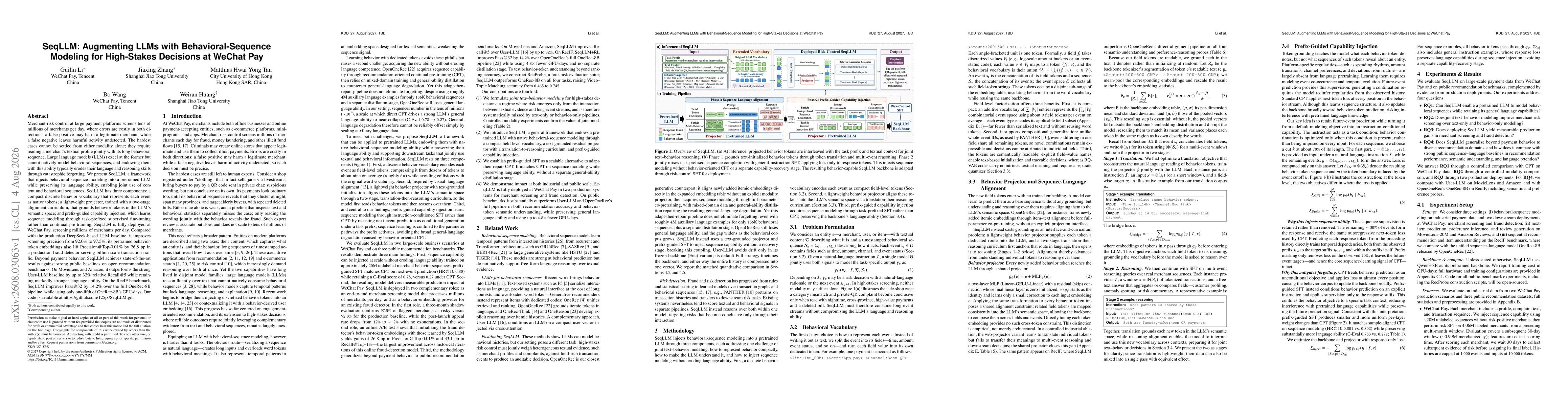
SeqLLM integrates three components to add behavioral-sequence modeling to a pretrained LLM: (1) a compact discrete vocabulary of behavioral tokens to represent events, (2) a lightweight two-stage alignment projector (translation then reasoning) that grounds tokens in the LLM space, and (3) prefix-guided capability injection via task-prefixed supervised fine-tuning (SFT) to induce sequence modeling without CPT. Evaluation spans industrial WeChat Pay deployment and public benchmarks, with ablations and controlled modality studies to assess text–behavior fusion while preserving language ability.
SignificanceWhy the work matters
SeqLLM demonstrates that a pretrained LLM can acquire native behavioral-sequence modeling while preserving language abilities, enabling reliable high-stakes decisions that jointly leverage text and long event histories. The approach yields substantial industrial impact in fraud risk control and achieves state-of-the-art results on public benchmarks, suggesting broad applicability beyond payments.
Technical contributionsWhat the work introduces
A general framework that endows pretrained LLMs with native behavioral-sequence modeling through a compact field-level token vocabulary, a text-grounded residual projector with translation-to-reasoning curriculum, and prefix-guided capability injection via SFT as an alternative to CPT.
NoveltyHow it differs from prior work
First integration of a compact behavioral token space with an alignment projector and prefix-guided SFT to fuse long behavioral sequences with language reasoning in LLMs, enabling scalable, high-stakes decision making with preserved language ability.
Future workQuestions that remain
- Extend SeqLLM to additional high-stakes domains (e.g., insurance, healthcare) to validate generalizability.
- Explore dynamic vocabulary updates and continual alignment strategies to adapt to changing behavior patterns without forgetting language skills.
- Investigate automated safety and interpretability tools to audit the joint text-behavior decisions in real-time deployments.
Discussion 0