Abstract
Large Language Models (LLMs) have shown strong potential in parameterized layout generation via tool-augmented code synthesis. However, LLMs lack spatial awareness, making one-shot generation unreliable. While layout quality can be evaluated with established techniques, a critical gap remains: geometric-domain evaluation outcomes cannot be directly translated into actionable code-level fixes, trapping iterative refinement in blind refactoring. We propose SGLayout, a self-refining framework that closes this gap via a schema-guided mechanism. Upon code execution, a structured schema captures the correspondence between each code-level instance and its geometric attributes, establishing a bidirectional link between code space and geometry space. Emulating engineer review practices, SGLayout evaluates layouts along two complementary dimensions: intent compliance through quantitative structural checking and qualitative vision-language assessment, and rule compliance through DRC. All identified violations are then back-projected through the schema onto precise code targets, enabling surgical repair. This closed-loop process iterates until layout convergence. On a curated benchmark of 112 parameterized layout generation tasks using GDSFactory, SGLayout achieves a 76.79% pass rate, compared with 50.89% for the strongest baseline.
Analysis
AI-generated · verify against the original paper
Generated Jan 1, 0001ResultsWhat the authors found
- Achieves a 76.79% overall pass rate on a benchmark of 112 parameterized layout tasks, outperforming the strongest baseline (50.89%).
- Improves pass rates from 34.78% to 93.48% on Level‑2 tasks and from 10.00% to 42.50% on Level‑3 tasks.
- Ablation shows the full system raises Resolved@2 from 28.00% to 48.68% and reduces average repair rounds from 2.20 to 2.00.
LimitationsWhere the findings need caution
- The current implementation is evaluated only on GDSFactory‑based layouts, not on full custom physical design flows.
- The schema‑guided mechanism is tightly coupled with the orchestration layer, limiting independent ablation of its components.
MethodologyHow the work was done
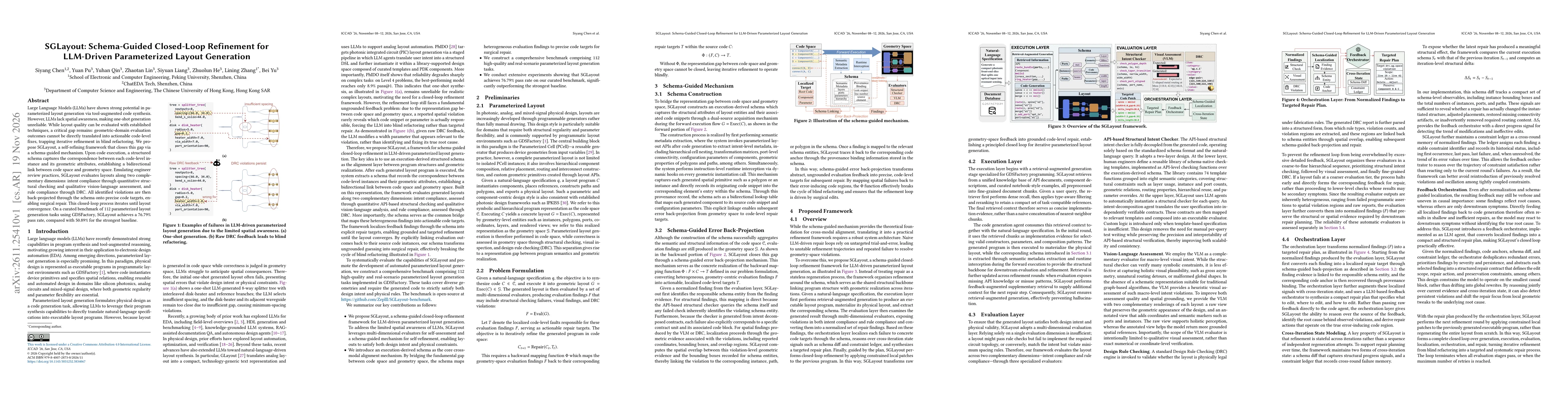
SGLayout implements a schema-guided closed-loop refinement framework where after each LLM-generated layout program is executed, a structured schema captures the mapping between code instances and their geometric attributes. The layout is evaluated on intent compliance (quantitative structural checks and vision-language assessment) and rule compliance (DRC). Violations are back-projected via the schema to precise code targets, enabling targeted repairs orchestrated across iterations until convergence.
SignificanceWhy the work matters
The work demonstrates that grounding geometry‑space feedback in an execution‑derived schema enables reliable, targeted refinement of LLM‑generated layouts, substantially closing the gap between code synthesis and spatial correctness in EDA.
Technical contributionsWhat the work introduces
Introduces an execution‑derived schema that aligns code‑level instances with geometric attributes, allowing heterogeneous evaluation signals (structural, vision‑language, DRC) to be back‑projected to precise code repairs within a closed‑loop system.
NoveltyHow it differs from prior work
First framework to use a bidirectional code‑geometry schema to translate geometric evaluation outcomes into actionable code‑level fixes for LLM‑driven parameterized layout generation.
Discussion 0