SHAPE: Discrete Supervision and Parallel Continuous Streams for Learning Dexterous Manipulation from Egocentric Human Data
Abstract
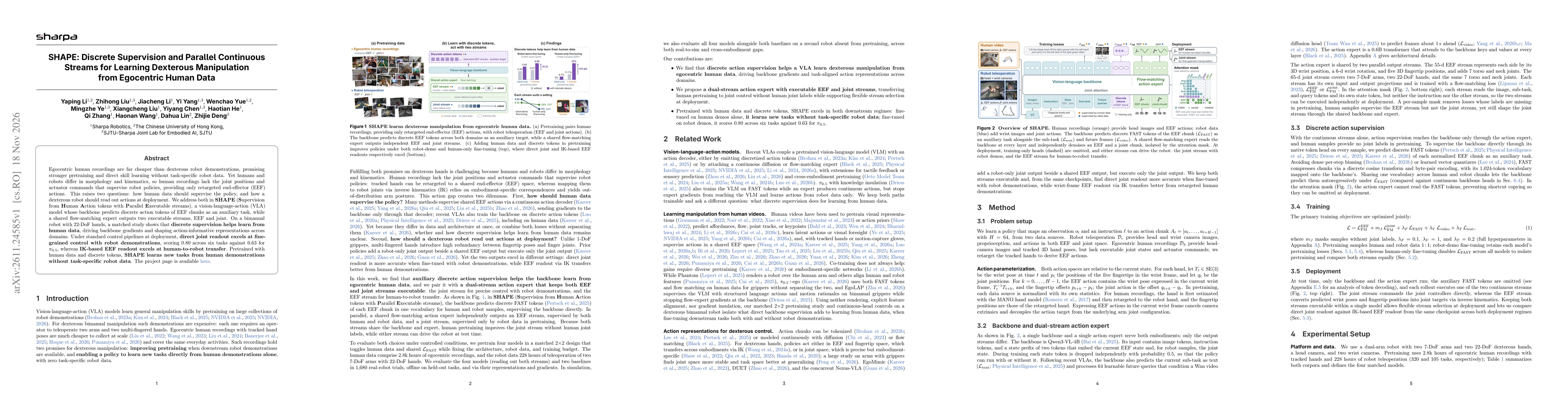
Egocentric human recordings are far cheaper than dexterous robot demonstrations, promising stronger pretraining and direct skill learning without task-specific robot data. Yet humans and robots differ in morphology and kinematics, so human recordings lack the joint positions and actuator commands that supervise robot policies, providing only retargeted end-effector (EEF) actions. This raises two questions: how human data should supervise the policy, and how a dexterous robot should read out actions at deployment. We address both in SHAPE (Supervision from Human Action tokens with Parallel Executable streams), a vision-language-action (VLA) model whose backbone predicts discrete action tokens of EEF chunks as an auxiliary task, while a shared flow-matching expert outputs two executable streams, EEF and joint. On a bimanual robot with 22-DoF hands, a matched study shows that discrete supervision helps learn from human data, driving backbone gradients and shaping action-informative representations across domains. Under standard control pipelines at deployment, direct joint readout excels at fine-grained control with robot demonstrations, scoring 0.80 across six tasks against 0.63 for π0.5, whereas IK-based EEF readout excels at human-to-robot transfer. Pretrained with human data and discrete tokens, SHAPE learns new tasks from human demonstrations without task-specific robot data.
Analysis
AI-generated · verify against the original paper
Generated Jan 1, 0001ResultsWhat the authors found
- Discrete token supervision improves policy learning from human data, increasing success rates on articulated Close tasks by 9.5 points (66.6% vs 57.1%).
- Direct joint readout achieves 0.80 average success across six real‑robot tasks, outperforming the π0.5 baseline (0.63).
- Human‑only pretraining with discrete tokens enables learning new tasks from human demonstrations without any task‑specific robot data.
LimitationsWhere the findings need caution
- Human recordings provide only retargeted EEF actions, lacking joint positions and actuator commands, which limits supervision for the joint stream during pretraining.
- The approach is evaluated on a specific 22‑DoF bimanual robot (GR‑1), and may not directly generalize to other morphologies without additional adaptation.
MethodologyHow the work was done
SHAPE uses a vision-language-action backbone that predicts discrete end-effector (EEF) action tokens as an auxiliary task while a shared flow‑matching expert outputs two independent continuous streams: an EEF stream supervised by both human and robot data, and a joint stream supervised only by robot data. The model is pretrained on a 2×2 design toggling human data and LFAST token supervision, then fine‑tuned on downstream tasks with either direct joint readout or IK‑based EEF readout.
SignificanceWhy the work matters
The work demonstrates that cheap egocentric human recordings can be leveraged to pretrain dexterous manipulation policies, bridging the morphology gap between humans and robots and reducing the need for expensive robot demonstrations.
Technical contributionsWhat the work introduces
Introduction of a dual‑stream action expert that simultaneously learns discrete EEF token supervision and continuous joint/EEF execution, enabling flexible deployment strategies for dexterous robots.
NoveltyHow it differs from prior work
First method to combine discrete action token supervision with parallel continuous streams for learning dexterous manipulation from egocentric human data.
Discussion 0