Sharp lifespan estimates and a Huygens-type effect for one-dimensional Nakao's problem
Abstract
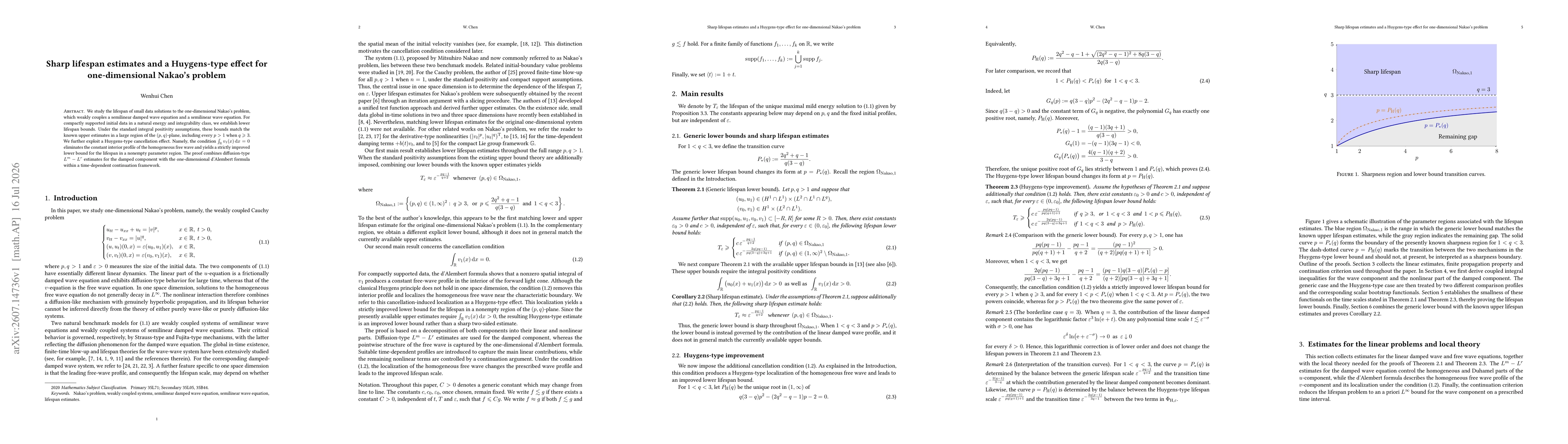
We study the lifespan of small data solutions to the one-dimensional Nakao's problem, which weakly couples a semilinear damped wave equation and a semilinear wave equation. For compactly supported initial data in a natural energy and integrability class, we establish lower lifespan bounds. Under the standard integral positivity assumptions, these bounds match the known upper estimates in a large region of the $(p,q)$-plane, including every $p>1$ when $q\geqslant3$. We further exploit a Huygens-type cancellation effect. Namely, the condition $\int_{\mathbb{R}}v_1(x)\,\mathrm{d}x=0$ eliminates the constant interior profile of the homogeneous free wave and yields a strictly improved lower bound for the lifespan in a nonempty parameter region. The proof combines diffusion-type $L^m-L^r$ estimates for the damped component with the one-dimensional d'Alembert formula within a time-dependent continuation framework.
Analysis
AI-generated · verify against the original paper
Generated Jul 18, 2026ResultsWhat the authors found
- Established lower lifespan bounds for small data solutions of Nakao’s problem in the full (p,q) range with q>1, matching known upper bounds in large regions when standard positivity assumptions hold.
- Demonstrated that for q≥3, every p>1 lies in a region where Tε scales like ε^{−(pq−1)/(q+2)}, confirming a matching lower-upper lifespan rate in Nakao’s problem.
- Identified a Huygens-type cancellation: the condition ∫Rv1(x)dx=0 eliminates the constant interior free-wave profile and yields a strictly improved lifespan lower bound in a nonempty parameter region.
- Showed that the cancellation-induced localization changes the leading linear contribution and leads to a refined lifespan scale under the interior-profile elimination.
LimitationsWhere the findings need caution
- In some subregions (1<p<some threshold for certain q), the lower bounds do not match the currently available upper bounds, indicating gaps require further refinement.
- The improved Lifespan due to the Huygens-type effect is established only under the integral cancellation condition, leaving open what happens without this assumption in tighter regions.
- The analysis relies on delicate time-dependent continuation arguments that may be challenging to extend to higher dimensions or more general nonlinearities.
MethodologyHow the work was done
The study employs a combination of diffusion-type Lm–Lr estimates for the damped component and the one-dimensional d’Alembert formula to capture the linear part, integrated within a time-dependent continuation framework to control nonlinear terms.
SignificanceWhy the work matters
The work provides the first matching lower and upper lifespan estimates for the one-dimensional Nakao’s problem in substantial regions of the (p,q)-plane and reveals a Huygens-type effect in one dimension, improving understanding of weakly coupled damped-wave and wave interactions and lifespan behavior.
Technical contributionsWhat the work introduces
A novel decomposition of the coupled system into linear and nonlinear parts combined with diffusion-type Lm–Lr estimates for the damped component and a one-dimensional d’Alembert representation within a time-dependent continuation framework; plus identification and exploitation of a Huygens-type cancellation to localize the free-wave interior.
NoveltyHow it differs from prior work
First demonstration of a Huygens-type effect yielding a strictly improved lifespan lower bound in Nakao’s problem for one-dimensional weakly coupled systems, along with explicit matching lower-upper lifespan scales in a broad parameter region.
Future workQuestions that remain
- Extend matching lower bounds to remaining subregions of the (p,q)-plane where gaps remain between upper and lower estimates.
- Explore generalizations beyond one dimension to assess whether similar Huygens-type localization effects persist in higher dimensions.
- Investigate robustness of the cancellation condition under perturbations of initial data and damping terms.
- Develop alternative methods that may close the gaps without requiring integral cancellation or positivity assumptions.
Discussion 0