Sharp Time-Decay Estimates for Fractional Heat Semigroups Associated with Polynomial Anharmonic Oscillators
The paper shows that fractional heat semigroups generated by wide-ranging anisotropic polynomial oscillators behave like pseudo-differential operators with tailored symbols, enabling precise decay and smoothing estimates. Using Weyl–Hörmander calculus, it proves sharp time-decay in Lebesgue and modulation spaces, analyzes large- and small-time behavior, and applies the results to nonlinear equations to obtain well-posedness, blow-up rates, and global decay for small data in appropriate function spaces.
Abstract
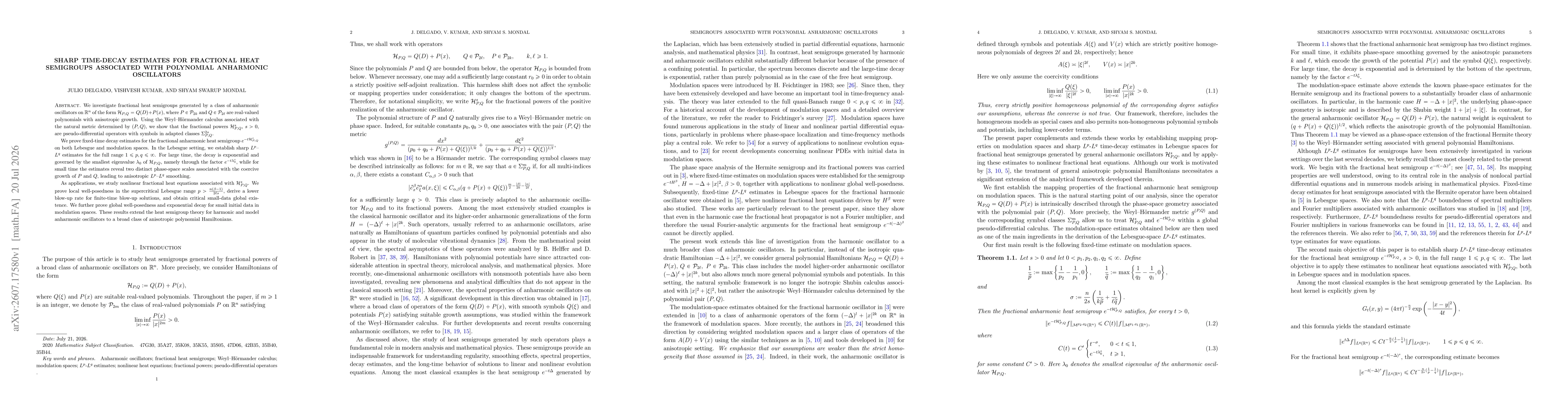
We investigate fractional heat semigroups generated by a class of anharmonic oscillators on $\mathbb R^n$ of the form $\mathcal H_{P,Q}=Q(D)+P(x),$ where $P\in\mathcal P_{2k}$ and $Q\in\mathcal P_{2\ell}$ are real-valued polynomials with anisotropic growth. Using the Weyl--Hörmander calculus associated with the natural metric determined by $(P,Q)$, we show that the fractional powers $\mathcal H_{P,Q}^s$, $s>0$, are pseudo-differential operators with symbols in adapted classes $Σ_{P,Q}^{2s}$. We prove fixed-time decay estimates for the fractional anharmonic heat semigroup $e^{-t\mathcal H_{P,Q}^s}$ on both Lebesgue and modulation spaces. In the Lebesgue setting, we establish sharp $L^p$--$L^q$ estimates for the full range $1\le p,q\le\infty$. For large time, the decay is exponential and governed by the smallest eigenvalue $λ_0$ of $\mathcal H_{P,Q}$, namely through the factor $e^{-tλ_0^s}$, while for small time the estimates reveal two distinct phase-space scales associated with the coercive growth of $P$ and $Q$, leading to anisotropic $L^p$--$L^q$ smoothing. As applications, we study nonlinear fractional heat equations associated with $\mathcal H_{P,Q}^s$. We prove local well-posedness in the supercritical Lebesgue range $ p>\frac{n(β-1)}{2\ell s},$ derive a lower blow-up rate for finite-time blow-up solutions, and obtain critical small-data global existence. We further prove global well-posedness and exponential decay for small initial data in modulation spaces. These results extend the heat semigroup theory for harmonic and model anharmonic oscillators to a broad class of anisotropic polynomial Hamiltonians.
Analysis
AI-generated · verify against the original paper
Generated Jul 22, 2026ResultsWhat the authors found
- Established sharp Lp–Lq fixed-time bounds for e^{-t H_{P,Q}^s} across the full Lebesgue range 1 ≤ p, q ≤ ∞, including anisotropic smoothing effects.
- Proved that fractional powers H_{P,Q}^s are pseudodifferential operators with symbols in the adapted class Σ_{P,Q}^{2s}, reflecting the anisotropic growth of P and Q.
- Demonstrated large-time decay e^{-t λ0^s} where λ0 is the smallest eigenvalue of H_{P,Q}, capturing exponential dissipation.
- Identified two distinct phase-space scales at small times corresponding to coercive growth in P and Q, leading to anisotropic smoothing in Lp–Lq spaces.
- Applied linear semigroup estimates to nonlinear fractional heat equations, proving local well-posedness in the supercritical Lebesgue range and small-data global existence in modulation spaces.
LimitationsWhere the findings need caution
- Results focus on polynomial potentials with specific anisotropic growth; extensions to more general nonpolynomial or degenerate potentials are not addressed.
- The analysis presumes certain lower bounds and regularity of P and Q to define the Weyl–Hörmander metric, restricting applicability to well-behaved polynomial families.
- Explicit constants in decay and smoothing estimates are not provided, which may limit quantitative applications.
MethodologyHow the work was done
The authors leverage Weyl–Hörmander calculus tied to a natural anisotropic metric determined by the polynomial pair (P, Q) to analyze fractional powers of the anharmonic oscillator H_{P,Q}. They show H_{P,Q}^s is a pseudodifferential operator with symbols in the adapted class Σ_{P,Q}^{2s}, derive fixed-time Lp–Lq estimates for e^{-t H_{P,Q}^s} on Lebesgue and modulation spaces, and obtain large-time exponential decay governed by the smallest eigenvalue λ0. The analysis combines spectral theory of polynomial Hamiltonians with microlocal tools to capture anisotropic phase-space behavior and smoothing effects at small times, and applies these semigroup estimates to nonlinear fractional heat equations to establish local well-posedness in supercritical Lebesgue ranges and global results for small data in modulation spaces.
SignificanceWhy the work matters
The work extends heat semigroup theory to a broad class of anisotropic polynomial Hamiltonians by integrating Weyl–Hörmander microlocal techniques with fractional calculus, enabling precise decay and smoothing estimates in both Lebesgue and modulation spaces and informing nonlinear dynamics for anharmonic oscillators.
Technical contributionsWhat the work introduces
Introduction of adapted Weyl–Hörmander metric and symbol classes Σ_{P,Q}^{m} for fractional powers of polynomial anharmonic oscillators, leading to pseudodifferential operator characterizations of H_{P,Q}^s and sharp fixed-time Lp–Lq estimates on Lebesgue and modulation spaces with anisotropic phase-space scaling.
NoveltyHow it differs from prior work
First comprehensive microlocal–spectral treatment of fractional heat semigroups generated by a broad anisotropic class of polynomial Hamiltonians, yielding precise decay, smoothing, and nonlinear well-posedness results across Lebesgue and modulation spaces that generalize classical harmonic oscillator theory.
Future workQuestions that remain
- Extend the framework to non-polynomial or varying-growth potentials while preserving adapted symbol classes.
- Develop numerical schemes that leverage Σ_{P,Q}^{2s} symbol structure for accurate simulation of fractional anharmonic heat flows.
- Investigate global well-posedness and decay for broader nonlinearities beyond those treated, including critical and supercritical regimes.
- Explore analogous results on manifolds or in the presence of external fields to broaden geometric applicability.
Discussion 0