SheetAlign: Grounded Interaction and Stage-Isolated Learning for Spreadsheet Agents
Abstract
Spreadsheets are widely used for data analysis and supporting decision-making. Automating spreadsheet analysis while protecting sensitive data and controlling deployment costs motivates locally deployed open-weight large language models (LLMs). Meanwhile, complex spreadsheet tasks require both task reasoning and workbook understanding, while predefined operation interfaces impose additional tool-selection and invocation demands. We introduce SheetAlign, a spreadsheet manipulation framework with stage-isolated policy learning, organized around where to operate, what to change, and how to implement transformations. Task-guided inspection and API grounding anchor code generation in workbook observations and available operations, while stage-isolated learning optimizes program generation and review using edit-progress rewards. At inference, execution consistency selects programs through agreement among workbook states. On SpreadsheetBench, our grounded task interface improves Qwen3-4B's accuracy from 13.5% to 29.2% on average without training. With learning and execution consistency, SheetAlign achieves 32.8% accuracy on average on SpreadsheetBench and 30.1% on Domain-Spreadsheet, outperforming comparable baselines. The code will be made publicly available upon publication.
Analysis
AI-generated · verify against the original paper
Generated Jan 1, 0001ResultsWhat the authors found
- Grounded task interface improves Qwen‑3‑4B accuracy from 13.5% to 29.2% on SpreadsheetBench without any training.
- With stage‑isolated learning and execution consistency, SheetAlign reaches 32.8% average accuracy on SpreadsheetBench.
- SheetAlign attains 30.1% average accuracy on the Domain‑Spreadsheet benchmark, outperforming comparable baselines.
LimitationsWhere the findings need caution
- Partial task feedback can obscure progress on multi‑edit tasks, limiting guidance for the model.
- Generation instability of LLMs may still produce inconsistent programs, requiring execution‑consistency voting.
- Workbook understanding is limited to 1,024 output tokens and a 300‑second execution timeout.
MethodologyHow the work was done
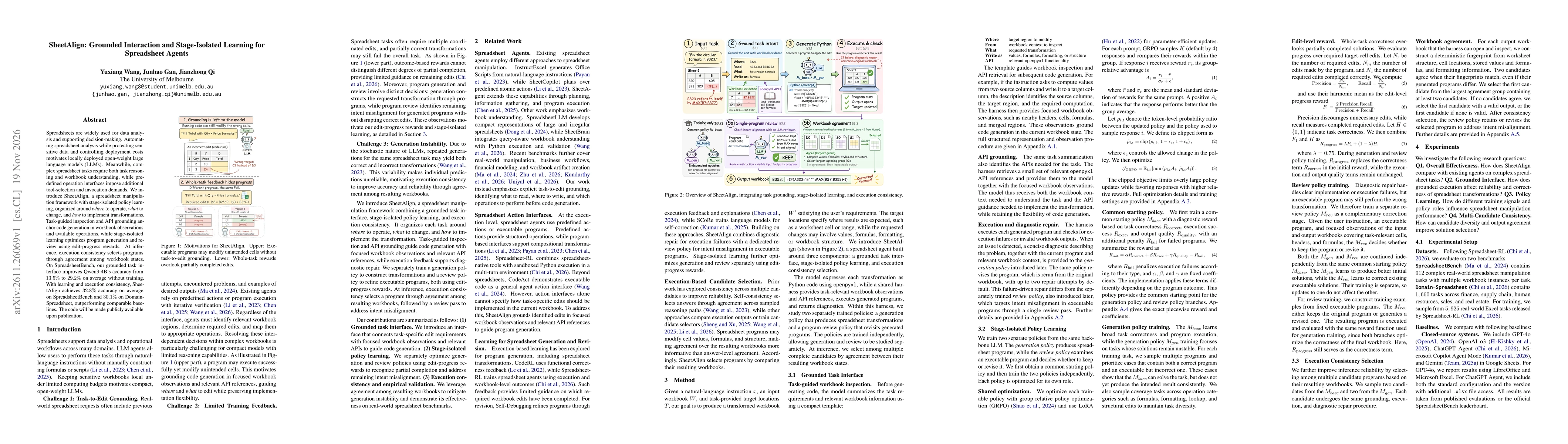
SheetAlign combines a grounded task interface that links edit requirements with focused workbook observations and relevant OpenPyXL APIs, stage‑isolated policy learning that separately trains generation and review policies using edit‑progress rewards, and an execution‑consistency inference step that selects programs based on agreement among resulting workbook states.
SignificanceWhy the work matters
The approach enables compact, open‑weight LLMs to reliably manipulate spreadsheets while preserving data locality and reducing deployment costs, addressing the need for trustworthy automation of sensitive spreadsheet workflows.
Technical contributionsWhat the work introduces
Introduces a three‑stage framework (where to operate, what to change, how to implement) that grounds code generation in workbook observations and API references, and trains separate generation and review policies with edit‑level rewards.
NoveltyHow it differs from prior work
First integration of task‑grounded inspection with API grounding and stage‑isolated policy learning for spreadsheet agents, coupled with an execution‑consistency selection mechanism.
Discussion 0