Single-Beat Cuffless Blood Pressure Estimation Using Ear-PPG and ECG with a Lightweight Hybrid Learning Framework
The study demonstrates single-beat cuffless blood pressure estimation using synchronized ear-PPG and chest ECG, along with motion sensing, by a lightweight hybrid model that blends a CNN-derived PPG beat embedding with physiology-based features and LightGBM regression. It achieves beat-wise accuracy (MAE: systolic ~4.02 mmHg, diastolic ~1.79 mmHg) without long temporal context, offering efficient wearable BP monitoring with robust performance in dynamic, real-world conditions.
Abstract
Continuous cuffless blood pressure (BP) monitoring remains challenging due to motion artifacts, physiological variability, and the limited robustness of conventional pulse transit time (PTT) models under dynamic conditions. Many prior approaches rely on multi-second windows to stabilize estimation, an assumption that is frequently violated during real-world monitoring with intermittent signal corruption. Here, we show that discriminative BP-related information is preserved at the single-beat level and present a lightweight multi-modal wearable framework for continuous BP estimation. The system integrates synchronized chest electrocardiography (ECG) and ear-clip reflectance photoplethysmography, each co-located with a 6-axis inertial measurement unit to provide motion context. We introduce a hybrid learning architecture in which a one-dimensional convolutional neural network extracts a 64-dimensional embedding from individual PPG beats and fuses it with 30 physiology-grounded features, including PTT statistics and heart rate variability, followed by LightGBM regression. The method was evaluated using a multi-phase stress protocol ($n=10$) and the PulseDB public dataset with subject-disjoint validation. Across 30 independent runs, the model achieved mean absolute errors of $4.02 \pm 0.21$~mmHg for systolic BP and $1.79 \pm 0.05$~mmHg for diastolic BP, corresponding to a 28.2\% reduction in combined MAE relative to baseline models. By enabling beat-wise estimation without long temporal context, this framework supports computationally efficient cuffless BP monitoring suitable for wearable deployment under practical resource constraints. The source code for this work is available at https://github.com/SYMBIOX-Lab/BP-wireless.
Analysis
AI-generated · verify against the original paper
Generated Aug 1, 2026ResultsWhat the authors found
- Across 30 independent runs, the model achieved mean absolute errors of 4.02 ± 0.21 mmHg for SBP and 1.79 ± 0.05 mmHg for DBP, indicating clinically meaningful accuracy in beat-level estimation.
- The hybrid CNN + LightGBM model achieved a 28.2% reduction in combined MAE relative to LightGBM-only baselines, demonstrating the value of incorporating beat-level morphology with physiology-grounded features.
- The beat-wise pipeline provides robust performance without requiring multi-second temporal windows, enabling real-time cuffless BP monitoring on resource-constrained wearables.
LimitationsWhere the findings need caution
- Limited multi-wavelength PPG fusion; only a single optimal channel was used to minimize complexity, potentially limiting robustness to wavelength-dependent artifacts.
- Validation spans 109 subjects but still warrants larger and more diverse populations to fully establish generalizability.
- Signals were resampled to 125 Hz, which may constrain temporal precision for features like PTT compared to higher sampling rates.
- Beat-wise processing does not model long-term temporal dependencies; potential improvements could arise from lightweight temporal extensions.
MethodologyHow the work was done
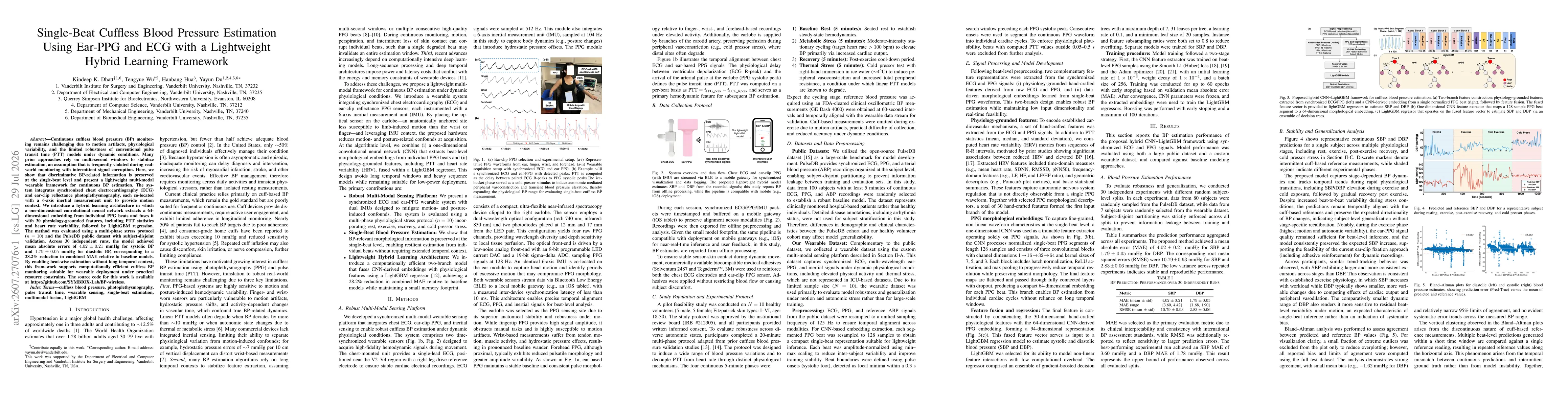
A lightweight hybrid learning framework fuses a beat-level CNN embedding extracted from ear-PPG with 30 physiology-grounded features (including PTT statistics and HRV), and uses LightGBM regression to estimate systolic and diastolic BP on a beat-by-beat basis without relying on long temporal windows. The sensing platform integrates synchronized chest ECG and ear-clip PPG with dual IMUs to provide motion context, enabling robust beat-level BP estimation under dynamic conditions. Evaluation involved a multi-phase physiological stress protocol (n=10) and the PulseDB dataset with subject-disjoint validation, reporting MAEs and demonstrating a 28.2% MAE reduction over baseline models. The approach emphasizes computational efficiency suitable for on-device wearable deployment, with an end-to-end inference time around 3 ms per beat on GPU and small memory footprint (<2 MB).
SignificanceWhy the work matters
Demonstrates that discriminative BP-related information is preserved at the single-beat level, enabling accurate cuffless BP estimation under motion and autonomic stress without heavy sequential models, which is favorable for low-power wearable deployment and real-world applicability.
Technical contributionsWhat the work introduces
Proposes a lightweight hybrid CNN+LightGBM framework that performs beat-level BP estimation from ear-PPG and ECG with IMU context, achieving substantial MAE improvements over baselines while maintaining a sub-2 MB model footprint and millisecond-scale per-beat inference suitable for wearables.
NoveltyHow it differs from prior work
Introduces single-beat cuffless BP estimation using synchronized ear-PPG and ECG with an IMU-enabled wearable platform, combined with physiology-grounded features and a computationally efficient fusion model, enabling accurate beat-wise BP estimation without long temporal contexts.
Future workQuestions that remain
- Explore multi-wavelength PPG fusion and more extensive optical layouts to improve motion artifact robustness.
- Expand validation to larger, more diverse cohorts and real-world long-term deployments to assess generalizability.
- Investigate lightweight temporal extensions to capture abrupt physiological transitions while preserving low power constraints.
- Advance miniaturized ear-PPG hardware designs to improve mechanical coupling and further reduce motion-related confounds.
Discussion 0