This paper investigates singularities of two-dimensional Nijenhuis operators where the trace has a non-zero differential at the singular point. It describes these singularities by examining the smoothness of a specific function related to the operator's determinant and provides detailed descriptions for special classes of functions.
Abstract
A Nijenhuis operator $L$ is a $(1,1)$-tensor field on a smooth manifold $M$ with vanishing Nijenhuis torsion ${ {\mathcal N_L}}$. At each point $x\in M$, the algebraic type of $L(x)$ is characterized by its Jordan normal form. In this paper, we study singularities of a two-dimensional Nijenhuis operator in the case when its trace has a non-zero differential at the singular point. A description of such singularities reduces to studying the smoothness of some function, which is a fraction depending on partial derivatives of the determinant of $L$. We completely describe singularities for some special classes of functions. We also obtained interesting examples of Nijenhuis operators and their singularities.
Analysis
AI-generated · verify against the original paper
Generated Jun 10, 2025ResultsWhat the authors found
- Complete description of Nijenhuis operators with a Morse singularity in the second variable.
- Identification of Nijenhuis operators with cubic singularities in the second variable.
- Examples of Nijenhuis operators and their singularities provided.
- General form of smooth Nijenhuis operators with admissible discriminants having non-degenerate singularities at the origin.
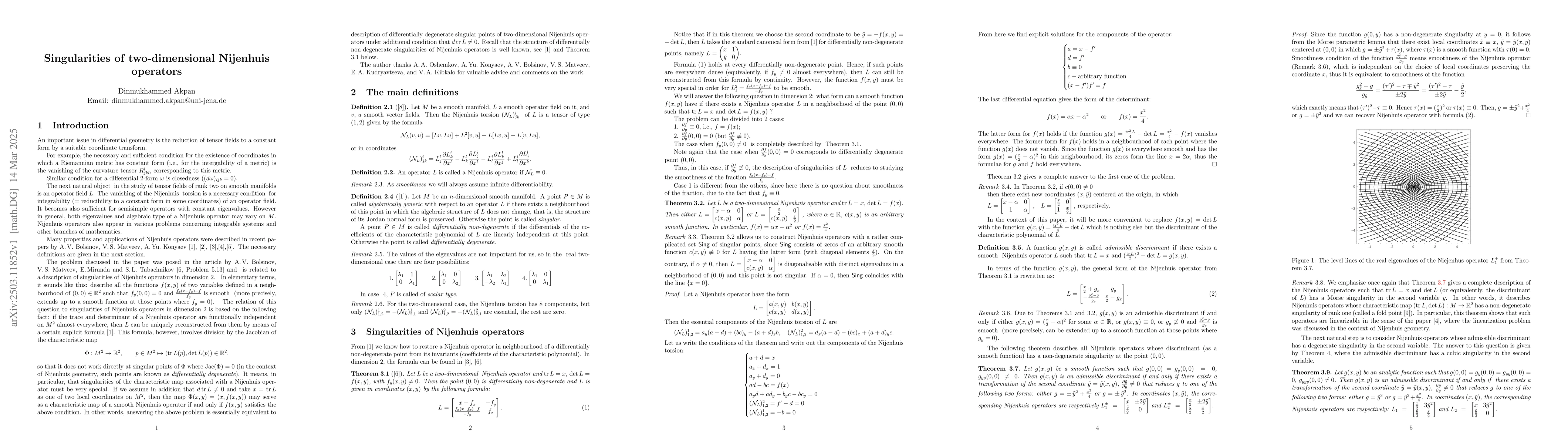
- Formulas for real eigenvalues of specific Nijenhuis operators illustrated through figures.
LimitationsWhere the findings need caution
- The study is limited to two-dimensional Nijenhuis operators.
- Focus is primarily on singularities at the origin, with less exploration of singularities at other points.
MethodologyHow the work was done
The research studies singularities of two-dimensional Nijenhuis operators by characterizing their algebraic types via Jordan normal form and analyzing the smoothness of a function dependent on partial derivatives of the determinant of the operator.
SignificanceWhy the work matters
This research contributes to understanding the geometric structure of Nijenhuis operators, which are crucial in differential geometry and have applications in areas like hydrodynamic systems and integrable systems.
Technical contributionsWhat the work introduces
The paper presents a comprehensive classification of two-dimensional Nijenhuis operators with specific types of singularities, linking them to the smoothness properties of a function derived from their determinants.
NoveltyHow it differs from prior work
This work extends previous research by providing a detailed analysis of singularities for two-dimensional Nijenhuis operators, identifying new classes of operators, and offering explicit examples and characterizations.
Future workQuestions that remain
- Investigate Nijenhuis operators with degenerate admissible discriminants in the second variable.
- Extend the analysis to higher-dimensional Nijenhuis operators.
Discussion 0