SituationAdapt: Contextual UI Optimization in Mixed Reality with Situation Awareness via LLM Reasoning
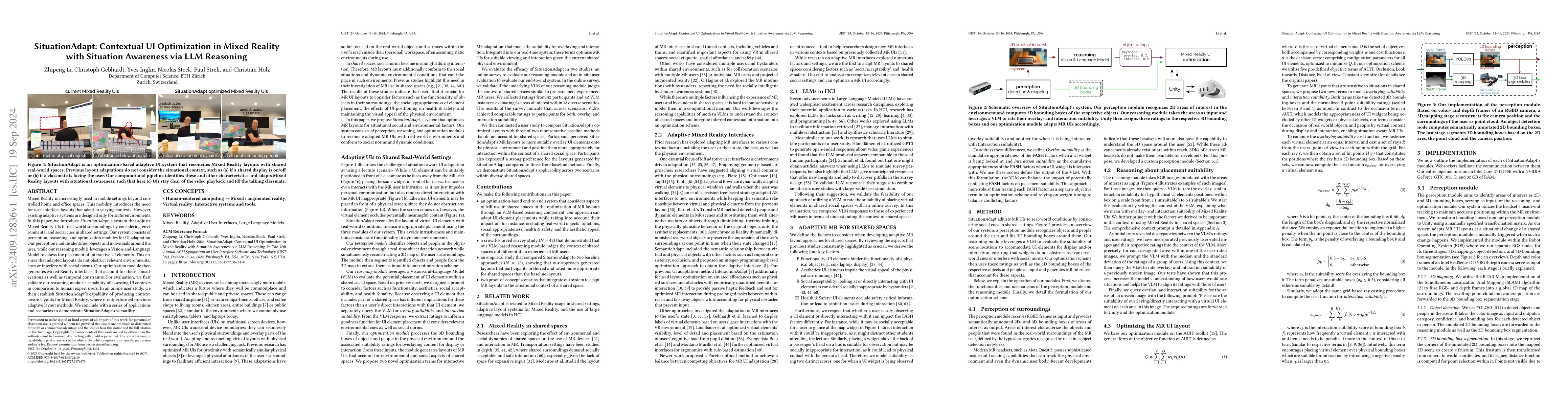
SituationAdapt optimizes Mixed Reality UIs by adapting layouts to real-world surroundings through perception, reasoning, and optimization modules. It leverages a Vision-and-Language Model to ensure UI placements do not interfere with environmental cues or social norms, outperforming previous adaptive methods in user studies.
Abstract
Mixed Reality is increasingly used in mobile settings beyond controlled home and office spaces. This mobility introduces the need for user interface layouts that adapt to varying contexts. However, existing adaptive systems are designed only for static environments. In this paper, we introduce SituationAdapt, a system that adjusts Mixed Reality UIs to real-world surroundings by considering environmental and social cues in shared settings. Our system consists of perception, reasoning, and optimization modules for UI adaptation. Our perception module identifies objects and individuals around the user, while our reasoning module leverages a Vision-and-Language Model to assess the placement of interactive UI elements. This ensures that adapted layouts do not obstruct relevant environmental cues or interfere with social norms. Our optimization module then generates Mixed Reality interfaces that account for these considerations as well as temporal constraints. For evaluation, we first validate our reasoning module's capability of assessing UI contexts in comparison to human expert users. In an online user study, we then establish SituationAdapt's capability of producing context-aware layouts for Mixed Reality, where it outperformed previous adaptive layout methods. We conclude with a series of applications and scenarios to demonstrate SituationAdapt's versatility.
AI Key Findings
Get AI-generated insights about this paper's methodology, results, significance, and more — available when analysis has been generated.
Discussion 0