SkillAA: Attribution-Guided Skill-Graph Updating with Targeted Validation and Rollback
Abstract
External skills provide domain procedures without parameter updates, but existing methods often edit skills directly from failed rollouts without structured routing from an observed failure to an editable location; existing skill graphs also underuse semantic boundaries, object addresses, and topological dependencies for skill retrieval, targeted updating, and scoped validation. We introduce SkillAA (Skill Abductive Attribution), a structured skill-optimization framework for frozen language models. It represents skill applicability, execution, and composition in a unified graph, allowing the same structure to support skill selection, attribution-guided repair, and update validation. SkillAA contrasts successful and failed executions to route candidate repairs to specific graph objects, updates only the selected local structure, and uses Local and Big Gates to screen candidate changes before commitment. With gpt-5.6-sol, SkillAA reaches 81.5%, 66.7%, and 91.2% on SearchQA, LiveMath, and DocVQA, respectively, and attains the highest observed mean in every main setting. These results support the utility of attribution-guided graph editing and graph-scoped validation.
Analysis
AI-generated · verify against the original paper
Generated Jan 1, 0001ResultsWhat the authors found
- With GPT-5.6-sol, GraphSkillAA achieves 81.5% on SearchQA, 66.7% on LiveMath, and 91.2% on DocVQA, the highest mean performance across all settings.
- Removing edges reduces accuracy by 4.0, 4.6, and 1.2 percentage points respectively, demonstrating the contribution of relational information.
- Shuffling initial edit targets shows diagnosed targets outperform random type‑compatible targets by 3.2, 6.0, and 1.5 percentage points on test accuracy.
LimitationsWhere the findings need caution
- The current skill graph fits only modest-sized libraries; larger libraries increase prompt cost and make error tracing harder.
- Edit granularity is limited to node fields and edges, lacking finer identifiers for sentences, theorems, or image regions.
- The system currently edits only the skill graph; it does not address retrieval, perception tools, or model training adaptations.
MethodologyHow the work was done
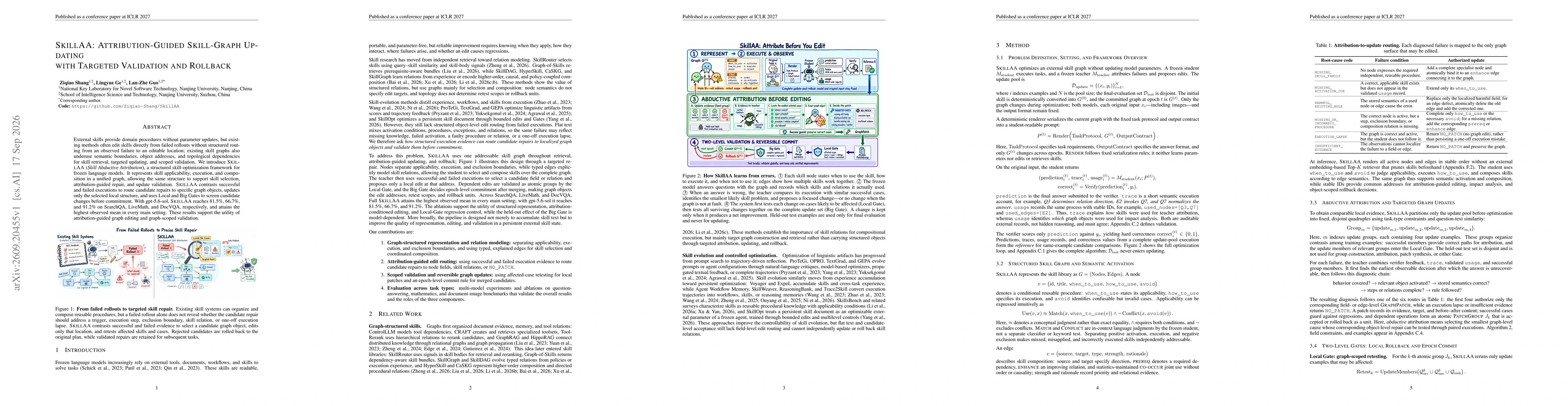
GraphSkillAA stores external skills as nodes with applicability, procedures, and exclusion conditions, and edges describing prerequisite and enhancement relations. During execution, the student records used nodes and edges, and the teacher contrasts successful and failed trajectories to localize errors into specific node fields or edges, proposing minimal edits. Edits are validated through a two-level process: a Local Gate retests affected examples and a Big Gate validates the merged graph on the full update pool, with rejected edits rolled back while model parameters remain frozen.
SignificanceWhy the work matters
The work shows that a structured skill graph enables precise skill selection, composition, and targeted repair, improving performance on diverse tasks without altering model parameters and providing a systematic framework for error localization and rollback.
Technical contributionsWhat the work introduces
Introduces a skill‑graph representation with stable IDs for nodes and edges, an object‑level abductive attribution mechanism that contrasts success and failure to propose minimal edits, and a two‑level validation with rollback that preserves model parameters.
NoveltyHow it differs from prior work
Combines error localization, targeted skill‑graph updating, and systematic validation/rollback within a single graph‑based framework, enabling explicit repair targets and evidence‑driven edits not addressed by prior skill‑graph or external‑tool systems.
Future workQuestions that remain
- Develop finer‑grained edit identifiers (e.g., per sentence, theorem, table cell, image region) while retaining group retesting and rollback.
- Extend the framework to select and edit retrieval modules, perception tools, or model parameters based on error type, incorporating alias recognition and semantic equivalence feedback.
- Scale skill selection to large libraries using hierarchical or DAG‑based structures, and integrate joint optimization of rule selection, dependency completion, and context cost.
Discussion 0