Solve Vision with Code: Coding Agents Are Stronger Visual Reasoners Than Video Models
Abstract
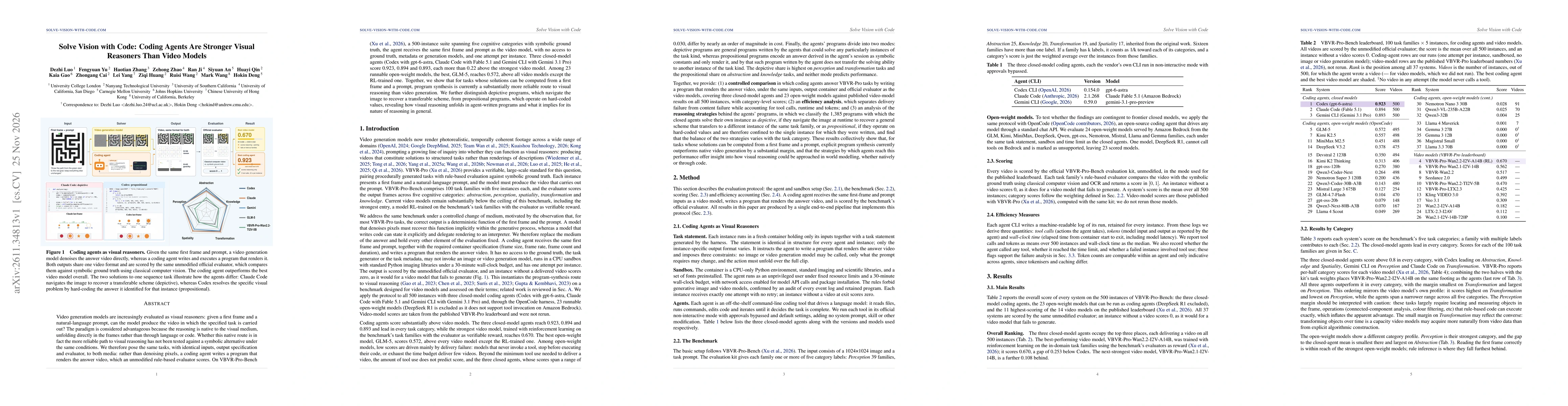
Video generation models are increasingly evaluated as visual reasoners: given a first frame and a natural-language prompt, can the model produce the video in which the specified task is carried out? The paradigm is considered advantageous because the reasoning is native to the visual medium, unfolding directly in the frames rather than through language or code. Whether this native route is in fact the more reliable path to visual reasoning has not been tested against a symbolic alternative under the same conditions. We therefore pose the same tasks, with identical inputs, output specification and evaluator, to both media: rather than denoising pixels, a coding agent writes a program that renders the answer video, which an unmodified rule-based evaluator scores. On VBVR-Pro-Bench (Xu et al., 2026), a 500-instance suite spanning five cognitive categories with symbolic ground truth, the agent receives the same first frame and prompt as the video model, with no access to ground truth, metadata or generation models, and one attempt per instance. Three closed-model agents (Codex with gpt-6-astra, Claude Code with Fable 5.1 and Gemini CLI with Gemini 3.1 Pro) score 0.923, 0.894 and 0.893, each more than 0.22 above the strongest video model. Among 23 runnable open-weight models, the best, GLM-5, reaches 0.572, above all video models except the RL-trained one. Together, we show that for tasks whose solutions can be computed from a first frame and a prompt, program synthesis is currently a substantially more reliable route to visual reasoning than video generation. We further distinguish depictive programs, which navigate the image to recover a transferable scheme, from propositional programs, which operate on hard-coded values, revealing how visual reasoning unfolds in agent-written programs and what it implies for its nature of reasoning in general.
Analysis
AI-generated · verify against the original paper
Generated Jan 1, 0001ResultsWhat the authors found
- Closed‑model coding agents achieve scores of 0.923 (Codex), 0.894 (Claude Code), and 0.893 (Gemini CLI), each exceeding the strongest video model by >0.22.
- The best open‑weight coding model, GLM‑5, reaches 0.572, surpassing all video models except the RL‑trained one (0.670).
- Coding agents consistently outperform video models across all five cognitive categories of the benchmark.
LimitationsWhere the findings need caution
- The evaluation is limited to tasks whose solutions can be computed directly from the first frame and prompt, excluding more open‑ended visual reasoning scenarios.
- Open‑weight coding models often fail due to inability to invoke required tools, premature termination, or exceeding time budgets, indicating sensitivity to tool‑use capabilities.
MethodologyHow the work was done
The study evaluates visual reasoning by comparing video generation models with coding agents that synthesize programs to render answer videos. Both receive the same first frame and natural-language prompt, and outputs are scored by an unmodified rule‑based evaluator on the VBVR‑Pro‑Bench benchmark (500 instances, five cognitive categories). Three closed‑model coding agents (Codex, Claude Code, Gemini CLI) and 23 open‑weight coding models are tested under a single‑attempt, no‑ground‑truth, CPU‑sandbox setting with a 30‑minute wall‑clock budget.
SignificanceWhy the work matters
The results demonstrate that program synthesis is a substantially more reliable route to visual reasoning than pixel‑level video generation for tasks where the solution is a deterministic function of the first frame and prompt, challenging the prevailing assumption that native visual reasoning via video is superior.
Technical contributionsWhat the work introduces
Introduces a controlled experimental protocol that swaps the output medium from video to executable code while keeping inputs, evaluation metrics, and benchmark unchanged, enabling a direct comparison of visual reasoning performance between generative video models and code‑based agents.
NoveltyHow it differs from prior work
First systematic comparison of visual reasoning via program synthesis versus video generation under identical conditions, revealing distinct reasoning styles (depictive vs. propositional programs) and establishing coding agents as stronger visual reasoners.
Discussion 0