Sparse Evidence Can Suffice: Agentic Evidence Seeking for Multimodal Video Misinformation Detection
The paper argues that detecting multimodal video misinformation can be done by focusing on a few key clues rather than analyzing all content. It introduces SIEVE, a system where an evidence-seeking agent gathers compact, informative evidence packages that a verifier uses to judge truth, improving accuracy and transparency while reducing unnecessary analysis.
Abstract
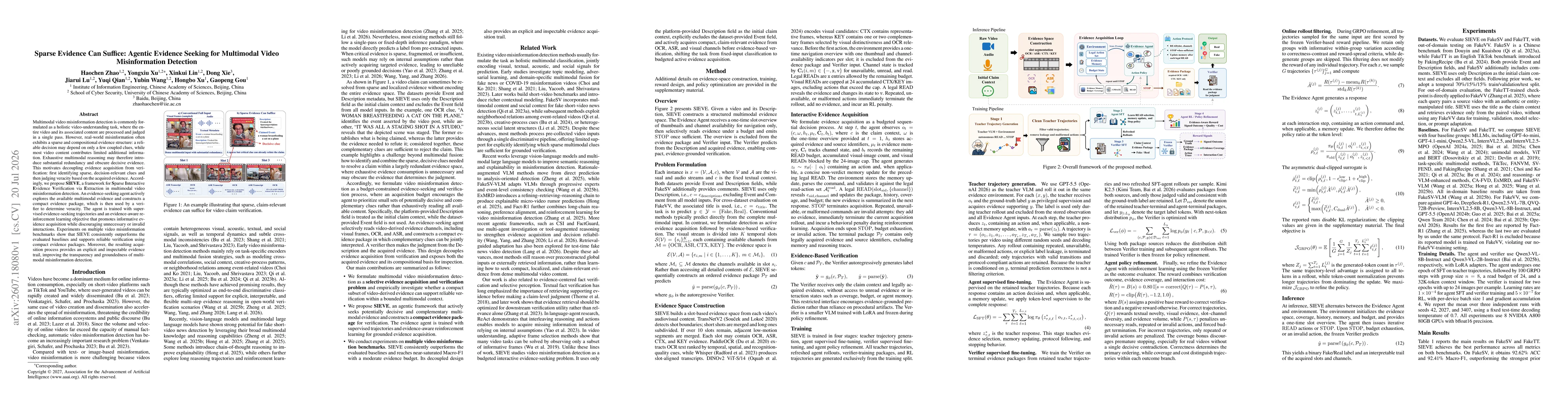
Multimodal video misinformation detection is commonly formulated as a holistic video-understanding task, where the entire video and its associated content are processed and judged in a single pass. However, real-world misinformation often exhibits a sparse and compositional evidence structure: a reliable decision may depend on only a few coupled clues, while most video content contributes limited additional information. Exhaustive multimodal reasoning may therefore introduce substantial redundancy and obscure decisive evidence. This motivates decoupling evidence acquisition from verification: first identifying sparse, decision-relevant clues and then judging veracity based on the acquired evidence. Accordingly, we propose SIEVE, a framework for Sparse Interactive Evidence Verification via Extraction in multimodal video misinformation detection. An evidence-seeking agent actively explores the available multimodal evidence and constructs a compact evidence package, which is then used by a verifier to determine veracity. The agent is trained with supervised evidence-seeking trajectories and an evidence-aware reinforcement learning objective that promotes informative evidence acquisition while discouraging unnecessary or invalid interactions. Experiments on multiple video misinformation benchmarks show that SIEVE consistently outperforms the evaluated baselines and supports reliable verification using compact evidence packages. Moreover, the resulting acquisition process provides an explicit and inspectable evidence trail, improving the transparency and groundedness of multimodal misinformation detection.
Analysis
AI-generated · verify against the original paper
Generated Jul 22, 2026ResultsWhat the authors found
- SIEVE consistently outperforms evaluated baselines in accuracy and macro-F1 across multiple benchmarks using a compact evidence package.
- Near-saturated Macro-F1 is achieved with a moderate evidence budget, indicating efficient evidence usage.
- The acquisition process yields explicit, inspectable evidence trails, enhancing transparency and groundedness in detection.
LimitationsWhere the findings need caution
- Evaluation is limited to available benchmarks; generalization to unseen domains or languages is not established.
- The approach relies on predefined channels (OCR, ASR, CTX, KEY); other modalities may provide additional discriminative clues not explored.
MethodologyHow the work was done
SIEVE formulates multimodal video misinformation detection as a budgeted, selective evidence acquisition and verification problem. An evidence-seeking agent actively explores heterogeneous evidence channels (visual frames, OCR, ASR) to construct a compact evidence package, which is then used by a verifier to judge veracity. The agent is trained with supervised trajectories and an evidence-aware reinforcement learning objective that balances informative evidence collection with penalties for unnecessary interactions. Experiments on multiple benchmarks demonstrate performance gains with reduced evidence budgets and provide an inspectable evidence trail for transparency.
SignificanceWhy the work matters
The work demonstrates that reliable multimodal misinformation verification can be achieved by selectively acquiring sparse, decision-relevant clues rather than processing exhaustive multimodal content, enabling more efficient, interpretable, and transparent detection workflows.
Technical contributionsWhat the work introduces
Proposes SIEVE, an agentic framework that actively seeks complementary multimodal evidence and constructs a compact evidence package for verification, with a reinforcement-learning objective to optimize evidence acquisition under budget constraints and an interpretable evidence trail.
NoveltyHow it differs from prior work
Introduces a budgeted, interactive evidence-seeking paradigm for multimodal video misinformation detection, decoupling evidence acquisition from verification and enabling explicit, inspectable evidence trails for transparent decision-making.
Future workQuestions that remain
- Explore broader modality integration and adaptive channel expansion to capture more diverse evidence signals.
- Investigate transfer learning to adapt the evidence-seeking policy across new misinformation domains and languages.
- Develop stronger theoretical guarantees on evidence sufficiency under budget constraints.
Discussion 0