Spatial and Temporal Cluster Tomography of Active Matter
Abstract
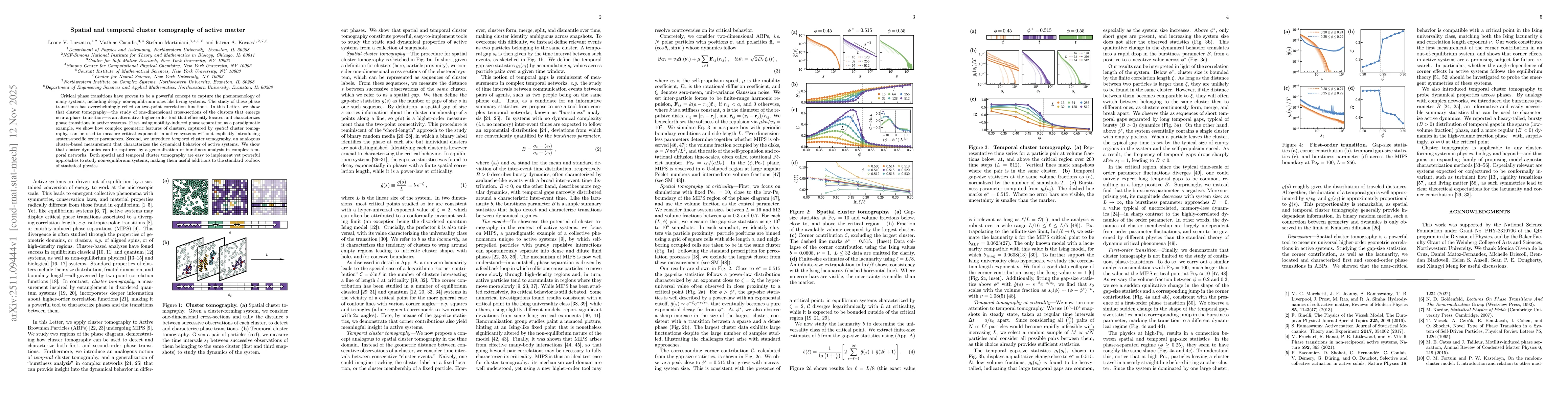
Critical phase transitions have proven to be a powerful concept to capture the phenomenology of many systems, including deeply non-equilibrium ones like living systems. The study of these phase transitions has overwhelmingly relied on two-point correlation functions. In this Letter, we show that cluster tomography -- the study of one-dimensional cross-sections of the clusters that emerge near a phase transition -- is an alternative higher-order tool that efficiently locates and characterizes phase transitions in active systems. First, using motility-induced phase separation as a paradigmatic example, we show how complex geometric features of clusters, captured by spatial cluster tomography, can be used to measure critical exponents in active systems without explicitly introducing system-specific order parameters. Second, we introduce temporal cluster tomography, an analogous cluster-based measurement that characterizes the dynamical behavior of active systems. We show that cluster dynamics can be captured by a generalization of burstiness analysis in complex temporal networks. Both spatial and temporal cluster tomography are easy to implement yet powerful approaches to study non-equilibrium systems, making them useful additions to the standard toolbox of statistical physics.
AI Key Findings
Get AI-generated insights about this paper's methodology, results, significance, and more — available when analysis has been generated.
Discussion 0