Spatiotemporal Distillation via Recurrent Bottlenecks for Aortic Tracking
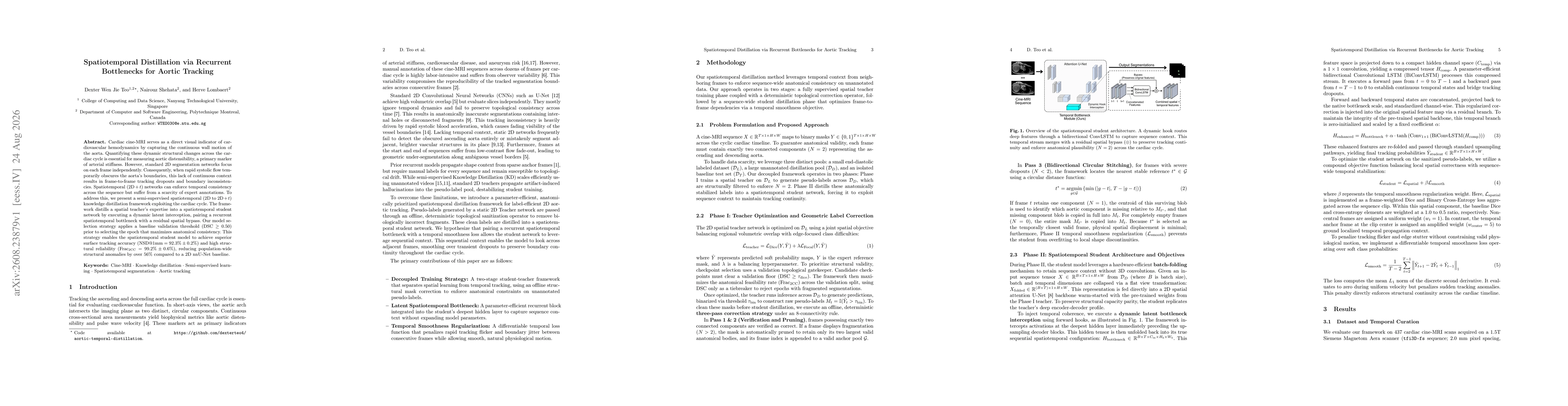
The paper introduces a semi-supervised spatiotemporal distillation method that transfers knowledge from a 2D spatial model to a 2D+time recurrent network for robust aortic tracking in cine-MRI. By using a dynamic latent interception with a recurrent bottleneck and a spatial bypass, the approach achieves high surface tracking accuracy and structural reliability, reducing tracking errors and anatomical inconsistencies compared with a standard 2D baseline.
Abstract
Cardiac cine-MRI serves as a direct visual indicator of cardiovascular hemodynamics by capturing the continuous wall motion of the aorta. Quantifying these dynamic structural changes across the cardiac cycle is essential for measuring aortic distensibility, a primary marker of arterial stiffness. However, standard 2D segmentation networks focus on each frame independently. Consequently, when rapid systolic flow temporarily obscures the aorta's boundaries, this lack of continuous context results in frame-to-frame tracking dropouts and boundary inconsistencies. Spatiotemporal ($2\text{D}+t$) networks can enforce temporal consistency across the sequence but suffer from a scarcity of expert annotations. To address this, we present a semi-supervised spatiotemporal ($2\text{D}$ to $2\text{D}+t$) knowledge distillation framework exploiting the cardiac cycle. The framework distills a spatial teacher's expertise into a spatiotemporal student network by executing a dynamic latent interception, pairing a recurrent spatiotemporal bottleneck with a residual spatial bypass. Our model selection strategy applies a baseline validation threshold ($\text{DSC} \ge 0.50$) prior to selecting the epoch that maximizes anatomical consistency. This strategy enables the spatiotemporal student model to achieve superior surface tracking accuracy ($\text{NSD@1mm} = 92.3\% \pm 0.2\%$) and high structural reliability ($\text{Frac}_{2\text{CC}} = 99.2\% \pm 0.6\%$), reducing population-wide structural anomalies by over 56\% compared to a 2D nnU-Net baseline.
AI Key Findings
Get AI-generated insights about this paper's methodology, results, significance, and more — available when analysis has been generated.
Discussion 0