Speak When You See It: Proactive Task Assistants Should Wait for Evidence, Not the Clock
Abstract
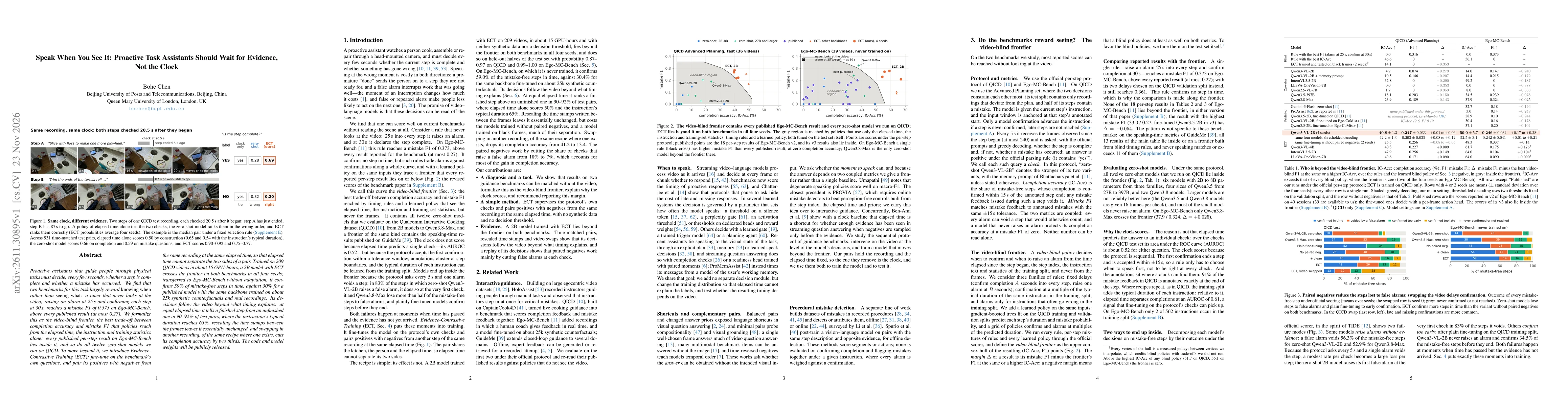
Proactive assistants that guide people through physical tasks must decide, every few seconds, whether a step is complete and whether a mistake has occurred. We find that two benchmarks for this task largely reward knowing when rather than seeing what: a timer that never looks at the video, raising an alarm at 25 s and confirming each step at 30 s, reaches a mistake F1 of 0.373 on Ego-MC-Bench, above every published result (at most 0.27). We formalize this as the video-blind frontier, the best trade-off between completion accuracy and mistake F1 that policies reach from the elapsed time, the instruction and training statistics alone: every published per-step result on Ego-MC-Bench lies inside it, and so do all twelve zero-shot models we run on QICD. To move beyond it, we introduce Evidence-Contrastive Training (ECT): fine-tune on the benchmark's own questions, and pair its positives with negatives from the same recording at the same elapsed time, so that elapsed time cannot separate the two sides of a pair. Trained on 209 QICD videos in about 15 GPU-hours, a 2B model with ECT crosses the frontier on both benchmarks in all four seeds; transferred to Ego-MC-Bench without adaptation, it confirms 59% of mistake-free steps in time, against 30% for a published model with the same backbone trained on about 25k synthetic counterfactuals and real recordings. Its decisions follow the video beyond what timing explains: at equal elapsed time it tells a finished step from an unfinished one in 90-92% of test pairs, where the instruction's typical duration reaches 65%, rescaling the time stamps between the frames leaves it essentially unchanged, and swapping in another recording, of the same recipe where one exists, cuts its completion accuracy by two thirds. The code and model weights will be publicly released.
Analysis
AI-generated · verify against the original paper
Generated Jan 1, 0001ResultsWhat the authors found
- ECT‑trained models cross the video‑blind frontier on both QICD and Ego‑MC‑Bench in all four random seeds.
- On Ego‑MC‑Bench, the ECT model confirms 59% of mistake‑free steps in time versus 30% for a comparable model trained on ~25k synthetic counterfactuals.
- At equal elapsed time, the ECT model ranks finished steps above unfinished ones in 90–92% of test pairs, far above the 50% baseline of timing alone.
- Rescaling timestamps has negligible effect on ECT performance, while swapping recordings of the same recipe drops completion accuracy by two thirds.
LimitationsWhere the findings need caution
- The approach is evaluated only on two specific cooking benchmarks (QICD and Ego‑MC‑Bench) and may not generalize to other domains without further testing.
- Training relies on a relatively small set of 209 videos, limiting exposure to diverse task variations.
MethodologyHow the work was done
The authors introduce Evidence-Contrastive Training (ECT), which fine‑tunes a 2B video‑language model on the benchmark’s own question‑answer pairs, pairing each positive instance with a negative from the same recording at the same elapsed time so that elapsed time alone cannot separate the pair. Training uses 209 QICD videos (~15 GPU‑hours) without synthetic data or decision thresholds, employing LoRA adapters and cross‑entropy loss over answer tokens.
SignificanceWhy the work matters
The work reveals that current proactive assistance benchmarks can be gamed by timing alone (the video‑blind frontier) and demonstrates that incorporating visual evidence via ECT substantially improves step‑completion and mistake detection, highlighting the necessity of video‑aware models for reliable task assistance.
Technical contributionsWhat the work introduces
Evidence‑Contrastive Training (ECT) that pairs positive and negative instances from the same video at identical elapsed times, forcing the model to base decisions on visual evidence rather than temporal cues.
NoveltyHow it differs from prior work
Identification of the video‑blind frontier as a performance ceiling for timing‑only policies and the introduction of ECT to surpass this frontier without synthetic data.
Discussion 0