Abstract
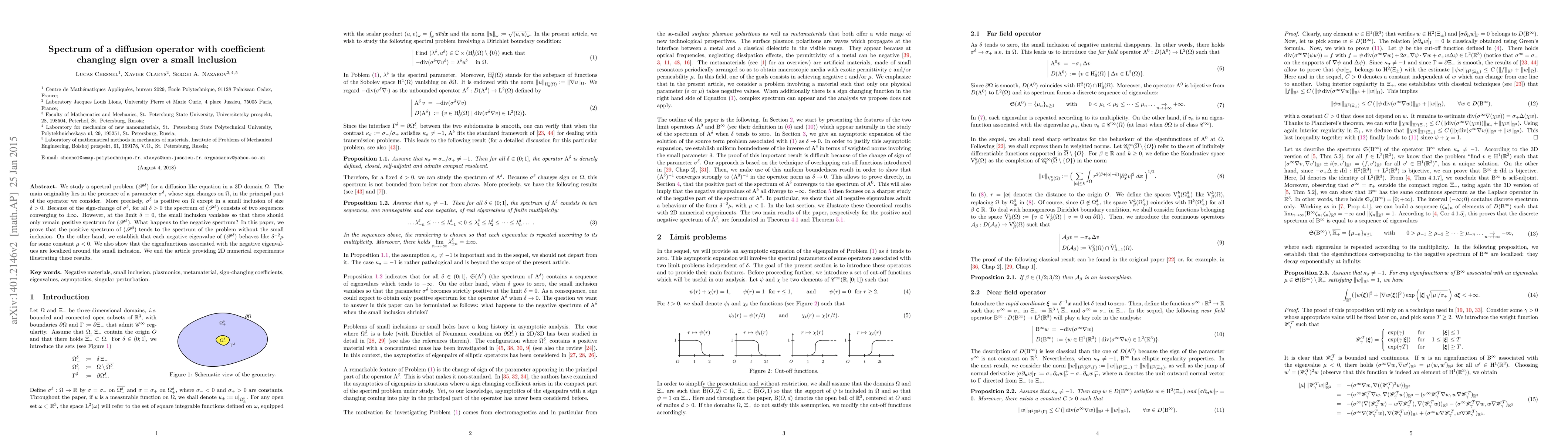
We study a spectral problem $(\mathscr{P}^{\delta})$ for a diffusion like equation in a 3D domain $\Omega$. The main originality lies in the presence of a parameter $\sigma^{\delta}$, whose sign changes on $\Omega$, in the principal part of the operator we consider. More precisely, $\sigma^{\delta}$ is positive on $\Omega$ except in a small inclusion of size $\delta>0$. Because of the sign-change of $\sigma^{\delta}$, for all $\delta>0$ the spectrum of $(\mathscr{P}^{\delta})$ consists of two sequences converging to $\pm\infty$. However, at the limit $\delta=0$, the small inclusion vanishes so that there should only remain positive spectrum for $(\mathscr{P}^{\delta})$. What happens to the negative spectrum? In this paper, we prove that the positive spectrum of $(\mathscr{P}^{\delta})$ tends to the spectrum of the problem without the small inclusion. On the other hand, we establish that each negative eigenvalue of $(\mathscr{P}^{\delta})$ behaves like $\delta^{-2}\mu$ for some constant $\mu<0$. We also show that the eigenfunctions associated with the negative eigenvalues are localized around the small inclusion. We end the article providing 2D numerical experiments illustrating these results.
AI Key Findings
Get AI-generated insights about this paper's methodology, results, significance, and more — available when analysis has been generated.
Discussion 0