Spin-adapted state preparation for quantum chemistry
Abstract
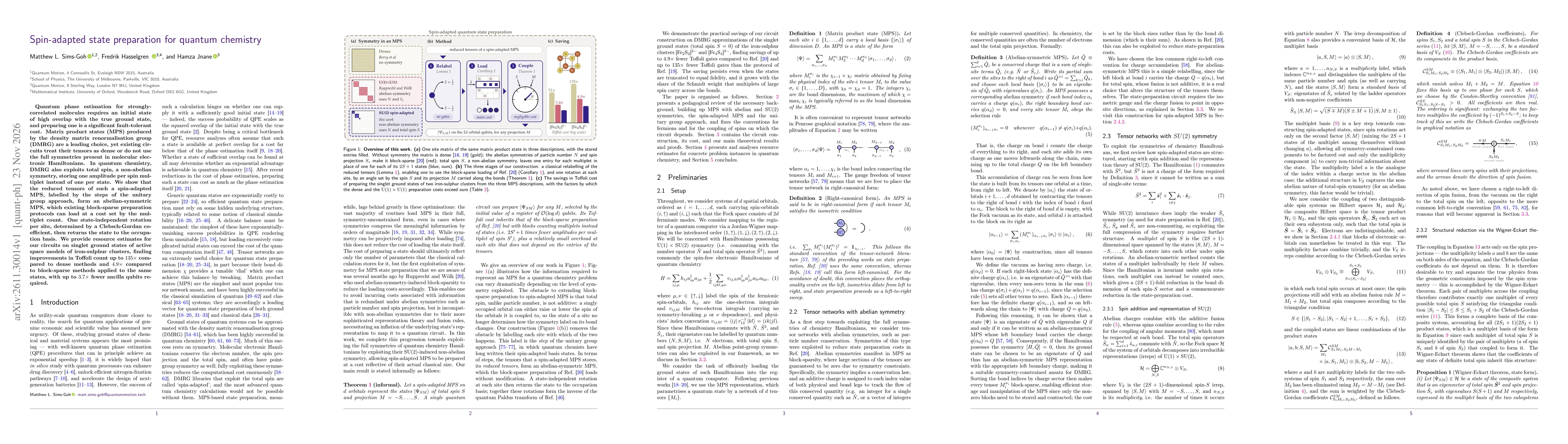
Quantum phase estimation for strongly-correlated molecules requires an initial state of high overlap with the true ground state, and preparing one is a significant fault-tolerant cost. Matrix product states (MPS) produced by the density matrix renormalisation group (DMRG) are a leading choice, yet existing circuits treat their tensors as dense or do not use the full symmetries present in molecular electronic Hamiltonians. In quantum chemistry, DMRG also exploits total spin, a non-abelian symmetry, storing one amplitude per spin multiplet instead of one per state. We show that the reduced tensors of such a spin-adapted MPS, labelled by the steps of the unitary group approach, form an abelian-symmetric MPS, which existing block-sparse preparation protocols can load at a cost set by the multiplet count. One state-independent rotation per site, determined by a Clebsch-Gordan coefficient, then returns the state to the occupation basis. We provide resource estimates for our circuits on singlet ground states of active space models of iron-sulphur clusters, finding improvements in Toffoli count up to $135\times$ compared to dense methods and $4.9\times$ compared to block-sparse methods applied to the same states, with up to $3.7\times$ fewer ancilla qubits required.
AI Key Findings
Get AI-generated insights about this paper's methodology, results, significance, and more — available when analysis has been generated.
Discussion 0