Abstract
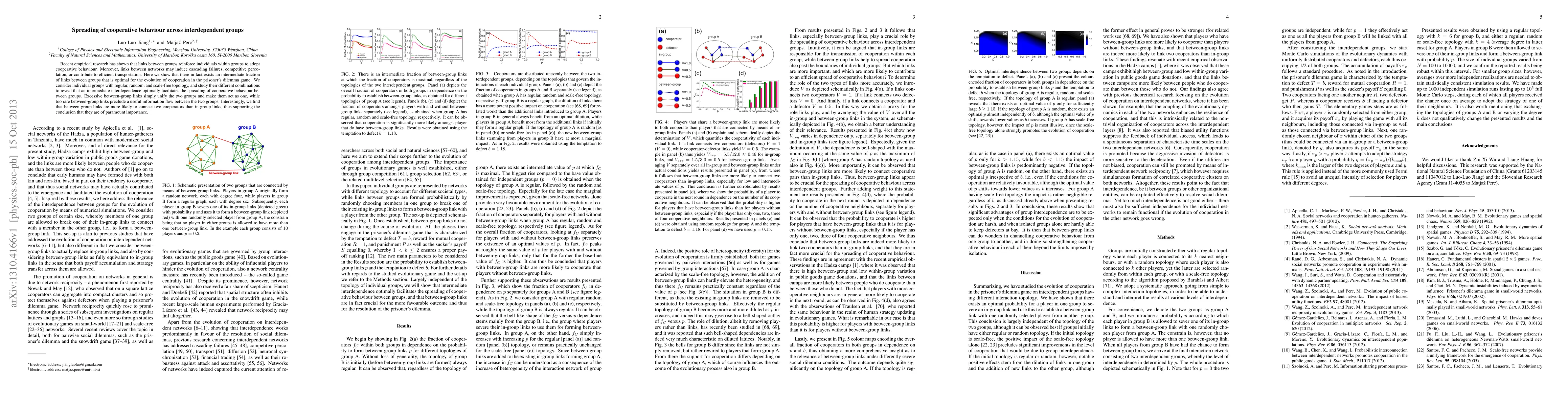
Recent empirical research has shown that links between groups reinforce individuals within groups to adopt cooperative behaviour. Moreover, links between networks may induce cascading failures, competitive percolation, or contribute to efficient transportation. Here we show that there in fact exists an intermediate fraction of links between groups that is optimal for the evolution of cooperation in the prisoner's dilemma game. We consider individual groups with regular, random, and scale-free topology, and study their different combinations to reveal that an intermediate interdependence optimally facilitates the spreading of cooperative behaviour between groups. Excessive between-group links simply unify the two groups and make them act as one, while too rare between-group links preclude a useful information flow between the two groups. Interestingly, we find that between-group links are more likely to connect two cooperators than in-group links, thus supporting the conclusion that they are of paramount importance.
AI Key Findings
Get AI-generated insights about this paper's methodology, results, significance, and more — available when analysis has been generated.
Discussion 0