Stacking-dependent anisotropic altermagnetism in V$_{1/3}$NbS$_2$
The stacking sequence of V1/3NbS2 dramatically changes its magnetic easy axis and anomalous Hall effect, revealing two distinct polytypes with different magnetic properties. Using x-ray and neutron diffraction plus transport and magnetization measurements, supported by inelastic neutron scattering analysis, the study shows that oscillatory RKKY interactions stabilize quasi-collinear A-type altermagnetic order in both polytypes, highlighting stacking as a powerful way to engineer bulk magnetism in layered materials.
Abstract
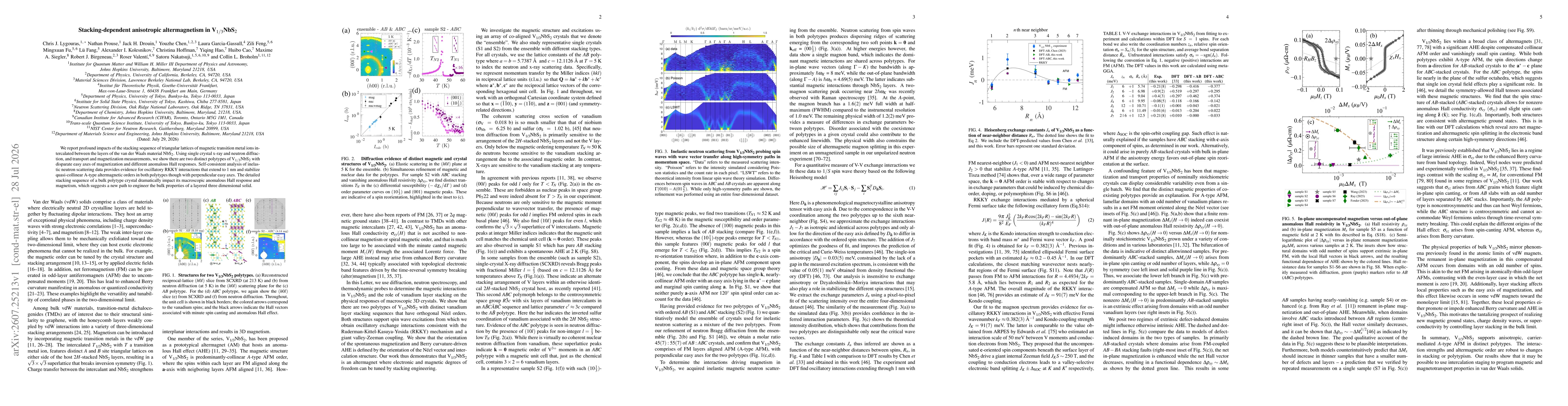
We report profound impacts of the stacking sequence of triangular lattices of magnetic transition metal ions intercalated between the layers of the van der Waals material NbS$_2$. Using single crystal x-ray and neutron diffraction, and transport and magnetization measurements, we show there are two distinct polytypes of $\rm V_{1/3}NbS_2$ with disparate easy axes of magnetization and different anomalous Hall responses. Self-consistent analysis of inelastic neutron scattering data provides evidence for oscillatory RKKY interactions that extend to 1 nm and stabilize quasi-collinear A-type altermagnetic orders in both polytypes though with perpendicular easy axes. The detailed stacking sequence of a bulk polytype crystal dramatically impact its macroscopic anomalous Hall response and magnetism, which suggests a new path to engineer the bulk properties of a layered three dimensional solid.
Analysis
AI-generated · verify against the original paper
Generated Aug 2, 2026ResultsWhat the authors found
- Two distinct vanadium stacking polytypes (AB and ABC) exhibit orthogonal Néel orders and different anomalous Hall responses, linked to their stacking sequence.
- Neutron data reveal spin-wave excitations consistent with oscillatory RKKY interactions extending to 1 nm, stabilizing quasi-collinear A-type altermagnetic orders in both polytypes.
- X-ray diffraction detects nonstandard Bragg peaks above TN in ABC stacking, confirming alternate stacking and a 6-layer magnetic unit cell in the ABC polytype.
- The orientation of spontaneous magnetization and Berry-curvature–driven anomalous Hall effect is controlled by the Néel vector orientation and intercalation structure, enabling altermagnetic behavior in a bulk 3D vdW solid.
LimitationsWhere the findings need caution
- Quantitative extraction of all exchange parameters relies on model assumptions from spin-wave analysis and may be sensitive to sample-specific stacking quality.
- The study focuses on two representative polytypes (AB and ABC); other stacking variants or defects are less explored.
- Direct real-space imaging of magnetic textures is not provided, leaving some ambiguity in the exact spin configurations at the atomic scale.
MethodologyHow the work was done
The study integrates single-crystal X-ray diffraction, neutron diffraction, transport and magnetization measurements, and inelastic neutron scattering to probe stacking-dependent magnetism in V1/3NbS2. Data are analyzed with simultaneous refinements of magnetic and nuclear structures, and spin-wave spectra are interpreted to extract oscillatory RKKY interactions up to ~1 nm, supporting A-type altermagnetic order across two polytypes.
SignificanceWhy the work matters
Demonstrates stacking engineering as a viable route to tailor magnetic and topological properties in layered magnets, revealing a bulk altermagnetic mechanism in V1/3NbS2 driven by intercalant stacking and RKKY-mediated interactions.
Technical contributionsWhat the work introduces
Experimentally establishes stacking-dependent altermagnetism in a bulk vdW material and provides a self-consistent framework linking intercalant stacking, spin-wave excitations, and anomalous Hall responses via RKKY interactions.
NoveltyHow it differs from prior work
First demonstration that vanadium-layer stacking sequence in V1/3NbS2 dictates Néel order, AHE sign, and altermagnetic behavior in a bulk 3D crystal, enabling stacking-engineered control of electronic and magnetic properties.
Future workQuestions that remain
- Extend diffraction and spectroscopy to additional stacking sequences and defect-rich crystals to map the full stacking–magnetism phase diagram.
- Develop real-space imaging (e.g., spin-polarized STM or LTEM) to visualize the altermagnetic spin textures and confirm A-type order at the atomic scale.
- Theoretically refine RKKY-based models with ab initio calculations across more polytypes to quantify interlayer coupling variations and Berry curvature contributions.
Discussion 0