STAG-Net: Structure-Aware Attention over Landmark Groups for Lightweight Head Pose Estimation
Abstract
Head pose estimation is important for human computer interaction and driver monitoring, but many image based methods remain too costly for resource constrained deployment. We propose STAG-Net, a structure-aware attention over landmark groups for lightweight head Pose estimation that estimates head pose from facial landmarks using movement aware selection, spatial clustering, compact DeepSet encoders, self attention, and a global geometry descriptor. We develop variants using FaceMesh and Face Alignment Network landmarks and evaluate them under cross dataset and subject independent protocols on 300W-LP, AFLW2000, and BIWI. STAG-Net achieves the lowest mean absolute error among all compared landmark based methods in every evaluated setting. On BIWI frames with valid detections, the FAN variant also records the lowest overall error among all compared methods, reaching $3.51^\circ$ under cross dataset evaluation and $2.39^\circ$ under subject independent evaluation. The regressors use only 0.012 to 0.043 million parameters and 24.1 to 83.6 thousand FLOPs, about three orders of magnitude fewer FLOPs than FSA-Net. Despite including landmark extraction and regression, the FaceMesh pipeline reaches 322.9 frames per second on a Tesla T4 GPU, nearly twice the 164.5 frames per second of the fastest measured image based baseline, and 111.0 frames per second on CPU. After normalization by dataset size, STAG-Net processes training samples seven to eight times faster than FSA-Net and more than one hundred times faster than HopeNet and TokenHPE, while complete training finishes within 28 minutes. These results show that STAG-Net combines leading landmark based accuracy with substantially lower training and inference cost.
Analysis
AI-generated · verify against the original paper
Generated Jan 1, 0001ResultsWhat the authors found
- STAG-Net achieves the lowest mean absolute error among all landmark-based methods on 300W-LP, AFLW2000, and BIWI datasets.
- The FAN variant records the lowest overall MAE on BIWI, reaching 3.51° under cross-dataset evaluation and 2.39° under subject-independent evaluation.
- Regressors contain only 0.012–0.043 million parameters and require 24.1–83.6 thousand FLOPs, about three orders of magnitude fewer than FSA-Net.
- The FaceMesh pipeline processes 322.9 frames per second on a Tesla T4 GPU and 111.0 fps on CPU, nearly twice the speed of the fastest image-based baseline.
- Training samples are processed seven to eight times faster than FSA-Net and over one hundred times faster than HopeNet and TokenHPE, with full training completing in 28 minutes.
LimitationsWhere the findings need caution
- Extreme pose coverage is limited primarily by the upstream landmark detector rather than the pose regression stage.
- Performance depends on the quality and completeness of detected landmarks; invalid detections reduce overall accuracy.
MethodologyHow the work was done
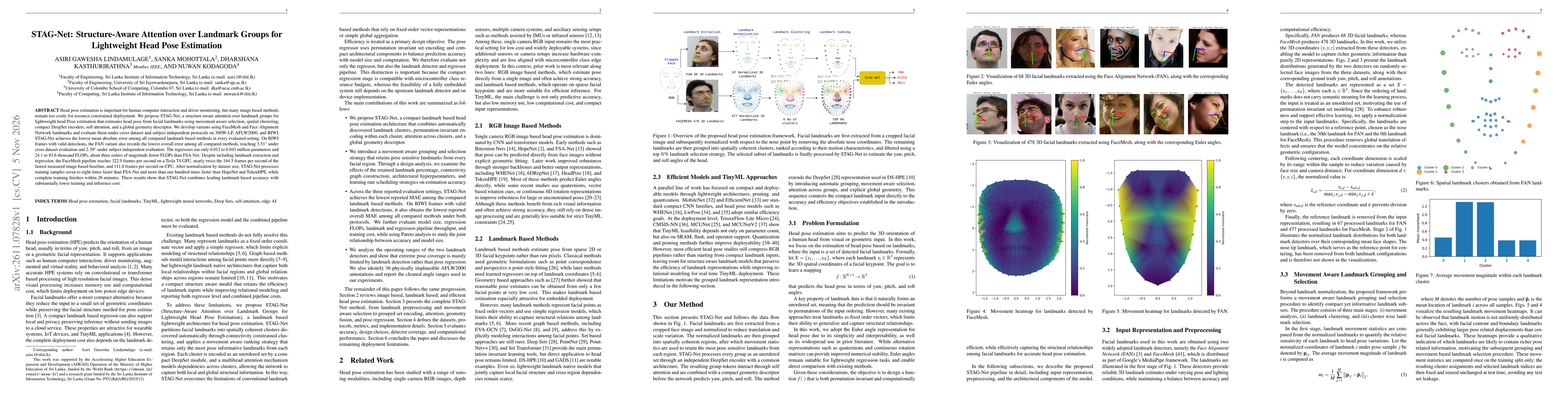
STAG-Net partitions facial landmarks into spatially coherent clusters via connectivity-constrained clustering, applies a movement-aware ranking to retain the most pose-informative landmarks per region, encodes each cluster with a compact DeepSet module, models inter-cluster dependencies with multi-head self-attention, and fuses a global geometry descriptor before regressing yaw, pitch, and roll.
SignificanceWhy the work matters
STAG-Net demonstrates that landmark-based head pose estimation can match or exceed the accuracy of image-based methods while drastically reducing computational and memory requirements, enabling deployment on resource-constrained edge and TinyML devices.
Technical contributionsWhat the work introduces
Introduces a structure-aware attention mechanism over automatically discovered landmark groups, combined with movement-aware landmark selection, permutation-invariant DeepSet encoders, and a global geometry descriptor for lightweight head pose regression.
NoveltyHow it differs from prior work
First lightweight head pose estimator that jointly leverages spatial clustering, movement-aware landmark selection, and self-attention across landmark groups to achieve state-of-the-art accuracy with orders-of-magnitude lower computational cost.
Discussion 0