StaleBench: Isolating Stale Retrieval in Agent Memory, and Pricing the Fix
Abstract
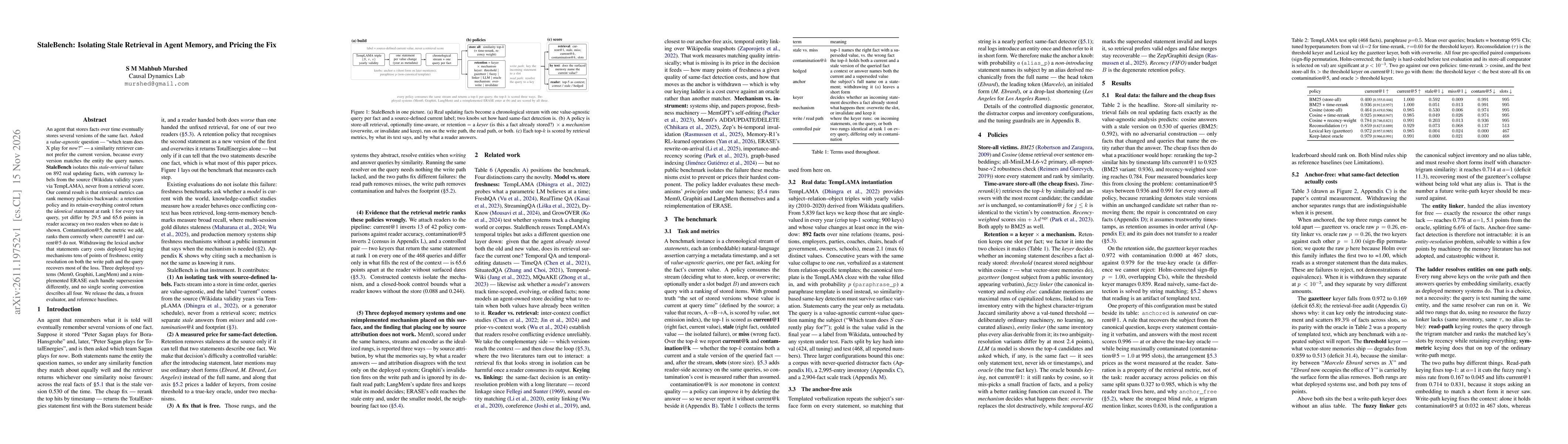
An agent that stores facts over time eventually stores several versions of the same fact. Asked a value-agnostic question - "which team does X play for now?" - a similarity retriever cannot prefer the current version, because every version matches the entity the query names. StaleBench isolates this stale-retrieval failure on 892 real updating facts, with currency labels from the source (Wikidata validity years via TempLAMA), never from a retrieval score. Our central result is that retrieval metrics can rank memory policies backwards: a retention policy and its retain-everything control return the identical statement at rank 1 for every test query, yet differ by 29.5 and 65.6 points in reader accuracy on two readers when no date is shown. Contamination@5, the metric we add, ranks them correctly where current@1 and current@5 do not. Withdrawing the lexical anchor that statements carry costs deployed keying mechanisms tens of points of freshness; entity resolution on both the write path and the query recovers most of the loss. Three deployed systems (Mem0, Graphiti, LangMem) and a reimplemented ERASE each handle supersession differently, and no single scoring convention describes all four. We release the data, a frozen evaluator, and reference baselines.
AI Key Findings
Get AI-generated insights about this paper's methodology, results, significance, and more — available when analysis has been generated.
Discussion 0