Statistically optimal analysis of samples from multiple equilibrium states
A new method called multistate Bennett acceptance ratio (MBAR) is presented to estimate free energy differences and thermodynamic expectations from samples obtained from multiple equilibrium states, offering advantages over traditional methods in terms of accuracy and efficiency.
Abstract
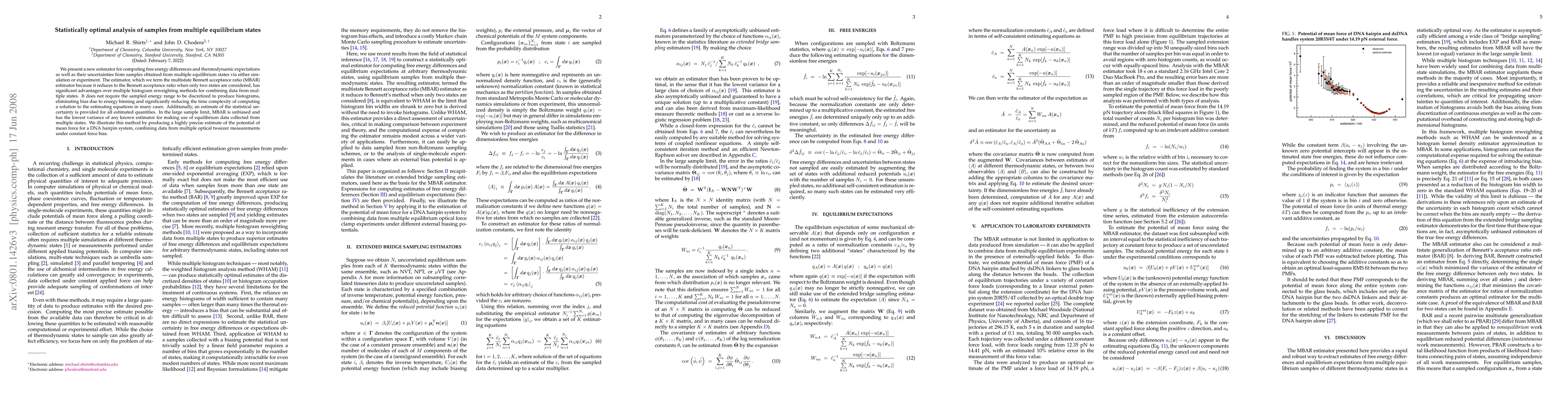
We present a new estimator for computing free energy differences and thermodynamic expectations as well as their uncertainties from samples obtained from multiple equilibrium states via either simulation or experiment. The estimator, which we term the multistate Bennett acceptance ratio (MBAR) estimator because it reduces to the Bennett acceptance ratio when only two states are considered, has significant advantages over multiple histogram reweighting methods for combining data from multiple states. It does not require the sampled energy range to be discretized to produce histograms, eliminating bias due to energy binning and significantly reducing the time complexity of computing a solution to the estimating equations in many cases. Additionally, an estimate of the statistical uncertainty is provided for all estimated quantities. In the large sample limit, MBAR is unbiased and has the lowest variance of any known estimator for making use of equilibrium data collected from multiple states. We illustrate this method by producing a highly precise estimate of the potential of mean force for a DNA hairpin system, combining data from multiple optical tweezer measurements under constant force bias.
AI Key Findings
Get AI-generated insights about this paper's methodology, results, significance, and more — available when analysis has been generated.
Discussion 0