Statistics of extremes in eigenvalue-counting staircases
Abstract
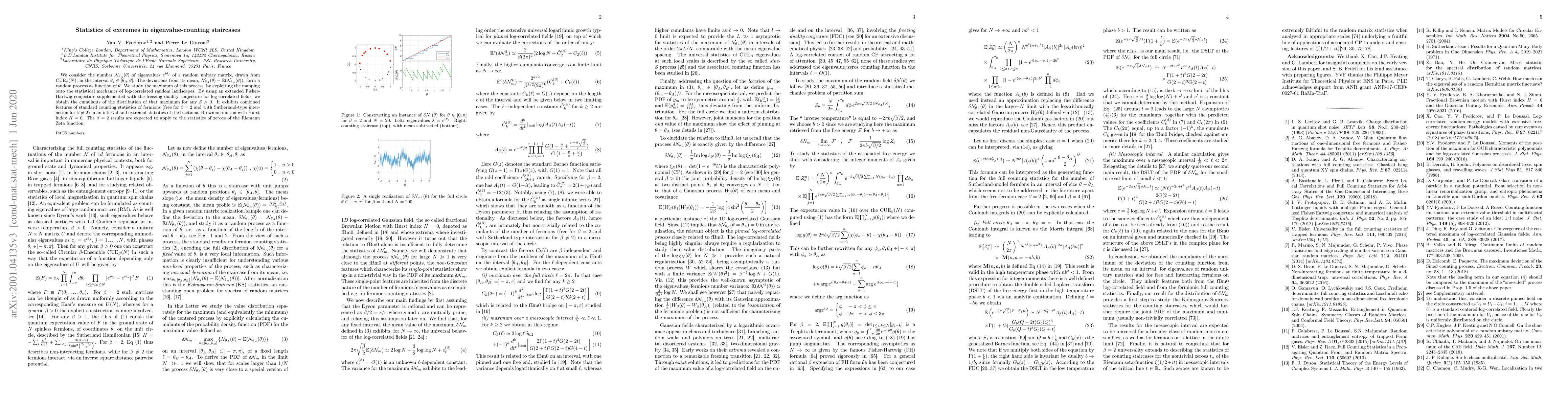
We consider the number ${\cal N}_{\theta_A}(\theta)$ of eigenvalues $e^{i \theta_j}$ of a random unitary matrix, drawn from CUE$_{\beta}(N)$, in the interval $\theta_j \in [\theta_A,\theta]$. The deviations from its mean, ${\cal N}_{\theta_A}(\theta) - \mathbb{E}({\cal N}_{\theta_A}(\theta))$, form a random process as function of $\theta$. We study the maximum of this process, by exploiting the mapping onto the statistical mechanics of log-correlated random landscapes. By using an extended Fisher-Hartwig conjecture for Toeplitz determinants, supplemented with the freezing duality conjecture for log-correlated fields, we obtain the cumulants of the distribution of that maximum for any $\beta>0$. It exhibits combined features of standard counting statistics of fermions (free for $\beta=2$ and with Sutherland-type interaction for $\beta\ne 2$) in an interval and extremal statistics of the fractional Brownian motion with Hurst index $H=0$. The $\beta=2$ results are expected to apply to the statistics of zeroes of the Riemann Zeta function
AI Key Findings
Get AI-generated insights about this paper's methodology, results, significance, and more — available when analysis has been generated.
Discussion 0