Structural Agreement Indicates Prediction Accuracy For Protein-Ligand Co-Folding
Abstract
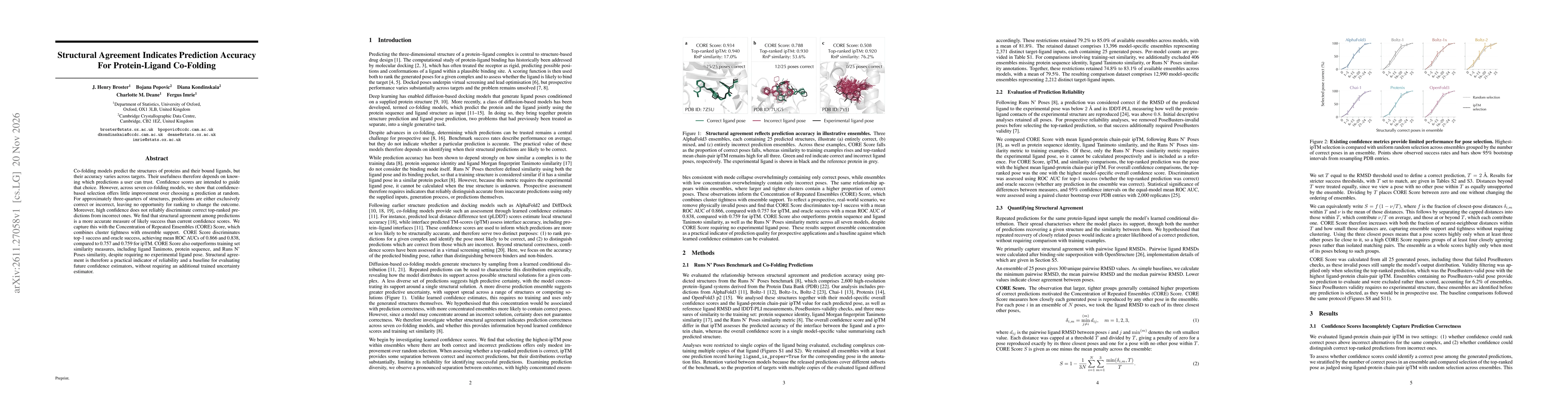
Co-folding models predict the structures of proteins and their bound ligands, but their accuracy varies across targets. Their usefulness therefore depends on knowing which predictions a user can trust. Confidence scores are intended to guide that choice. However, across seven co-folding models, we show that confidence-based selection offers little improvement over choosing a prediction at random. For approximately three-quarters of structures, predictions are either exclusively correct or incorrect, leaving no opportunity for ranking to change the outcome. Moreover, high confidence does not reliably discriminate correct top-ranked predictions from incorrect ones. We find that structural agreement among predictions is a more accurate measure of likely success than current confidence scores. We capture this with the Concentration of Repeated Ensembles (CORE) Score, which combines cluster tightness with ensemble support. CORE Score discriminates top-1 success and oracle success, achieving mean ROC AUCs of 0.866 and 0.838, compared to 0.757 and 0.759 for ipTM. CORE Score also outperforms training set similarity measures, including ligand Tanimoto, protein sequence, and Runs N' Poses similarity, despite requiring no experimental ligand pose. Structural agreement is therefore a practical indicator of reliability and a baseline for evaluating future confidence estimators, without requiring an additional trained uncertainty estimator.
Analysis
AI-generated · verify against the original paper
Generated Jan 1, 0001ResultsWhat the authors found
- Confidence‑based selection improves prediction success only marginally over random choice.
- For roughly 75% of targets all predictions are either uniformly correct or uniformly incorrect, limiting the benefit of ranking.
- High confidence scores (ipTM) do not reliably separate correct from incorrect top‑ranked predictions.
- The CORE Score discriminates top‑1 success with a mean ROC AUC of 0.866 and oracle success with 0.838, outperforming ipTM (0.757 and 0.759).
- CORE also surpasses training‑set similarity measures (ligand Tanimoto, protein sequence, Runs N’ Poses) despite requiring no experimental ligand pose.
LimitationsWhere the findings need caution
- A concentrated ensemble may still correspond to an incorrect solution, so high CORE scores do not guarantee correctness.
- The analysis relies on available ensembles; performance may vary with different sampling strategies or model architectures.
MethodologyHow the work was done
The authors evaluated seven protein‑ligand co‑folding models by generating ensembles of predictions, computing learned confidence scores (e.g., ipTM) and a new Concentration of Repeated Ensembles (CORE) Score that combines cluster tightness with ensemble support, and assessing discrimination performance using ROC AUC across top‑1 and oracle success metrics.
SignificanceWhy the work matters
Structural agreement among ensemble predictions provides a practical, model‑agnostic indicator of reliability that can serve as a baseline for future confidence estimators without additional training.
Technical contributionsWhat the work introduces
Introduction of the Concentration of Repeated Ensembles (CORE) Score, which quantifies structural agreement by merging cluster tightness and ensemble support to assess co‑folding prediction accuracy without extra training.
NoveltyHow it differs from prior work
Demonstrating that structural agreement across co‑folding model ensembles is a more accurate predictor of success than existing learned confidence scores or training‑set similarity metrics.
Future workQuestions that remain
- Develop and benchmark new confidence estimators that build on the CORE framework.
- Integrate structural agreement metrics with learned uncertainty models to further improve prediction reliability.
Discussion 0