Structurally Different, Functionally Persistent: Capability Regions Under Model Optimization
Abstract
Large language model (LLM) capabilities have been associated with localized parameter regions, enabling targeted model editing and intervention. However, it remains unclear whether a region identified before model optimization remains an effective intervention target afterward. We evaluate the functional persistence and parameter overlap of coding capability regions across three instruction-tuned models under quantization, pruning, and LoRA-based adaptation. Although re-extracted regions exhibit substantial parameter reorganization, ablating the original region after optimization eliminates or nearly eliminates coding performance in almost all conditions, while magnitude-matched controls preserve performance. Partition analysis further shows that the shared subset of the original and re-extracted regions accounts for most of the observed ablation effect in the majority of conditions. These results demonstrate that parameter overlap and functional persistence are distinct: capability regions can remain causally effective intervention targets even when their parameter realization changes substantially.
Analysis
AI-generated · verify against the original paper
Generated Jan 1, 0001ResultsWhat the authors found
- Ablating the original capability region after model optimization eliminates or nearly eliminates coding performance in almost all conditions, while magnitude‑matched control ablations preserve performance.
- Re‑extracted regions exhibit substantial parameter reorganization, yet the shared subset between original and re‑extracted regions accounts for the majority of the observed ablation effect.
- Functional persistence of coding capability is observed despite low parameter overlap, indicating that capability regions can remain effective intervention targets after optimization.
LimitationsWhere the findings need caution
- The experiments focus solely on coding capability and three instruction‑tuned models, limiting generalizability to other tasks or model families.
- Only a limited set of optimization techniques (quantization, pruning, LoRA) are examined, leaving other possible transformations untested.
MethodologyHow the work was done
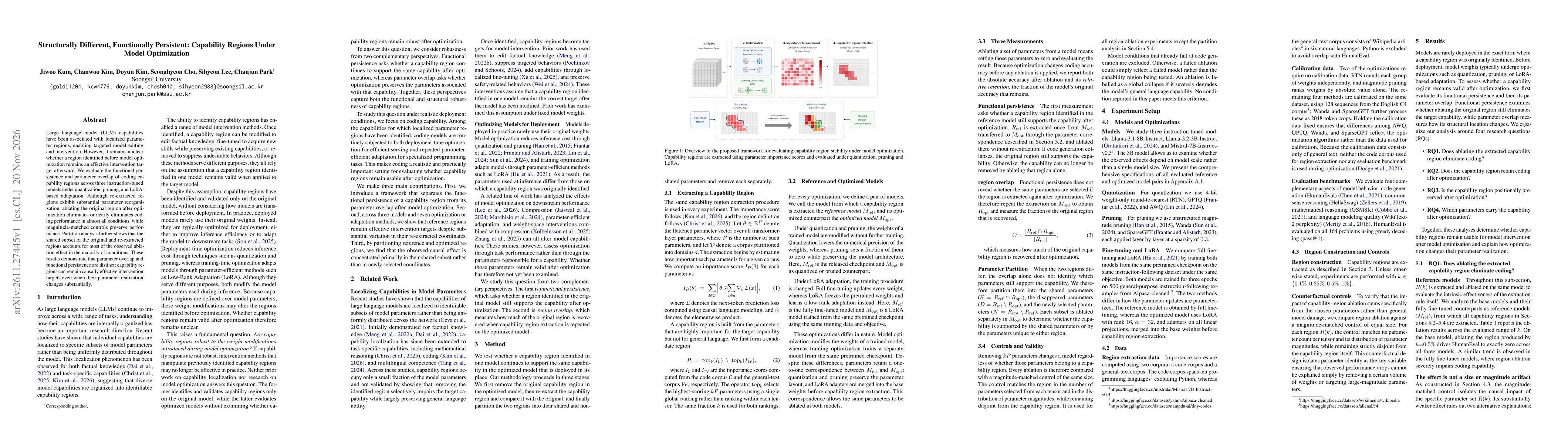
The study follows a three-stage pipeline: (1) ablate the original coding capability region in the optimized model, (2) re‑extract the capability region from the optimized model, and (3) partition the original and re‑extracted regions into shared, disappeared, and newly selected subsets to assess functional persistence versus parameter overlap across three instruction‑tuned models and seven optimization/adaptation methods (quantization, pruning, LoRA).
SignificanceWhy the work matters
These findings reveal that capability regions are functionally robust to deployment‑time optimizations, enabling reliable model editing and safety interventions even when the underlying parameter instantiation changes dramatically.
Technical contributionsWhat the work introduces
Introduces a framework that separates functional persistence from parameter overlap for capability regions, provides systematic evaluation across multiple models and optimization methods, and employs partition‑based ablation analysis to pinpoint the causal role of shared parameters.
NoveltyHow it differs from prior work
Demonstrates that functional persistence and parameter overlap are distinct properties, showing that capability regions can remain causally effective intervention targets despite substantial structural changes induced by model optimization.
Discussion 0