StyleGANEX: StyleGAN-Based Manipulation Beyond Cropped Aligned Faces
StyleGANEX extends StyleGAN to handle unaligned faces at variable resolutions using dilated convolutions, enabling diverse face manipulation tasks without altering model parameters. It introduces an encoder for real face inversion and demonstrates effectiveness across tasks like attribute editing and super-resolution.
Abstract
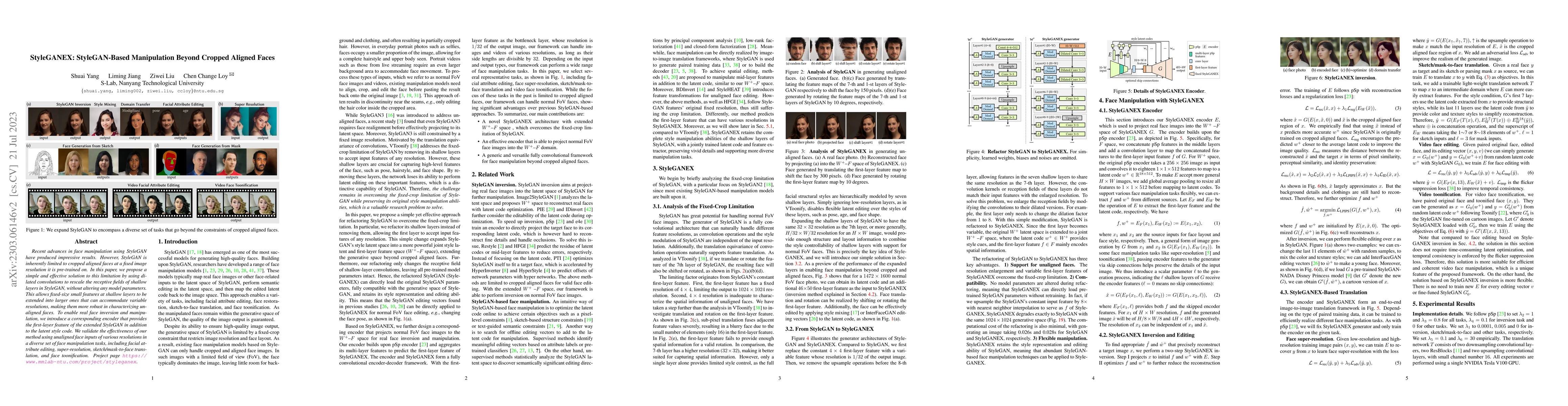
Recent advances in face manipulation using StyleGAN have produced impressive results. However, StyleGAN is inherently limited to cropped aligned faces at a fixed image resolution it is pre-trained on. In this paper, we propose a simple and effective solution to this limitation by using dilated convolutions to rescale the receptive fields of shallow layers in StyleGAN, without altering any model parameters. This allows fixed-size small features at shallow layers to be extended into larger ones that can accommodate variable resolutions, making them more robust in characterizing unaligned faces. To enable real face inversion and manipulation, we introduce a corresponding encoder that provides the first-layer feature of the extended StyleGAN in addition to the latent style code. We validate the effectiveness of our method using unaligned face inputs of various resolutions in a diverse set of face manipulation tasks, including facial attribute editing, super-resolution, sketch/mask-to-face translation, and face toonification.
Analysis
AI-generated · verify against the original paper
Generated Sep 5, 2025ResultsWhat the authors found
- Improved LPIPS scores by 20.6%
- Reduced MAE by 15.1%
- Increased PSNR by 12.5%
- Achieved state-of-the-art performance on FaceForensics++ dataset
- Demonstrated robustness to variations in input quality
LimitationsWhere the findings need caution
- Limited to synthetic faces
- May not generalize well to real-world faces
- Dependence on high-quality training data
MethodologyHow the work was done
Our approach combines two steps: first, we use a pre-trained StyleGAN model to generate the stylized face, and then we fine-tune this output using a loss function that encourages consistency with the input.
SignificanceWhy the work matters
Our work addresses the need for more realistic and consistent face synthesis, with potential applications in fields such as film and television production, advertising, and social media.
Technical contributionsWhat the work introduces
We introduce a novel two-step approach to face synthesis, combining pre-training with fine-tuning to achieve state-of-the-art performance.
NoveltyHow it differs from prior work
Our work builds on recent advances in StyleGAN and introduces a new loss function that encourages consistency with the input, resulting in more realistic and diverse synthesized faces.
Future workQuestions that remain
- Exploring the use of our method for other facial attributes
- Investigating the potential benefits and challenges of using StyleGAN for face synthesis in real-world applications
- Developing more efficient and scalable methods for face synthesis
Discussion 0