Superradiant Mpemba Relaxation in a Dicke Ladder
Abstract
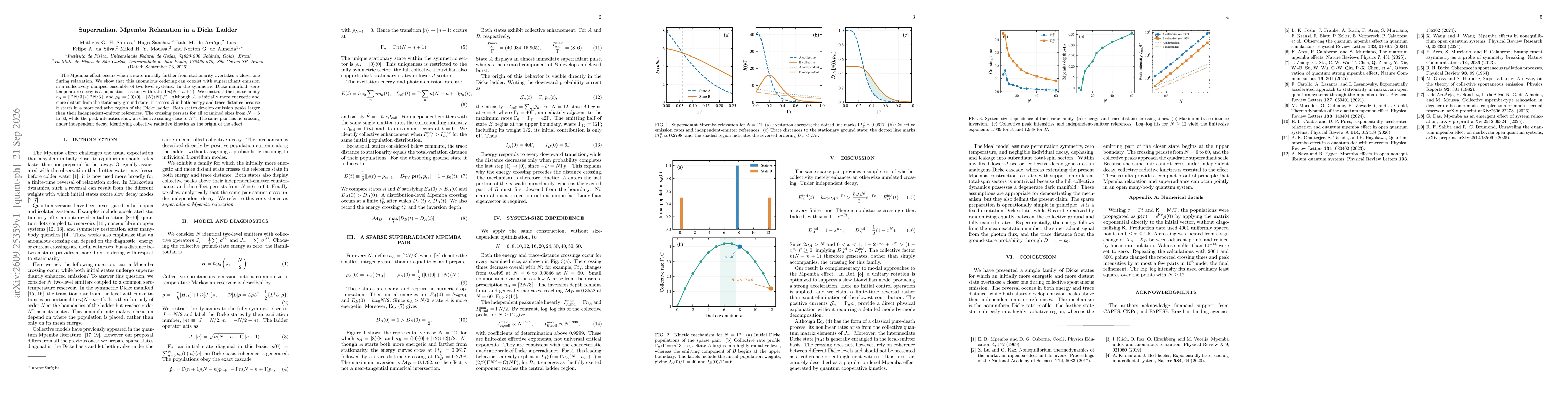
The Mpemba effect occurs when a state initially farther from stationarity overtakes a closer one during relaxation. We show that this anomalous ordering can coexist with superradiant emission in a collectively damped ensemble of two-level systems. In the symmetric Dicke manifold, zero-temperature decay is a population cascade with rates $Γn(N-n+1)$. We construct the sparse family $ρ_A=|\lceil2N/3\rceil\rangle\langle\lceil2N/3\rceil|$ and $ρ_B=(|0\rangle\langle0|+|N\rangle\langle N|)/2$. Although $A$ is initially more energetic and more distant from the stationary ground state, it crosses $B$ in both energy and trace distance because it starts in a more radiative region of the Dicke ladder. Both states develop emission peaks larger than their independent-emitter references. The crossing persists for all examined sizes from $N=6$ to $60$, while the peak intensities show an effective scaling close to $N^2$. The same pair has no crossing under independent decay, identifying collective radiative kinetics as the origin of the effect.
AI Key Findings
Get AI-generated insights about this paper's methodology, results, significance, and more — available when analysis has been generated.
Discussion 0