Surf-Style: Surface-Based Scene Stylization
Abstract
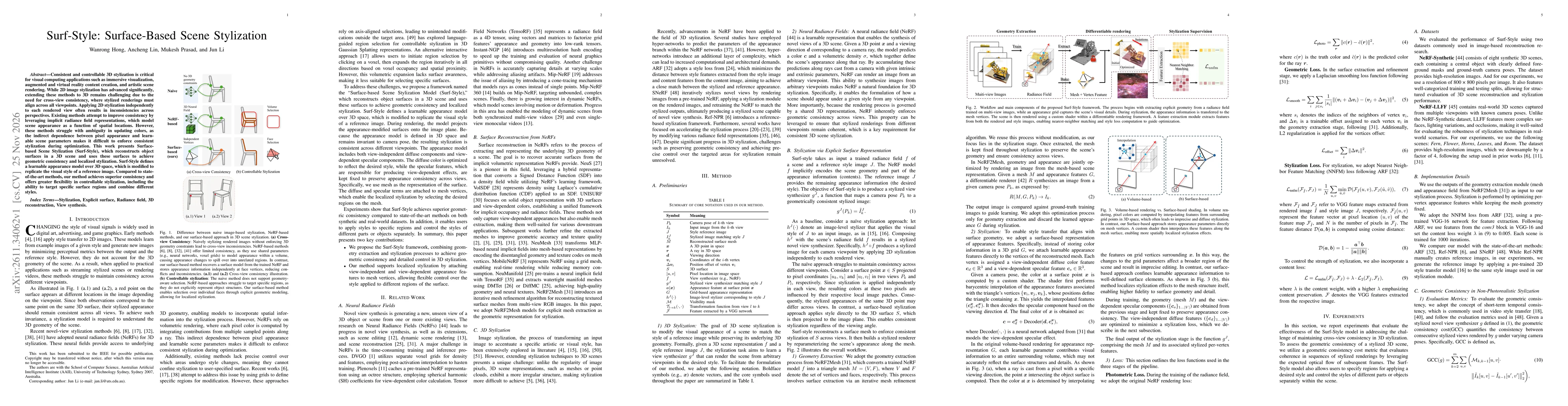
Consistent and controllable 3D stylization is critical for visual computing applications such as immersive visualization, augmented and virtual reality content creation, and artistic scene rendering. While 2D image stylization has advanced significantly, extending these methods to 3D remains challenging due to the need for cross-view consistency, where stylized renderings must align across all viewpoints. Applying 2D stylization independently to each rendered view often results in inconsistencies across perspectives. Existing methods attempt to improve consistency by leveraging implicit radiance field representations, which model scene appearance as a function of spatial locations. However, these methods struggle with ambiguity in updating colors, as the indirect dependence between pixel appearance and learnable scene parameters makes it difficult to enforce consistent stylization during optimization. This work presents Surface-based Scene Stylization (Surf-Style), which reconstructs object surfaces in a 3D scene and uses these surfaces to achieve geometric consistency and localized stylization. Surf-Style defines a learnable appearance model over 3D space, which is modified to replicate the visual style of a reference image. Compared to state-of-the-art methods, our method achieves superior consistency and offers greater flexibility in controllable stylization, including the ability to target specific surface regions and combine different styles.
Analysis
AI-generated · verify against the original paper
Generated Jan 1, 0001ResultsWhat the authors found
- Achieves superior cross‑view consistency compared to state‑of‑the‑art NeRF‑based stylization methods on synthetic and real‑world datasets.
- Enables localized, controllable stylization of specific surface regions by attaching appearance features to mesh vertices.
- Demonstrates both qualitative and quantitative improvements in consistency and flexibility over existing approaches.
MethodologyHow the work was done
Surf-Style reconstructs object surfaces from a trained NeRF using mesh extraction (NeRF2Mesh) and defines a learnable appearance model over 3D space that is attached to mesh vertices, modifying diffuse colors to replicate a reference style while keeping specular components fixed, enabling consistent rendering across viewpoints and localized stylization via vertex selection.
SignificanceWhy the work matters
Provides a practical solution for consistent and controllable 3D scene stylization, addressing the major limitation of view inconsistency in prior 2D‑style‑transfer and NeRF‑based methods, and expands artistic control for AR/VR and immersive content creation.
Technical contributionsWhat the work introduces
Introduces a surface‑based scene stylization framework that combines explicit geometry extraction with a vertex‑wise learnable appearance model, allowing independent control of diffuse and specular components for consistent and region‑specific style transfer.
NoveltyHow it differs from prior work
First method to leverage explicit mesh surfaces for 3D stylization, moving beyond volumetric NeRF representations to achieve geometric consistency and fine‑grained control over stylized regions.
Discussion 0