SurgeCount: A Protocol-Guided Composition Harness for Bimanual Surgical Sponge Counting
Abstract
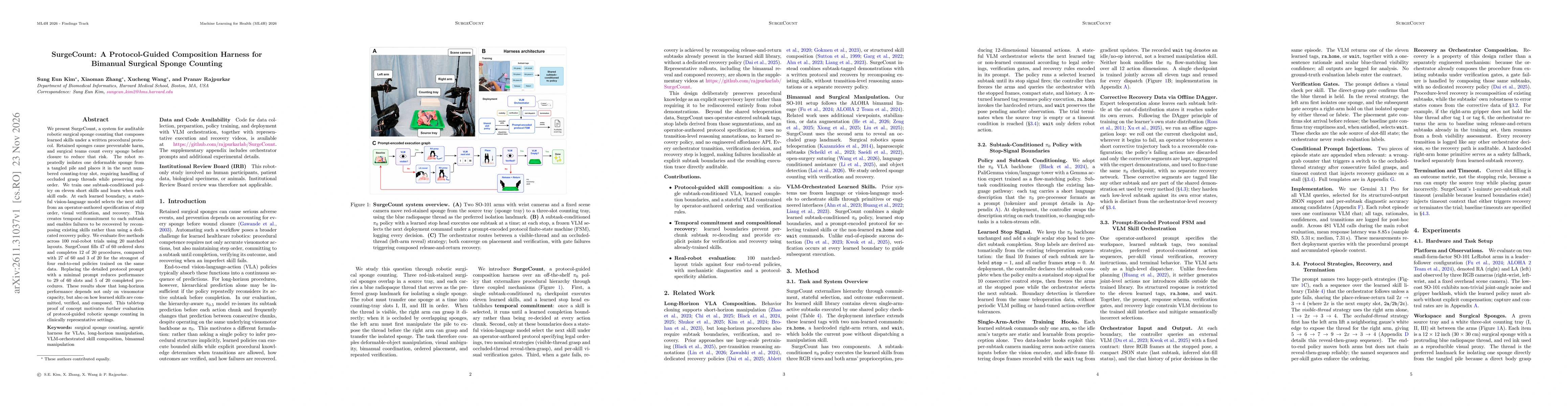
We present SurgeCount, a system for auditable robotic surgical sponge counting that composes learned skills under a written procedural protocol. Retained sponges cause preventable harm, and surgical teams count every sponge before closure to reduce that risk. The robot repeatedly isolates one deformable sponge from a tangled pile and places it in the next numbered counting-tray slot, requiring handling of occluded grasp threads while preserving step order. We train one subtask-conditioned policy on eleven short skills and learn when each skill ends. At each learned boundary, a stateful vision-language model selects the next skill from an operator-authored specification of step order, visual verification, and recovery. This creates temporal commitment to each subtask and enables failures to be recovered by recomposing existing skills rather than using a dedicated recovery policy. We evaluate five methods across 100 real-robot trials using 20 matched layouts. SurgeCount fills 47 of 60 ordered slots and completes 12 of 20 procedures, compared with 27 of 60 and 3 of 20 for the strongest of four end-to-end policies trained on the same data. Replacing the detailed protocol prompt with a minimal prompt reduces performance to 29 of 60 slots and 5 of 20 completed procedures. These results show that long-horizon performance depends not only on visuomotor capacity, but also on how learned skills are committed, verified, and composed. This tabletop proof of concept motivates further evaluation of protocol-guided robotic sponge counting in clinically representative settings.
Analysis
AI-generated · verify against the original paper
Generated Jan 1, 0001ResultsWhat the authors found
- SurgeCount filled 47 of 60 ordered slots and completed 12 of 20 procedures in 100 real‑robot trials.
- The strongest end‑to‑end baseline filled 27 of 60 slots and completed 3 of 20 procedures.
- Using a minimal protocol prompt reduced performance to 29 of 60 slots and 5 of 20 completed procedures.
LimitationsWhere the findings need caution
- Evaluation was limited to a tabletop proof‑of‑concept with 20 matched layouts and 100 trials.
- The study involved only robot‑only experiments with no human participants or clinical data.
MethodologyHow the work was done
SurgeCount uses a subtask‑conditioned policy trained on eleven short skills with learned stop boundaries, combined with a stateful vision‑language model that selects the next skill based on an operator‑authored procedural protocol, enabling temporal commitment, visual verification, and recovery by recomposing existing skills.
SignificanceWhy the work matters
The results demonstrate that long‑horizon robotic performance relies not only on visuomotor capability but also on how learned skills are temporally committed, verified, and composed under explicit procedural guidance.
Technical contributionsWhat the work introduces
Integration of a subtask‑conditioned policy with a stateful vision‑language orchestrator that enforces protocol‑driven skill sequencing, verification gates, and compositional recovery without dedicated recovery policies.
NoveltyHow it differs from prior work
First protocol‑guided composition harness for bimanual surgical sponge counting that combines learned short‑skill policies with explicit procedural knowledge for long‑horizon task execution.
Future workQuestions that remain
- Conduct further evaluation of protocol‑guided robotic sponge counting in clinically representative settings.
Discussion 0