Symmetry-Resolved Criticality in Dissipative Quantum Phase Transitions
Abstract
Symmetry breaking in mixed quantum states exhibits a rich strong-to-weak hierarchy, yet the use of symmetry as an operational probe of dissipative criticality remains largely unexplored. In this work, we develop a symmetry-based framework that connects semiclassical phase space, trajectory-level dynamics, and ensemble responses, and demonstrate it in the two-dimensional dissipative XYZ model. We show that symmetry breaking manifests semiclassically as a bifurcation of the Husimi-Q distribution and dynamically as a sharp change in a trajectory-level symmetry residual. At the ensemble level, the weak-symmetry sensitivity to a perturbed symmetry operator exhibits pronounced finite-size scaling, yielding an estimate of the dissipative critical point. Finally, we propose a trajectory-based quantum-circuit algorithm in which mid-circuit measurements condition quantum jumps and allow the proposed indicators to be extracted from circuit observables. Our work provides a symmetry-centered route to diagnosing dissipative phase transitions and critical scaling in open quantum many-body systems.
Analysis
AI-generated · verify against the original paper
Generated Jan 1, 0001ResultsWhat the authors found
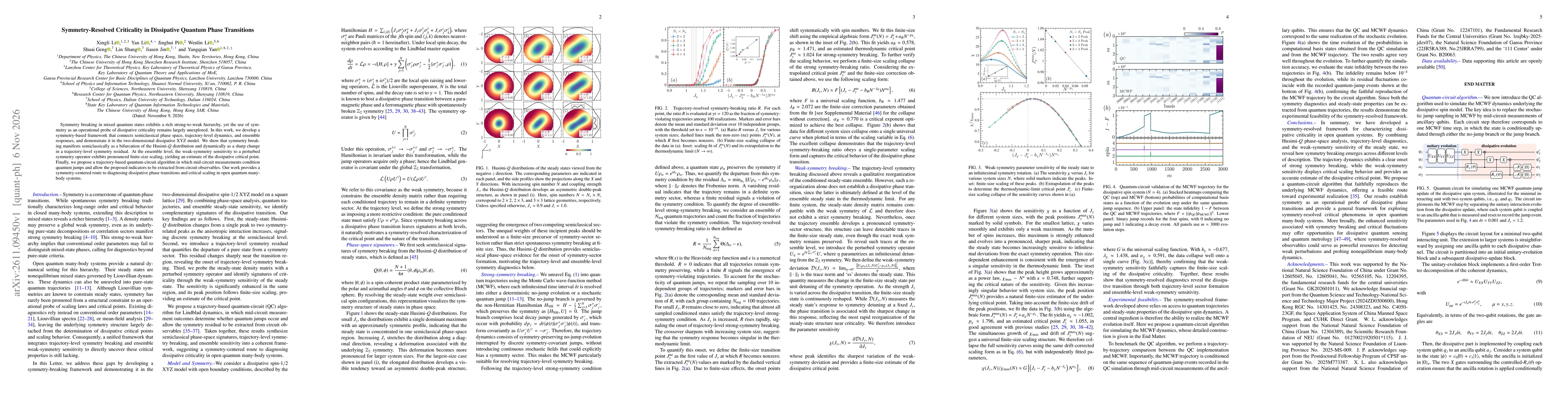
- The steady‑state Husimi‑Q distribution changes from a single peak to a symmetric double‑peak as the anisotropic coupling Jy increases, signalling semiclassical symmetry breaking.
- A trajectory‑level symmetry residual (ratio R) exhibits a sharp increase near the transition, shows finite‑size scaling collapse, and provides an estimate of the critical point.
- The weak‑symmetry sensitivity χ of the steady‑state density matrix displays a pronounced peak that sharpens with system size, also obeys finite‑size scaling and yields a consistent critical point estimate.
- The proposed quantum‑circuit algorithm successfully extracts the trajectory‑level symmetry residual from circuit observables via conditioned mid‑circuit measurements.
LimitationsWhere the findings need caution
- Finite‑size effects are significant for the smallest cluster (N=4), leading to deviations in scaling analyses.
- The framework is demonstrated only for the XYZ model with a global Z2 symmetry, limiting immediate generality.
- Implementation of the quantum‑circuit algorithm requires mid‑circuit measurement capabilities that may be challenging on current hardware.
MethodologyHow the work was done
We develop a symmetry‑resolved framework that links semiclassical phase‑space analysis (Husimi‑Q distribution), trajectory‑level dynamics via Monte‑Carlo wave‑function unraveling, and ensemble weak‑symmetry sensitivity, and we demonstrate it on the 2D dissipative XYZ model; additionally we propose a trajectory‑based quantum‑circuit algorithm using mid‑circuit measurements to extract symmetry indicators.
SignificanceWhy the work matters
The work provides a symmetry‑centered operational probe for diagnosing dissipative quantum phase transitions and critical scaling in open many‑body systems, unifying semiclassical, trajectory, and ensemble perspectives.
Technical contributionsWhat the work introduces
A unified symmetry‑resolved diagnostic combining phase‑space Husimi‑Q analysis, quantum‑trajectory symmetry residuals, and weak‑symmetry ensemble response, together with a novel trajectory‑based quantum‑circuit algorithm for extracting these indicators.
NoveltyHow it differs from prior work
First operational use of symmetry breaking as a probe of dissipative criticality, integrating semiclassical, trajectory‑level, and ensemble weak‑symmetry analyses, and introducing a trajectory‑based quantum‑circuit method to access these diagnostics.
Future workQuestions that remain
- Apply the symmetry‑resolved framework to other models and symmetry groups beyond Z2.
- Scale up the quantum‑circuit implementation to larger system sizes and explore error‑mitigation strategies.
- Investigate continuous‑time measurement schemes and the interplay of strong versus weak symmetries in higher dimensions.
Discussion 0