TaCo: Rethinking Correlation for Visual Tracking on Edge Devices
Abstract
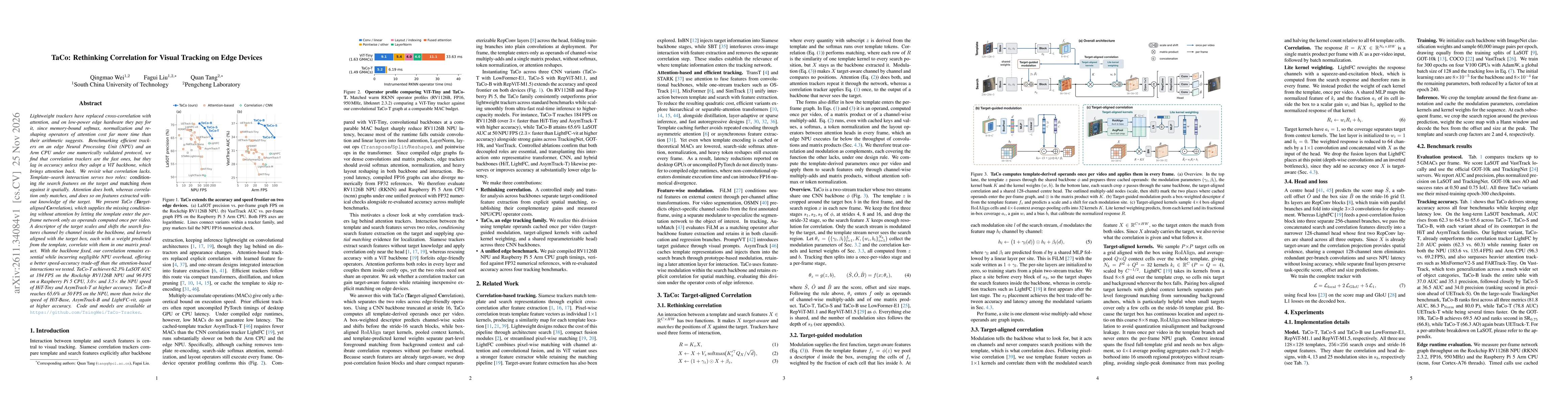
Lightweight trackers have replaced cross-correlation with attention, and on low-power edge hardware they pay for it, since memory-bound softmax, normalization and reshaping operators of attention cost far more time than their arithmetic suggests. Benchmarking efficient trackers on an edge Neural Processing Unit (NPU) and an Arm CPU under one numerically validated protocol, we find that correlation trackers are the fast ones, but they lag in accuracy unless they adopt a ViT backbone, which brings attention back. We revisit what correlation lacks. Template--search interaction serves two roles: conditioning the search features on the target and matching them against it spatially. Attention does both, whereas correlation only matches, and does so on features extracted without knowledge of the target. We present TaCo (Target-aligned Correlation), which supplies the missing conditioning without attention by letting the template enter the per-frame network only as operands computed once per video. A descriptor of the target scales and shifts the search features channel by channel inside the backbone, and kernels aligned with the target box, each with a weight predicted from the template, correlate with them in one matrix product. With the backbone fixed, our correlation remains essential while incurring negligible NPU overhead, offering a better speed-accuracy trade-off than the attention-based interactions we tested. TaCo-T achieves 62.3% LaSOT AUC at 184 FPS on the Rockchip RV1126B NPU and 96 FPS on a Raspberry Pi 5 CPU, 3.0x and 3.5x the NPU speed of HiT-Tiny and AsymTrack-T at higher accuracy. TaCo-B reaches 65.6% at 50 FPS on the NPU, more than twice the speed of HiT-Base, AsymTrack-B and LightFC-vit, again at higher accuracy. Code and models are available at https://github.com/TsingWei/TaCo-Tracker.
Analysis
AI-generated · verify against the original paper
Generated Jan 1, 0001ResultsWhat the authors found
- TaCo-T achieves 62.3% LaSOT AUC at 184 FPS on the Rockchip RV1126B NPU and 96 FPS on a Raspberry Pi 5 CPU, 3.0× and 3.5× faster than HiT-Tiny and AsymTrack-T respectively, with higher accuracy.
- TaCo-B reaches 65.6% LaSOT AUC at 50 FPS on the NPU, more than twice the speed of HiT-Base, AsymTrack-B, and LightFC-vit while also improving accuracy.
- Operator profiling shows TaCo incurs negligible NPU overhead compared to attention-based trackers, eliminating costly softmax, normalization, and reshaping operations.
MethodologyHow the work was done
The authors benchmark lightweight visual trackers on an edge NPU and Arm CPU using a unified protocol, then propose TaCo (Target-aligned Correlation) which decouples target conditioning and spatial matching by computing template-derived operands once per video and integrating them as channel-wise scaling, shifting, and target-aligned kernels within a fixed CNN backbone, avoiding attention mechanisms.
SignificanceWhy the work matters
TaCo demonstrates that correlation can be made target-aware without attention, delivering a superior speed‑accuracy trade‑off for visual tracking on low‑power edge devices, and establishes a unified benchmarking methodology for edge NPUs and CPUs.
Technical contributionsWhat the work introduces
TaCo introduces a template‑guided modulation of search features channel‑wise and target‑aligned convolutional kernels whose weights are predicted from the template, enabling per‑frame correlation via a single matrix product while keeping the backbone fixed and avoiding expensive attention operators.
NoveltyHow it differs from prior work
The work rethinks correlation by separating conditioning and matching roles, providing target‑aware features through cached template operands rather than attention, and validates this approach on real edge hardware with a comprehensive performance analysis.
Discussion 0