Tasklets: A Unit-Test Benchmark for Language Model Architectures
Abstract
We introduce Tasklets, a benchmark of small synthetic tasks for evaluating the computational capabilities of language model sequence-mixing layers. These tasks probe foundational capabilities such as recall, sequence manipulation, and state tracking. Such tasks are widely used in architecture research, but differences in task selection, formulation, and evaluation make comparisons across studies difficult. Tasklets brings these tasks together, organizing them by the capabilities they test and providing a shared setup for evaluating how different architectural layer types learn fundamental computations. We compare a broad range of layer types through controlled experiments with small models. Our task implementations and evaluation code support reproducible, low-cost testing of new architectural proposals: https://github.com/zaydzuhri/flame/tree/tasklets.
Analysis
AI-generated · verify against the original paper
Generated Jan 1, 0001ResultsWhat the authors found
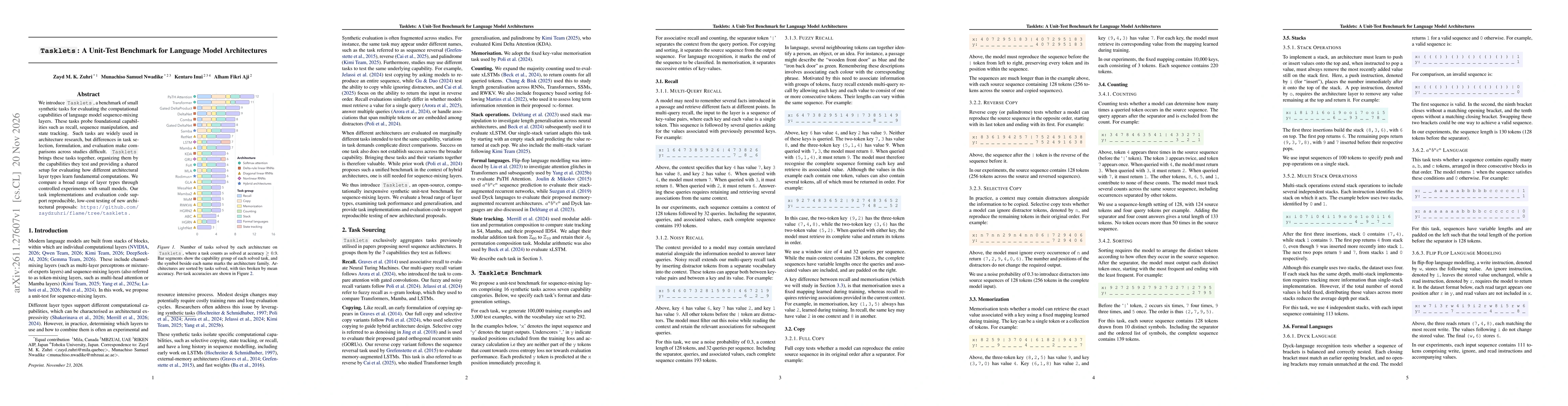
- A broad range of layer architectures were evaluated, revealing that softmax‑attention Transformers solved the most tasks, while many specialized mixers (e.g., Delta‑rule linear RNNs, GatedDeltaNet) solved fewer.
- Task performance varied systematically with architectural expressivity, allowing the authors to rank architectures by the number of tasks solved and mean accuracy.
- The benchmark demonstrated that modest design changes can lead to significant differences in computational capability across tasks.
LimitationsWhere the findings need caution
- The benchmark relies exclusively on synthetic tasks, which may not capture all nuances of real‑world language modeling.
- Experiments were limited to small‑scale models and a fixed hyperparameter regime, potentially restricting generalization to larger architectures.
MethodologyHow the work was done
The authors aggregated 16 synthetic tasks from prior work, grouped them by seven capability categories, and implemented a unified benchmark (Tasklets) with a shared data generation pipeline (100k training and 3k test examples per task). They conducted controlled experiments training small language models of various sequence-mixing layer types using a fixed hyperparameter schedule, early stopping, and evaluated task accuracy (≥0.9 considered solved). All code and task implementations are released open‑source for reproducibility.
SignificanceWhy the work matters
Tasklets provides the first open‑source, low‑cost unit‑test suite that standardizes evaluation of sequence‑mixing layers, enabling reproducible and comparable assessments of architectural expressivity across the research community.
Technical contributionsWhat the work introduces
Creation of a unified synthetic task suite (Tasklets) with standardized data generation, evaluation metrics, and open‑source implementations, together with a systematic experimental protocol for comparing diverse sequence‑mixing layer types.
NoveltyHow it differs from prior work
Introducing the first comprehensive, open‑source benchmark that consolidates fragmented synthetic tasks into a single, capability‑organized suite specifically for assessing sequence‑mixing layers in language models.
Future workQuestions that remain
- Extend Tasklets with additional tasks and capability categories, including more complex reasoning and long‑range dependencies.
- Evaluate larger models and alternative training regimes to assess scalability of the observed trends.
- Integrate downstream language modeling benchmarks to correlate unit‑test performance with real‑world task success.
Discussion 0