Testing horizon topology with electromagnetic observations
Abstract
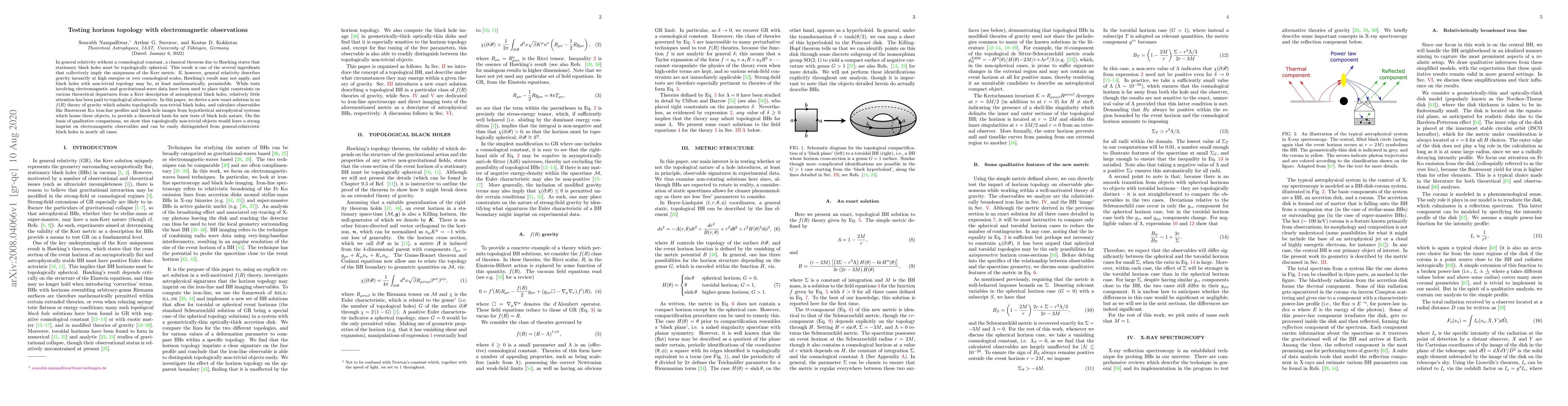
In general relativity without a cosmological constant, a classical theorem due to Hawking states that stationary black holes must be topologically spherical. This result is one of the several ingredients that collectively imply the uniqueness of the Kerr metric. If, however, general relativity describes gravity inexactly at high energies or over cosmological scales, Hawking's result may not apply, and black holes with non-trivial topology may be, at least mathematically, permissible. While tests involving electromagnetic and gravitational-wave data have been used to place tight constraints on various theoretical departures from a Kerr description of astrophysical black holes, relatively little attention has been paid to topological alternatives. In this paper, we derive a new exact solution in an $f(R)$ theory of gravity which admits topologically non-trivial black holes, and calculate observables like fluorescent K$\alpha$ iron-line profiles and black hole images from hypothetical astrophysical systems which house these objects, to provide a theoretical basis for new tests of black hole nature. On the basis of qualitative comparisons, we show that topologically non-trivial objects would leave a strong imprint on electromagnetic observables and can be easily distinguished from general-relativistic black holes in nearly all cases.
AI Key Findings
Get AI-generated insights about this paper's methodology, results, significance, and more — available when analysis has been generated.
Discussion 0