Abstract
The string theory Swampland programme has resulted in distinct scenarios for the particle nature of dark matter. In this research note, I use combined cosmological probes to constrain the Dark Dimension scenario, which predicts that dark matter consists of decaying massive gravitons characterised by a time-dependent kick velocity. I first provide updated constraints using a combination of CMB and BAO data. I then produce forecasts for a Stage-IV tomographic survey, and outline strategies for predicting the model's behaviour on nonlinear scales. The results demonstrate the potential of surveys like Euclid and LSST to confirm or rule out string theory models of the dark sector.
Analysis
AI-generated · verify against the original paper
Generated Jul 17, 2026ResultsWhat the authors found
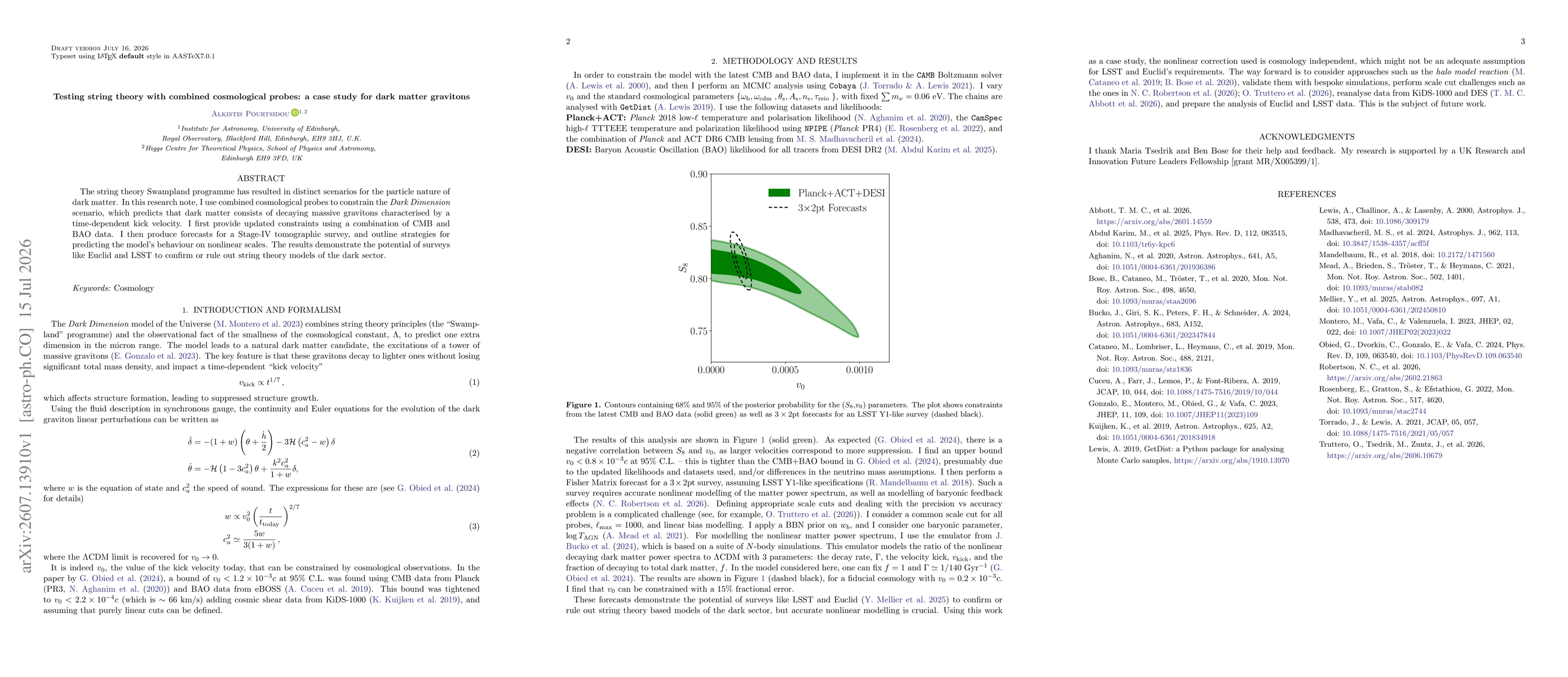
- CMB+BAO data constrain v0 to be below approximately 0.8×10⁻³ c at 95% CL, tighter than prior bounds from earlier work due to updated likelihoods and datasets.
- Forecasts for a Stage-IV 3×2pt survey with LSST-like specs show potential to constrain v0 with about 15% fractional error, highlighting the survey’s power to test the Dark Dimension model.
- An anti-correlation between S8 and v0 is recovered, indicating larger kick velocities suppress structure formation more strongly.
LimitationsWhere the findings need caution
- Nonlinear modeling relies on an emulator calibrated to N-body simulations, which may not capture all nonlinearities in the decaying dark matter framework.
- Assumes a single baryonic parameter and a fixed f=1, which may not reflect more complex decay fractions or baryonic feedback variations in real data.
- The analysis emphasizes linear-scale cuts up to ℓmax=1000; neglects potential information from smaller scales where baryonic and nonlinear effects are more significant.
MethodologyHow the work was done
Implemented a CAMB Boltzmann solver and performed MCMC analysis with Cobaya, varying v0 and standard cosmological parameters while fixing the sum of neutrino masses. Used Planck, ACT, DESI BAO data, and a 3×2pt Fisher forecast for an LSSTY1-like survey to derive constraints and forecast nonlinear behavior with a common scale cut and a single baryonic parameter, using an emulator to model the nonlinear matter power spectrum in the decaying dark matter scenario.
SignificanceWhy the work matters
Demonstrates that current and upcoming cosmological surveys (Planck, ACT, DESI, LSST/Euclid–like) can robustly test a string-theory motivated dark matter scenario, potentially confirming or ruling out decaying graviton models of the dark sector.
Technical contributionsWhat the work introduces
Integrated a decaying dark matter framework into a CAMB/Cobaya workflow, used a nonlinear emulator for the decaying-power spectrum, and produced both current constraint bounds and Stage-IV nonlinear forecasts within a consistent cosmological parameter space.
NoveltyHow it differs from prior work
First application of combined CMB and BAO data to constrain the Dark Dimension decaying graviton model, and the generation of nonlinear Stage-IV forecasts for this string-theory motivated dark matter scenario using an emulator-based approach.
Future workQuestions that remain
- Incorporate halo-model reactions and bespoke simulations to validate nonlinear corrections in the Dark Dimension scenario.
- Reanalyze KiDS-1000 and DES data with updated methodologies and prepare analyses for Euclid and LSST data with improved scale cuts.
- Extend modeling to explore a range of f (decaying fraction) and Γ values, and assess robustness to different neutrino mass assumptions.
Discussion 0