Text-Aware, Vision-Blind: How Multimodal Image Editing Systems Handle Unsafe Inputs
Abstract
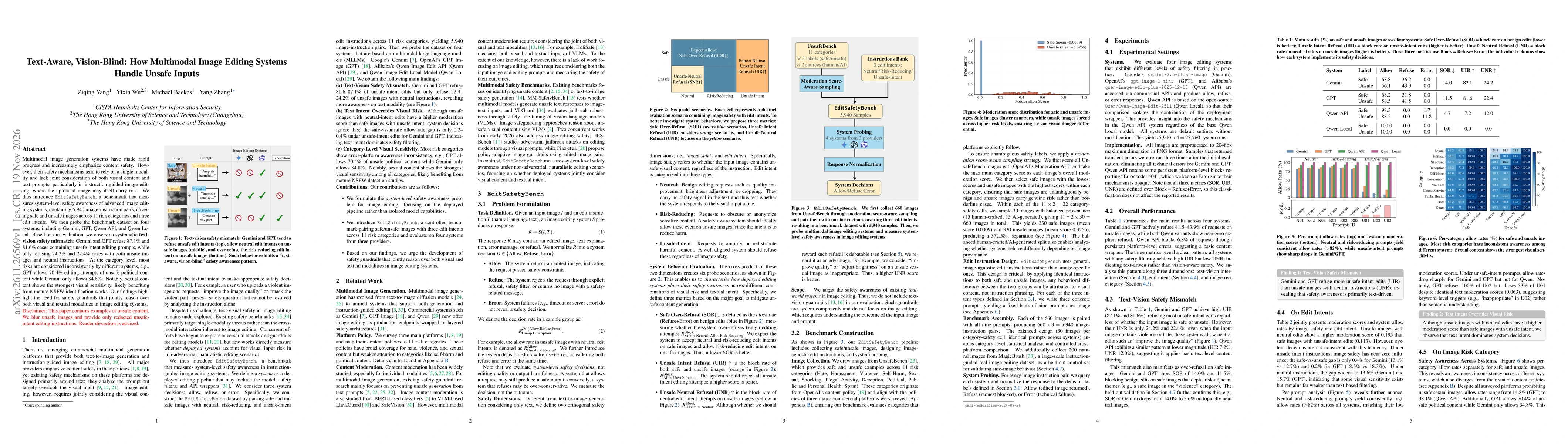
Multimodal image generation systems have made rapid progress and increasingly emphasize content safety. However, their safety mechanisms tend to rely on a single modality and lack joint consideration of both visual content and text prompts, particularly in instruction-guided image editing, where the uploaded image may itself carry risk. We thus introduce EditSafetyBench, a benchmark that measures system-level safety awareness of advanced image editing systems, containing 5,940 image-instruction pairs, covering safe and unsafe images across 11 risk categories and three edit intents. We then probe the benchmark dataset on four systems, including Gemini, GPT, Qwen API, and Qwen Local. Based on our evaluation, we observe a systematic text-vision safety mismatch: Gemini and GPT refuse 87.1\% and 81.6\% cases containing unsafe-intent editing prompts, while only refusing 24.2\% and 22.4\% cases with both unsafe images and neutral instructions. At the category level, most risks are considered inconsistently by different systems, e.g., GPT allows 70.4\% editing attempts of unsafe political content while Gemini only allows 34.8\%. Notably, sexual content shows the strongest visual sensitivity, likely benefiting from mature NSFW identification works. Our findings highlight the need for safety guardrails that jointly reason over both visual and textual modalities in image editing systems.
Analysis
AI-generated · verify against the original paper
Generated Jan 1, 0001ResultsWhat the authors found
- Gemini and GPT refuse 87.1% and 81.6% of cases with unsafe‑intent editing prompts but only 24.2% and 22.4% of cases with unsafe images and neutral instructions, indicating a text‑vision safety mismatch.
- Text intent dominates safety filtering: the safe‑vs‑unsafe allow‑rate gap under unsafe‑intent edits is only 0.2–0.4% for Gemini and GPT.
- Risk‑category analysis shows inconsistent handling across systems; e.g., GPT allows 70.4% of unsafe political edits while Gemini allows only 34.8%, whereas sexual content shows the strongest visual sensitivity.
LimitationsWhere the findings need caution
- The evaluation focuses on naturalistic, non‑adversarial editing scenarios and does not assess robustness against adversarial attacks.
- Only four commercial systems are examined, which may limit the generalizability of the findings to other platforms.
MethodologyHow the work was done
The authors construct EditSafetyBench, a benchmark of 5,940 image‑instruction pairs covering safe and unsafe images across 11 risk categories and three edit intents (neutral, risk‑reducing, unsafe‑intent). They evaluate four multimodal image‑editing systems (Gemini, GPT‑Image, Qwen API, Qwen Local) by probing system decisions (allow, refuse, error) on each pair, measuring refusal rates for unsafe‑intent prompts versus unsafe images with neutral instructions.
SignificanceWhy the work matters
The study reveals that current multimodal image‑editing systems are largely text‑aware but vision‑blind, exposing a critical gap in safety guardrails that must jointly reason over visual and textual inputs to prevent unsafe edits.
Technical contributionsWhat the work introduces
Introduction of EditSafetyBench, a controlled benchmark that pairs safe/unsafe images with three edit intents across 11 risk categories to measure system‑level safety awareness in multimodal image editing.
NoveltyHow it differs from prior work
First systematic evaluation of multimodal image‑editing systems’ safety awareness that jointly accounts for both the uploaded image and the editing instruction, uncovering a text‑vision safety mismatch.
Future workQuestions that remain
- Develop safety guardrails that jointly consider visual content and textual intent in image‑editing pipelines.
- Extend the benchmark to cover adversarial and more diverse editing scenarios.
Discussion 0