The acceptance-complement method revisited
Abstract
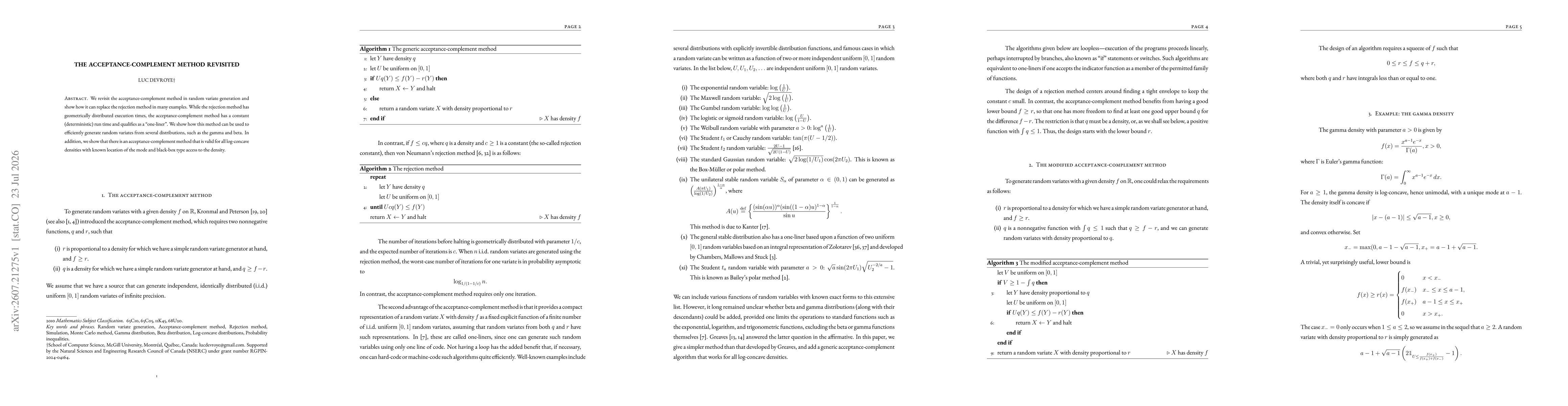
We revisit the acceptance-complement method in random variate generation and show how it can replace the rejection method in many examples. While the rejection method has geometrically distributed execution times, the acceptance-complement method has a constant (deterministic) run time and qualifies as a ``one-liner''. We show how this method can be used to efficiently generate random variates from several distributions, such as the gamma and beta. In addition, we show that there is an acceptance-complement method that is valid for all log-concave densities with known location of the mode and black-box type access to the density.
Analysis
AI-generated · verify against the original paper
Generated Jul 26, 2026ResultsWhat the authors found
- Acceptance-complement method can replace rejection in many cases, offering deterministic run time versus geometrically distributed time for rejection.
- For several distributions such as gamma and beta, the method enables efficient direct sampling with a single iteration per variate.
- There exists an acceptance-complement method valid for all log-concave densities with known mode location and black-box density access.
- Algorithmic formulations (one-liners) enable compact and potentially vectorized implementations of random variate generation.
LimitationsWhere the findings need caution
- Practical design of f, q, r and their normalizations may be nontrivial for complex densities.
- The method's guarantees rely on correct density access and suitable representations, which may not always be available or easy to construct.
- Empirical performance may vary across distributions and implementations, and the paper provides theoretical framing rather than exhaustive benchmarking.
- Extending the approach to high-dimensional or multimodal densities may encounter additional challenges not fully addressed.
MethodologyHow the work was done
The paper revisits the acceptance-complement method by outlining its theoretical framework, comparing it to the traditional rejection method, and illustrating its deterministic single-run-time property. It provides algorithmic descriptions (Algorithm 1: generic acceptance-complement, Algorithm 2: rejection) and discusses construction of f, q, r functions and density representations for practical variate generation. The work also extends to log-concave densities with known mode location and black-box density access, offering guidance on implementation and analysis of run-time characteristics.
SignificanceWhy the work matters
Provides a unifying framework that potentially reduces expected computational effort in random variate generation and offers deterministic timing, which is valuable for real-time or performance-critical simulations and for extending efficient sampling to broader classes of distributions.
Technical contributionsWhat the work introduces
Formalization and extension of the acceptance-complement method, including a unified algorithmic presentation, comparison with rejection, and extension to log-concave densities with practical considerations for deterministic run-time sampling.
NoveltyHow it differs from prior work
Revisits and broadens the applicability of the acceptance-complement framework, demonstrating deterministic runtime and one-liner implementations, and establishing validity for all log-concave densities with mode information and black-box access.
Future workQuestions that remain
- Develop automated guidelines for choosing f, q, r to optimize efficiency across diverse distributions.
- Extend empirical benchmarks comparing acceptance-complement against rejection in large-scale simulations.
- Explore adaptations to high-dimensional sampling and to densities lacking explicit mode locations.
- Investigate integration with existing random variate generator libraries and language-specific optimizations.
Discussion 0