The Bipartible Architecture Pattern: Transparently Directing HTTP Requests over InfiniBand
Abstract
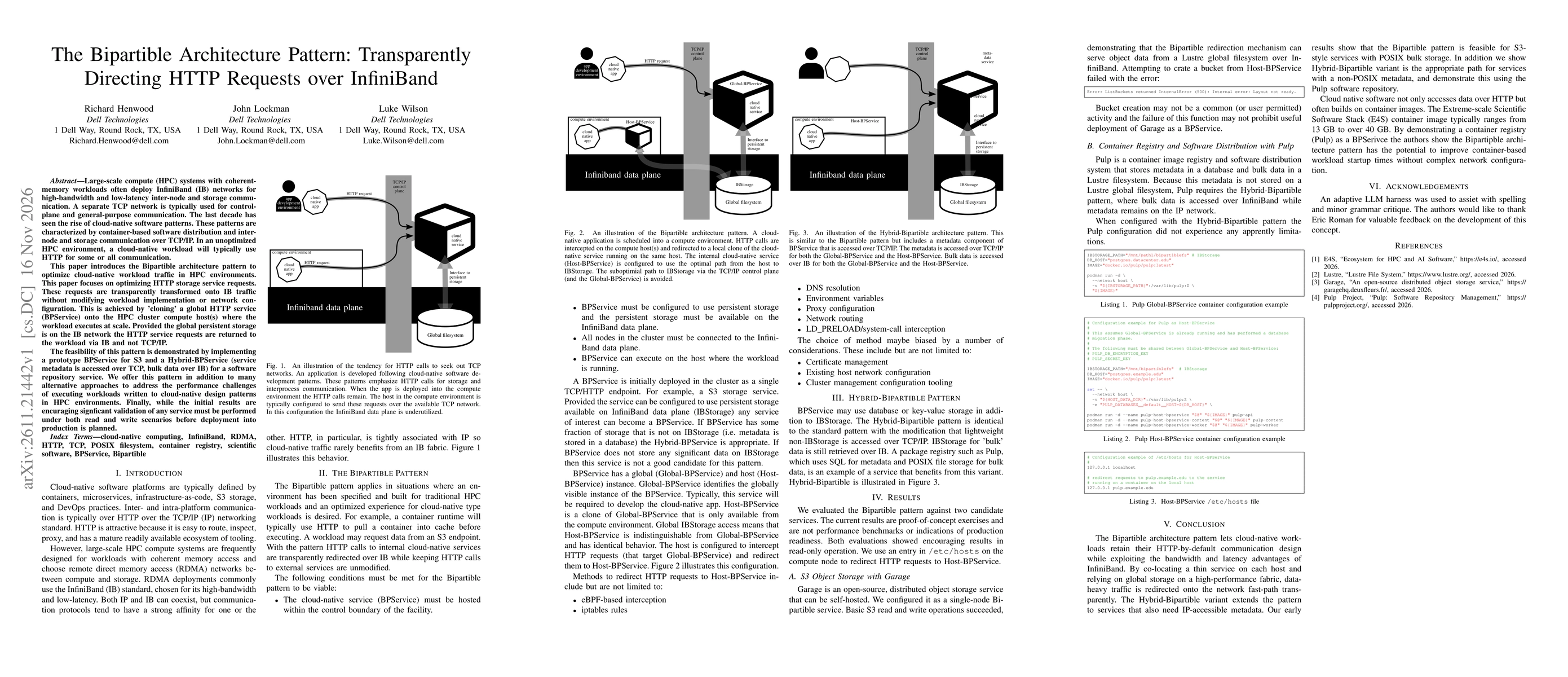
Large-scale compute (HPC) systems with coherent-memory workloads often deploy InfiniBand (IB) networks for high-bandwidth and low-latency inter-node and storage communication. A separate TCP network is typically used for control-plane and general-purpose communication. The last decade has seen the rise of cloud-native software patterns. These patterns are characterized by container-based software distribution and inter-node and storage communication over TCP/IP. In an unoptimized HPC environment, a cloud-native workload will typically use HTTP for some or all communication. This paper introduces the Bipartible architecture pattern to optimize cloud-native workload traffic in HPC environments. This paper focuses on optimizing HTTP storage service requests. These requests are transparently transformed onto IB traffic without modifying workload implementation or network configuration. This is achieved by 'cloning' a global HTTP service (BPService) onto the HPC cluster compute host(s) where the workload executes at scale. Provided the global persistent storage is on the IB network the HTTP service requests are returned to the workload via IB and not TCP/IP. The feasibility of this pattern is demonstrated by implementing a prototype BPService for S3 and a Hybrid-BPService (service metadata is accessed over TCP, bulk data over IB) for a software repository service. We offer this pattern in addition to many alternative approaches to address the performance challenges of executing workloads written to cloud-native design patterns in HPC environments. Finally, while the initial results are encuraging signficant validation of any service must be performed under both read and write scenarios before deployment into production is planned.
Analysis
AI-generated · verify against the original paper
Generated Jan 1, 0001ResultsWhat the authors found
- Proof‑of‑concept read‑only operations succeeded for an S3‑style Garage service, demonstrating that HTTP requests can be transparently served over InfiniBand.
- Basic S3 read and write operations succeeded, showing that bulk data can be retrieved from a Lustre filesystem via IB.
- Bucket creation from Host‑BPService failed with an internal error, indicating a limitation in write‑path functionality.
- The Hybrid‑Bipartible pattern enabled Pulp to access metadata over TCP/IP while bulk data was transferred over InfiniBand without apparent limitations.
- Early results suggest the pattern could reduce container‑registry startup times by exploiting the high‑performance IB fabric.
LimitationsWhere the findings need caution
- Bucket creation operations failed, indicating incomplete support for full S3 write semantics.
- The evaluation consists of proof‑of‑concept exercises and does not include quantitative performance benchmarks.
- The current validation is limited to read‑only scenarios for the S3 service and lacks extensive production‑readiness testing.
MethodologyHow the work was done
The authors implement the Bipartible architecture by cloning a global HTTP service (BPService) onto each compute host, intercepting HTTP requests via eBPF, iptables, or LD_PRELOAD, and redirecting them to the local Host‑BPService which is configured to use InfiniBand storage. They prototype a BPService for S3 (Garage) and a Hybrid‑BPService for Pulp, using /etc/hosts redirection and container configurations to evaluate the pattern.
SignificanceWhy the work matters
The Bipartible pattern allows cloud‑native applications to retain their HTTP‑centric design while exploiting the high bandwidth and low latency of InfiniBand, potentially improving data‑intensive workload performance in HPC environments without requiring changes to application code or complex network reconfiguration.
Technical contributionsWhat the work introduces
The paper introduces the Bipartible architecture pattern, which clones a global HTTP service onto compute hosts and transparently redirects HTTP traffic to InfiniBand storage, enabling cloud‑native workloads to benefit from RDMA‑based data paths without modifying the workload or network configuration.
NoveltyHow it differs from prior work
It is the first documented approach that leverages local cloning of HTTP services to transparently map cloud‑native HTTP storage requests onto InfiniBand, combining container‑native deployment with high‑performance fabric usage without altering existing application code.
Future workQuestions that remain
- Perform comprehensive validation under both read and write scenarios, including bucket creation and large‑scale data transfers.
- Conduct performance benchmarking to quantify latency and throughput gains compared to traditional TCP/IP paths.
- Extend the pattern to additional cloud‑native services and address identified functional gaps such as bucket creation failures.
Discussion 0