The Clifford Hierarchy from Clifford Stabilizers in 2D
Abstract
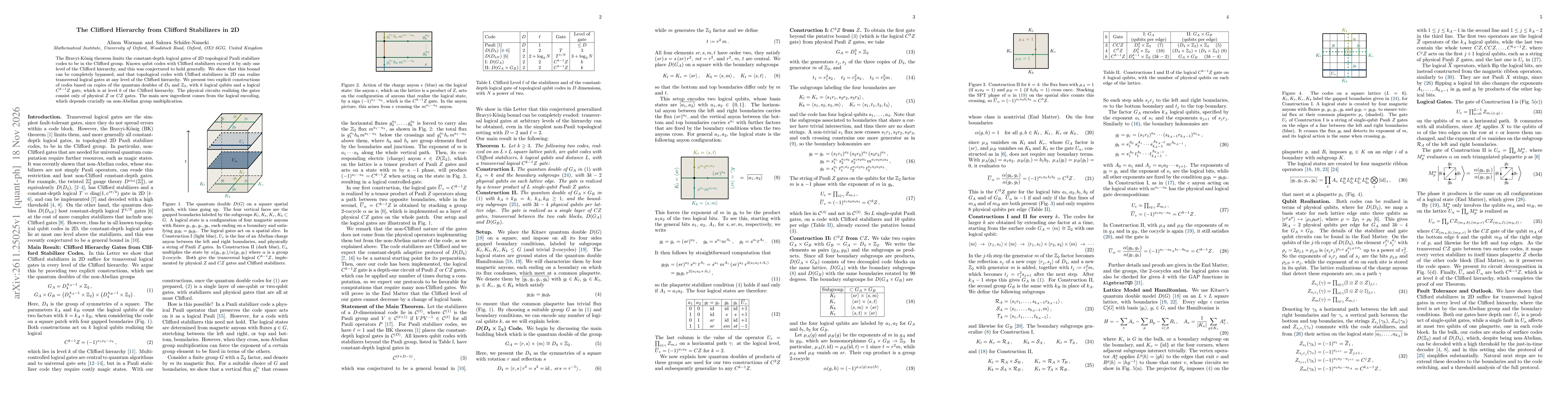
The Bravyi-König theorem limits the constant-depth logical gates of 2D topological Pauli stabilizer codes to be in the Clifford group. Known qubit codes with Clifford stabilizers exceed it by only one level of the Clifford hierarchy, and this was conjectured to hold generally. We show that this bound can be completely bypassed, and that topological codes with Clifford stabilizers in 2D can realize transversal logical gates at any level of the Clifford hierarchy. We present two explicit constructions of codes based on copies of the quantum doubles of $D_4$ and $\mathbb{Z}_2$, with $k$ logical qubits and a logical $C^{k-1}Z$ gate, which is at level $k$ of the Clifford hierarchy. The physical circuits realizing the gates consist only of physical $Z$ or $CZ$ gates. The main new ingredient comes from the logical encoding, which depends crucially on non-Abelian group multiplication.
Analysis
AI-generated · verify against the original paper
Generated Jan 1, 0001ResultsWhat the authors found
- Showed that Clifford stabilizers in 2D can realize transversal logical gates at any level of the Clifford hierarchy, bypassing the Bravyi‑König bound.
- Presented two explicit constructions based on copies of the quantum doubles of D4 and Z2 that implement a logical C^{k‑1}Z gate at level k for k logical qubits.
- Demonstrated that the physical circuits for these gates consist solely of single‑qubit Z or two‑qubit CZ gates.
- Identified non‑Abelian group multiplication in the logical encoding as the essential ingredient enabling the hierarchy‑level escalation.
LimitationsWhere the findings need caution
- The constructions rely on specific non‑Abelian groups (D4×Z2) and carefully chosen gapped boundary conditions.
- Code distance scales with the lattice size L, potentially leading to overhead for large k.
- Assumes availability of constant‑depth adaptive protocols for state preparation and decoding.
MethodologyHow the work was done
Constructed two explicit 2D topological codes using quantum doubles of the non‑Abelian group D4 combined with Z2, encoding logical qubits via magnetic anyons and non‑Abelian group multiplication; logical C^{k‑1}Z gates are realized transversally with only physical Z or CZ gates.
SignificanceWhy the work matters
The work overturns the previously conjectured limitation on constant‑depth logical gates in 2D topological Pauli stabilizer codes, providing a route to universal fault‑tolerant quantum computation in 2D without relying on magic‑state injection.
Technical contributionsWhat the work introduces
Provided explicit 2D topological code designs with Clifford stabilizers that achieve arbitrary‑level transversal Clifford‑hierarchy gates via non‑Abelian anyon encoding and simple physical Z/CZ operations.
NoveltyHow it differs from prior work
First demonstration that 2D topological Pauli stabilizer codes with Clifford stabilizers can realize transversal logical gates at any level of the Clifford hierarchy, completely bypassing the Bravyi‑König limitation.
Future workQuestions that remain
- Explore similar constructions with other non‑Abelian groups to broaden applicability.
- Optimize code parameters to improve distance and reduce qubit overhead.
- Integrate the transversal hierarchy gates with existing magic‑state distillation or error‑correction frameworks.
- Investigate experimental implementation and error‑threshold analysis for practical deployment.
Discussion 0