The correlations and anticorrelations in QPO data
Abstract
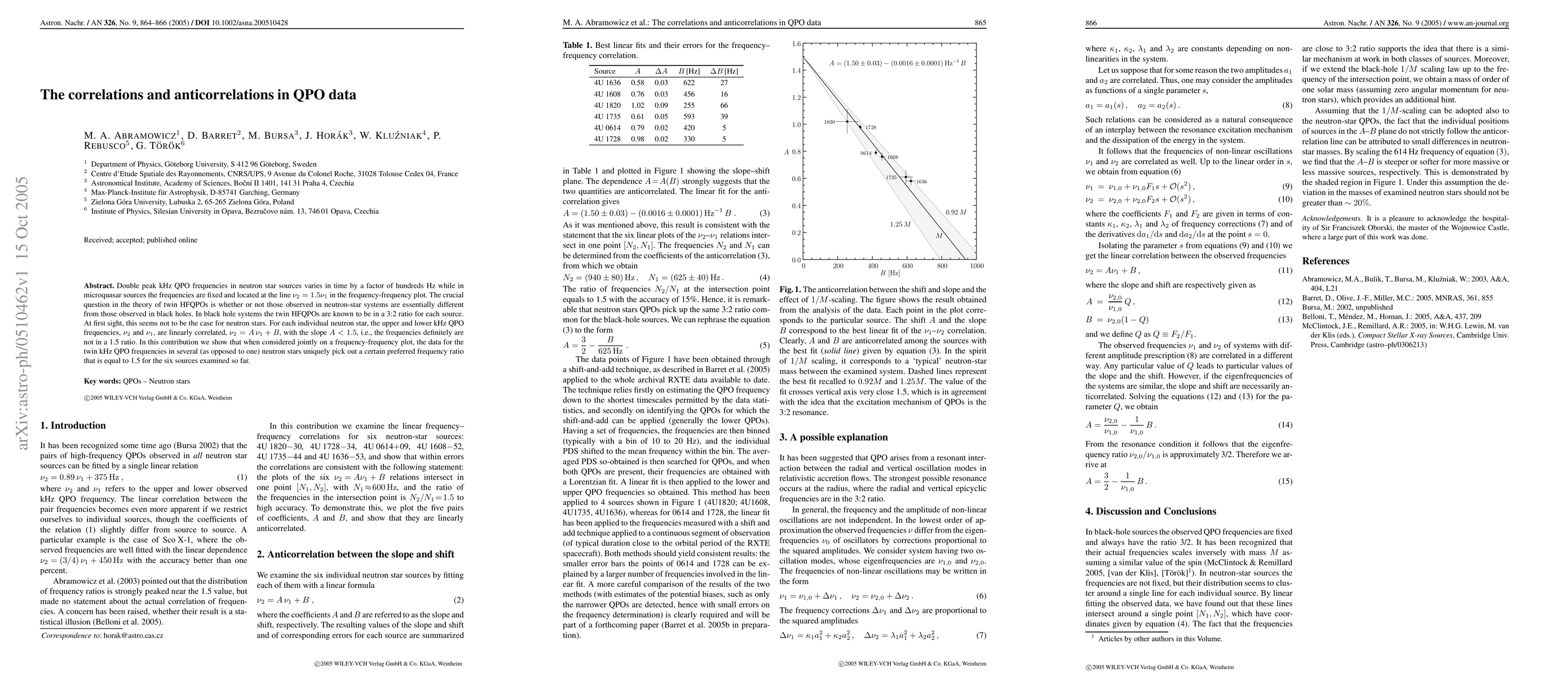
Double peak kHz QPO frequencies in neutron star sources varies in time by a factor of hundreds Hz while in microquasar sources the frequencies are fixed and located at the line \nu_2 = 1.5 \nu_1 in the frequency-frequency plot. The crucial question in the theory of twin HFQPOs is whether or not those observed in neutron-star systems are essentially different from those observed in black holes. In black hole systems the twin HFQPOs are known to be in a 3:2 ratio for each source. At first sight, this seems not to be the case for neutron stars. For each individual neutron star, the upper and lower kHz QPO frequencies, \nu_2 and \nu_1, are linearly correlated, \nu_2=A \nu_1 + B, with the slope A < 1.5, i.e., the frequencies definitely are not in a 1.5 ratio. In this contribution we show that when considered jointly on a frequency-frequency plot, the data for the twin kHz QPO frequencies in several (as opposed to one) neutron stars uniquely pick out a certain preferred frequency ratio that is equal to 1.5 for the six sources examined so far.
AI Key Findings
Get AI-generated insights about this paper's methodology, results, significance, and more — available when analysis has been generated.
Discussion 0