Abstract
Microservice architectures promise independent evolution through loose coupling, yet large systems often exhibit strong dependency concentration around a small set of services. In an exploratory industrial case study of a product composed of 267 microservices, we triangulated multiple dependency signals -- compile-time, run-time, and task dependencies -- and iteratively validated our interpretations with practitioners. We observed a recurring macro-structure in the dependency network that resembles a black hole: a dense core of dependency magnets, a transitional region of services increasingly entangled with the core, and an outer region of lightly connected services. Based on these observations, we propose the dependency black hole theory, mapping the network to the black hole anatomy of a singularity, an event horizon, and an accretion disk, and formulating three hypotheses about how dependency concentration emerges and evolves at scale. The theory provides an explanatory lens for reasoning about dependency growth, identifying services at risk of becoming dependency magnets, and motivating governance interventions. We outline practical implications and directions for longitudinal and multi-case validation.
Analysis
AI-generated · verify against the original paper
Generated Jun 26, 2026ResultsWhat the authors found
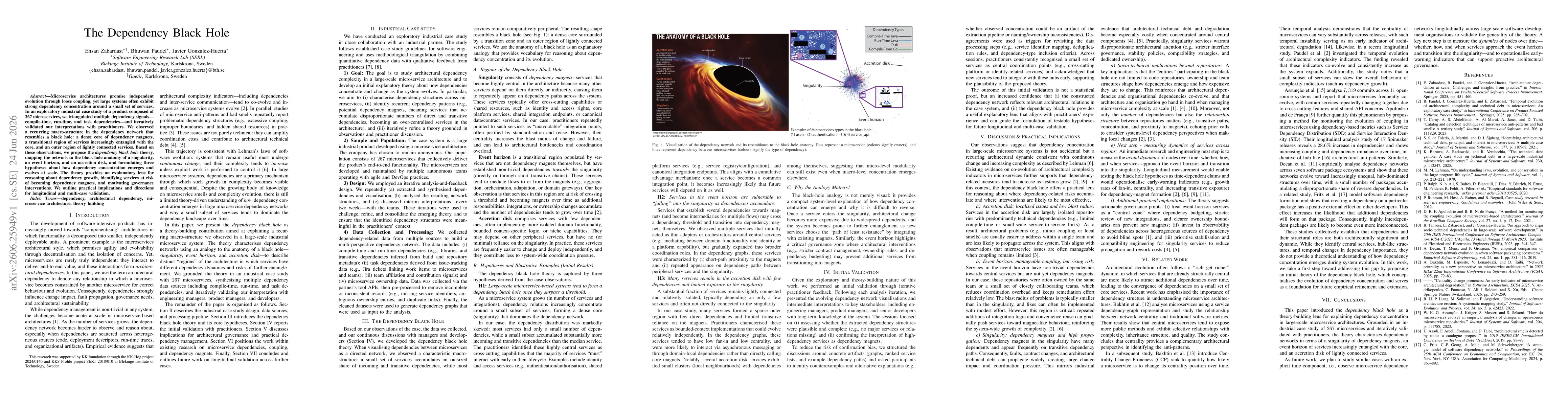
- A recurring macro-structure emerges: a dense core of dependency magnets, a transitional event horizon region, and an outer accretion disk of lightly connected services.
- The dependency black hole theory captures how dependency concentration forms and evolves, with three regions defined by distinct dynamics and risk profiles.
- Three hypotheses (H1-H3) describe threshold-based formation of magnets, transitional linking behaviors, and the high impact of singularity magnets on system-wide change.
- Practitioner validation confirms the theory aligns with experience and informs governance interventions and early-warning indicators for dependency-magnet formation.
LimitationsWhere the findings need caution
- Initial results are not statistical proofs but interpretive validations from a single industrial case.
- Longitudinal and multi-case evidence are needed to generalize beyond the case environment.
- Dynamic behavior over time remains to be empirically measured to validate time-dependent claims.
MethodologyHow the work was done
The study uses an exploratory industrial case study with methodological triangulation, combining quantitative dependency data (compile-time, run-time, and task dependencies) with qualitative practitioner feedback. Data from 267 microservices were collected via partner APIs, pre-processed for consistency, and used to generate dependency graphs; iterative two-week cycles with engineers validated interpretations and refined the theory.
SignificanceWhy the work matters
Provides a theoretical lens to explain and reason about dependency growth and concentration at scale, linking architectural dependencies with organizational structures, and guiding governance and mitigation strategies for large microservice ecosystems.
Technical contributionsWhat the work introduces
Introduction of the dependency black hole theory, mapping microservice dependency networks to black hole anatomy (singularity, event horizon, accretion disk) to explain concentration and evolution of dependencies at scale.
NoveltyHow it differs from prior work
First theoretical framing that conceptualizes dependency concentration in large microservice ecosystems as a black hole with region-specific dynamics, integrating multiple dependency signals and practitioner validation to guide future empirical refinement.
Future workQuestions that remain
- Conduct longitudinal longitudinal studies across additional cases to test the generality of the theory.
- Develop operational metrics and early-warning indicators to monitor magnet formation in real time.
- Investigate governance interventions targeted at event horizon and singularity regions to reduce propagation of changes.
Discussion 0